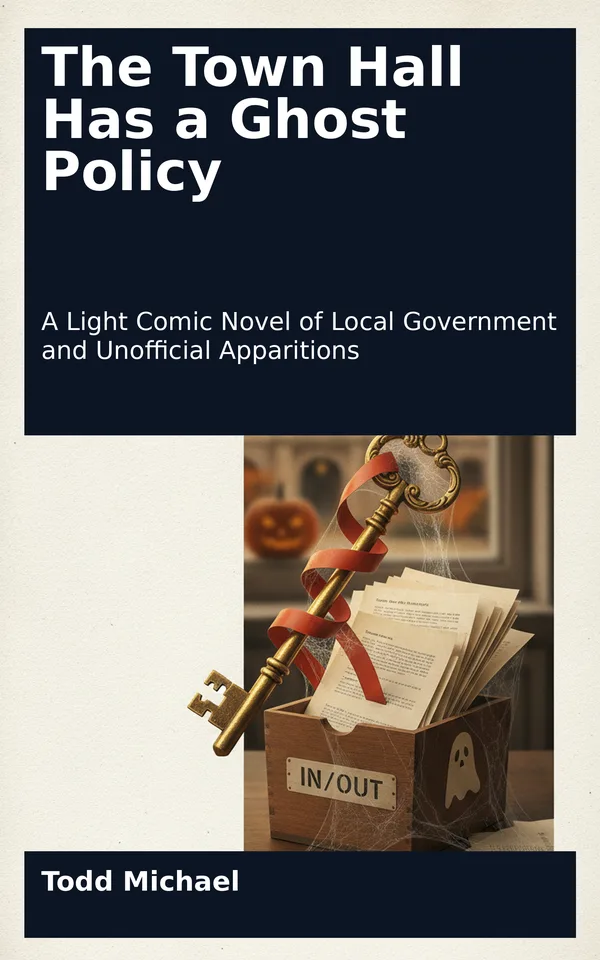
Read a sample: 1. A Noise After Closing
The first report arrived on a yellow sticky note, attached to a stack of invoices with such determination that Mara Bell had to hold down the paper while she peeled it off.
Heard footsteps upstairs after closing. Nobody there when I looked.
It was signed Len, although Mara would have known the handwriting. Len wrote as if every letter had been given a small job and was anxious to do it correctly.
She read the note twice, then looked at the invoice beneath it. The town had purchased twelve replacement light bulbs, which seemed a more promising explanation than most of the ones likely to follow.
At eight thirty, Len appeared at her counter with a ring of keys and a paper cup of coffee. He had been custodian of the town hall long enough to regard the building less as a historic landmark than as an elderly relative who refused to describe its symptoms.
“Morning,” Mara said. “I got your note.”
“I thought you ought to know.”
“Did you check the rooms?”
“Every one on the second floor.”
“And the stairs?”
“I checked those on my way up.”
“That was efficient.”
“It was dark. I wanted to get it over with.”
Len took a sip of coffee. He wore his work shirt buttoned to the collar, although the morning was still mild and the building’s heating system had begun its annual campaign against human comfort.
Mara asked, “What time was this?”
“After the knitting group left. I was downstairs locking the side door.”
“Could somebody from the group have gone back up?”
“They could have. I went to look, and there wasn’t anybody there.”
That was the useful part of Len’s reports. He separated what might have happened from what he had actually seen, a distinction the town council had discussed adopting but had never put to a vote.
“What did it sound like?” she asked.
“Footsteps.”
“I walked into that.”
“Apparently somebody did.”
He allowed himself a brief smile. Mara picked up a pen.
“Should I write this down somewhere?” she asked.
“You have a note.”
“Yes, but the note is on an invoice for light bulbs.”
“Then I’ve improved the invoice.”
She put the sticky note on the corner of her desk, where it remained visible while she opened the mail, signed for a delivery of paper, and told a man that the planning board had not, to her knowledge, taken a position on his neighbor’s hedge.
By ten o’clock she had forgotten the note. At ten twelve, she received the first request for official confirmation that the town hall was haunted.
The caller was Mrs. Dallow, who ran the knitting group and believed that an unanswered question was an invitation to ask it more loudly.
“Len heard someone walking,” she said.
“He heard a noise.”
“He told my sister footsteps.”
“He told me footsteps too.”
“So we’re agreed.”
“About the noise.”
There was a pause in which Mrs. Dallow appeared to consider whether Mara was being deliberately difficult or merely working for the town.
“The group would like to know if it’s haunted before next Thursday,” she said. “Celia won’t come if it is.”
“Has Celia seen anything?”
“She doesn’t want to. That’s why she’d like notice.”
Mara looked across the lobby. A poster for the Halloween open house had been taped to the glass doors. It showed a cheerful orange pumpkin, a paper bat, and the words EVERYONE WELCOME. Someone had drawn eyebrows on the pumpkin, giving it an expression of administrative concern.
“I can’t confirm that the building is haunted,” Mara said.
“Can you confirm it isn’t?”
“No.”
“Then what should I tell Celia?”
“That we’re aware of the noise.”
“She’ll say you’re avoiding the question.”
“I expect she will.”
After the call, Mara moved Len’s note into a folder marked BUILDING — GENERAL. The folder already contained a complaint about the temperature in the meeting room, a suggestion for a better temperature, and a second complaint from the same person after the thermostat had been adjusted.
The second request came by email from Edith Pruitt, who chaired the local history society and had once corrected the spelling on a memorial plaque before it was unveiled. Mara opened the message expecting an inquiry about the display cases for the open house.
Instead, Edith wanted to know whether the town would issue a statement acknowledging “the presence reported in the upper corridor.” If so, the society would appreciate an opportunity to review the wording for historical accuracy.
Mara read the sentence again. Len had reported footsteps; Edith had promoted them to a presence and given the presence a corridor.
A second paragraph offered Edith’s services in identifying the individual. She had, she wrote, several promising possibilities, though she preferred not to speculate without access to the relevant records.
Mara replied that no statement was planned and that she had no information about an individual. Edith responded within four minutes to say that the absence of information was often where history began.
The third request arrived in person, just before lunch, from a young man carrying a camera bag and wearing a sweatshirt printed with the name of a local online events page. He introduced himself as Ben and asked whether he could photograph the haunted hallway.
“It’s an ordinary hallway,” Mara said.
“Right, but is it the haunted one?”
“I don’t know that any hallway…