Read a sample: 1. Three People and a Rubric
The first sign that Maya’s Tuesday was going wrong was the word collaborate written across the whiteboard in purple marker.
Ms. Alvarez had underlined it twice. She had also drawn three cheerful stick figures holding hands, which suggested she had not recently watched three actual students try to share a glue gun.
“Your next project,” she announced, “will be completed in teams of three.”
Around the room, chairs scraped as people turned toward their friends with the speed of migrating birds. Maya turned toward Priya, who turned toward Maya, and both smiled.
Then Ms. Alvarez added, “I’ve chosen the teams.”
The room produced one long, disappointed noise.
“Thank you,” Ms. Alvarez said. “It’s nice to feel supported.”
Maya looked down at the assignment sheet. A project question. A prototype or model. Recorded tests. A presentation. Beside each requirement was a column of points, and at the bottom, in bold, was the reassuring number 100.
Maya liked rubrics. A rubric was a promise that if you did certain things, someone would acknowledge that you had done them. People were less dependable.
Priya leaned over. “Maybe we’ll still get lucky.”
“Maybe,” Maya said, although Ms. Alvarez was already unfolding a page with names on it.
The teams were read aloud to varying levels of celebration and despair. When Priya was assigned to a group with two people who owned matching highlighters, she gave Maya an apologetic wave.
“Maya, Ben, and Jules,” Ms. Alvarez said.
Ben, two rows over, continued writing in the margin of his notebook. Either he hadn’t heard or he was recording his objections before speaking them aloud.
Jules raised a hand. “Is there an appeals process?”
“There is,” said Ms. Alvarez. “You can appeal to me.”
“Great. I appeal.”
“Denied.”
Jules lowered the hand. “Efficient system.”
Maya had worked with Jules once, on a history presentation. Jules had brought excellent maps and then spent part of the presentation doing an impression of a furious king. The class had laughed. Maya had never been entirely sure whether the king had been furious in the textbook.
Ben was harder to assess. He answered questions when he knew the answer and sometimes when he thought the question itself needed improvement. Last month he had spent ten minutes explaining why the classroom’s paper-towel dispenser was poorly designed. He had made several convincing points, though nobody had asked.
“Move together,” Ms. Alvarez said. “Start by reading the rubric before you choose your project.”
Maya was already on her second reading.
Jules pulled up a chair backward and rested their arms across the back. Ben arrived carrying a notebook, a pencil, and the expression of someone who had been summoned to discuss a plumbing emergency.
“Hi,” Maya said.
“Hello, teammates,” Jules said. “I assume we’re all equally thrilled.”
Ben sat down. “I don’t mind.”
“That’s the nicest thing anyone’s said to me today.”
Maya placed the rubric between them. “We should pick something we can actually finish.”
“Agreed,” Ben said.
“And something people will want to see,” Jules added.
Maya pointed to the first row. “The project has to answer a testable question about a practical problem. We need a prototype or model, at least two rounds of testing, and a final presentation.”
Jules scanned the page. “Twenty points for presentation. That’s a whole fifth of our grade.”
“Thirty for testing and evidence,” Maya said.
Ben pointed at the same row. “And fifteen for design.”
Jules looked from one finger to the other. “Excellent. We’ve each found our favorite number.”
For a moment, the three of them considered the rubric as if it might suggest a project to avoid further discussion.
Across the room, someone proposed a robot that would do homework. Ms. Alvarez asked whether the robot would also explain photosynthesis to her during grading. The idea was withdrawn.
“We could build a water filter,” Maya said.
Ben tilted his head. “What would we test?”
“How clear the water gets?”
“We could do that,” he said. “But clear doesn’t mean safe to drink.”
“Then we don’t drink it,” Jules said. “Strong start.”
Maya wrote water filter on her paper and drew a small question mark beside it. “Other ideas?”
Jules tapped the desk. “A backpack alarm that screams when someone takes your stuff.”
“It would scream all day in the hallway,” Maya said.
“Exactly. A powerful statement about trust.”
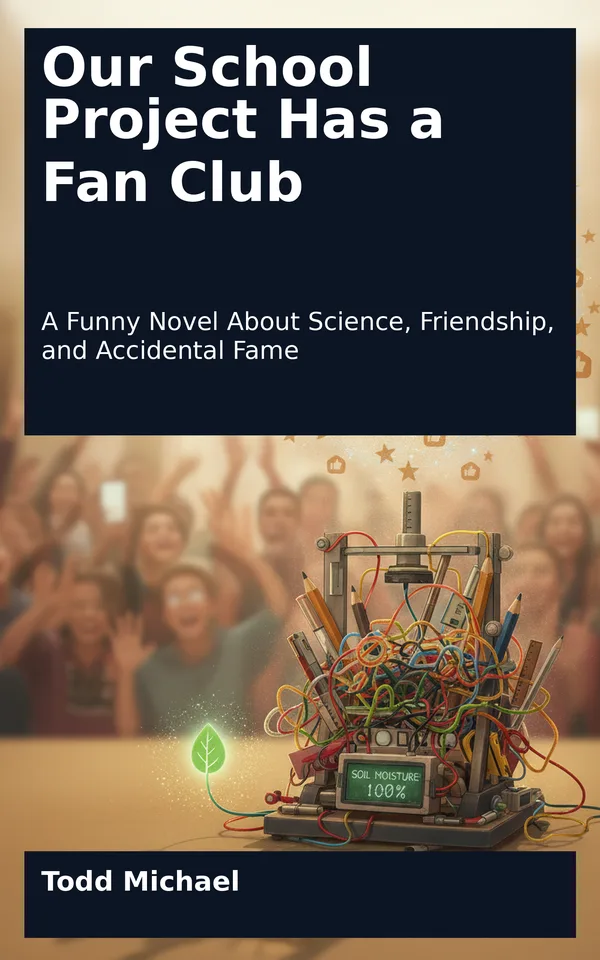
Ben had opened his notebook to a page filled with sketches of things Maya couldn’t identify. “What about a soil-moisture indicator?”
Jules blinked. “Does it indicate that soil is moist?”
“That’s the general ambition.”
Ben turned the notebook around. One sketch showed two thin probes connected to a small box with a light. There were arrows and notes crowded around it.
“My aunt has plants on her balcony,” he said. “She keeps forgetting which ones she watered. I was looking at ways to make a cheap indicator.”
“Did you make one?” Maya asked.
“No. I drew one during an assembly.”
“Which assembly?” Jules asked.
“The one about making good choices.”
“Promising.”
Ben ignored that. “The idea is to put probes into soil and use a circuit to get a reading. We could test whether the readings change with different amounts of water.”
Maya looked at the rubric again. A practical problem: knowing whether soil was wet or dry. A prototype: the probe and circuit. Tests: different amounts of water. It fit into the boxes.
“How…