Everyday Guidebooks
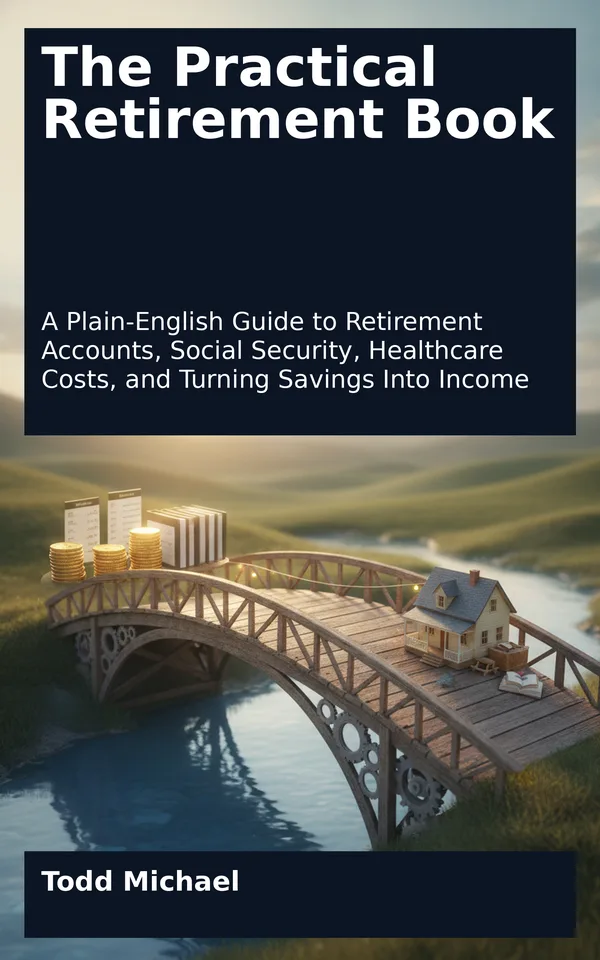
Cover of The Practical Retirement Book

Money, Investing & Precious Metals

The Practical Retirement Book

A Plain-English Guide to Retirement Accounts, Social Security, Healthcare Costs, and Turning Savings Into Income

by Todd Michael

Available now

Retirement planning is about more than reaching a savings number. It's about understanding how your accounts, future income, expenses, taxes, and healthcare choices work together.

The Practical Retirement Book gives you a clear starting point and a way to organize the decisions ahead. Learn the differences between a 401(k), a traditional IRA, and a Roth IRA; explore how withdrawal rates and market ups and downs can affect a plan; and understand the trade-offs involved in choosing when to claim Social Security. You'll also work through retirement budgets, healthcare costs, and common planning mistakes using relatable U.S. examples and checklists.

Whether retirement is approaching or still years away, you'll finish with a practical framework you can revisit as your circumstances change. This book is for educational purposes only, not individualized financial, tax, legal, or medical advice. Consult a qualified professional about your situation.

Contents
  1. 1. Retirement Is a Plan, Not Just a Number
  2. 2. Build a Retirement Spending Picture
  3. 3. Understand Your Retirement Accounts
  4. 4. Choose a Saving Strategy You Can Maintain
  5. 5. Invest for a Long Retirement
  6. Give Each Asset a Job
  7. Diversification Is More Than Owning Several Funds
  8. Build an Allocation Around Your Plan
  9. Assess Risk Capacity and Risk Tolerance
  10. Understand Sequence-of-Returns Risk
  11. Fees Deserve Attention
  12. Keep the Allocation From Drifting
  13. Review the Mix as Retirement Approaches
  14. 6. Estimate Your Income Gap
  15. Start With Spending, Not Account Balances
  16. Give Every Number the Same Time Frame
  17. List the Income You May Receive
  18. Calculate the Initial Gap
  19. Your Gap May Change More Than Once
  20. Use the Income-Gap Worksheet
  21. Test Alternatives Without Rewriting Your Life
  22. Look at the Gap Alongside Your Resources
  23. Turn the Estimate Into Decisions
  24. 7. Social Security Timing Basics
  25. Start With Your Own Estimate
  26. How Claiming Age Changes the Monthly Check
  27. The Bridge Between Retirement and Claiming
  28. Benefits While You Continue Working
  29. Think in Household Terms
  30. Consider the Surviving Spouse
  31. Compare Realistic Claiming Scenarios
  32. Inflation and Taxes Belong in the Comparison
  33. Before You File
  34. 8. Healthcare Before and After Medicare
  35. 9. Turn Savings Into Retirement Income
  36. 10. Plan Withdrawals With Taxes in Mind
  37. 11. Prepare for Surprises and Changing Needs
  38. 12. Coordinate the Household and Protect the Plan
  39. 13. Avoid Common Retirement Planning Mistakes
  40. 14. Create Your Retirement Action Plan

Read a sample: 1. Retirement Is a Plan, Not Just a Number

A retirement account balance is easy to find. Your account provider puts it near the top of the statement, often in large type. It can feel like the clearest answer to the question, “Am I going to be all right?”

But a balance is not an answer by itself. It does not tell you how much you will spend, when you might stop working, what other income you will receive, or how you will respond if life takes an unexpected turn. Two households with the same savings can face very different retirement choices.

Consider two hypothetical households, each with $600,000 saved for retirement. One owns its home outright, expects a pension, and plans to work part-time for several years. The other rents, has no pension, and wants to stop working as soon as possible. Neither household can judge its situation from the account balance alone. Each needs to connect its resources to its anticipated expenses and decisions.

That connection is the purpose of a retirement plan. It is not a prediction that must come true. It is a practical way to organize what you know, make reasonable assumptions where you do not know enough, and decide what to do next.

You do not need perfect information to begin. You need a starting point you can improve.

Retirement planning is sometimes presented as a search for a single savings target. A target can be useful: it gives you something concrete to work toward. But it becomes less useful when it hides the choices and assumptions underneath it.

A workable plan should eventually help you answer questions such as:

- When might I leave full-time work, and do I want a gradual transition? - What will it cost to support the life I want, including ordinary bills and less frequent expenses? - What income might come from Social Security, a pension, work, or other sources? - How much might I need to take from savings, and from which accounts? - How could taxes, healthcare costs, and inflation affect the amount available to spend? - What would I change if my income, expenses, health, or investments turn out differently than expected? - Who else depends on this plan, and what happens if one person dies or can no longer manage the finances?

You do not have to settle all of these questions today. In fact, some answers will change. The goal of this chapter is to give you a way to gather the information and identify the decisions that deserve attention.

Think of the plan as a map rather than a destination printed on a sign. A map shows where you are, where you hope to go, and possible routes. It also makes it easier to recognize when you need to choose another route.

Before estimating a savings target, describe what retirement might look like. Use ordinary language. The purpose is not to produce a binding commitment; it is to make your financial assumptions more realistic.

You might picture leaving a demanding job but continuing to earn some income through work you enjoy. You might want to stay in your current home, move closer to family, or divide time between places. Perhaps your main goal is greater control over your schedule, not a complete end to paid work.

Write down what matters to you in three broad areas:

Daily life. How do you expect to spend an ordinary week? Consider work, hobbies, transportation, meals, and social activities. A plan built around travel looks different from one built around staying close to home, but both need to account for routine days as well as special ones.

Home and family. Who will live with you? Does anyone rely on your financial support? Could you become a caregiver, or might you need help yourself? Your wishes matter, but so do the costs and responsibilities attached to them.

Flexibility. Which parts of your preferred retirement are essential, and which could change if necessary? You may be reluctant to move but willing to travel less often. You may prefer to retire at a certain time but be open to a different role before then.

If you share finances with a spouse or partner, compare your descriptions. One person may imagine retiring as soon as possible while the other expects both of you to keep working. One may assume the house will be sold; the other may consider staying there a priority. Finding those differences early is useful information, not evidence that the plan has failed.

It is also reasonable if your picture is incomplete. Some people know what they want to leave behind before they know exactly what comes next. Start with what is clear and mark the rest as a question to revisit.

An inventory is a snapshot of your current financial position. It is not a grade. Its job is to show what resources you have, what obligations compete for them, and where you need better information.

Gather recent statements or sign in to the accounts you normally use. If you have a spouse or partner and are planning together, decide which resources and obligations belong in the household picture. Include both people’s accounts where appropriate, while remembering that ownership, access, and benefit rules may differ.

Start with these categories:

- Cash and short-term savings: checking, savings, and other readily accessible reserves. - Retirement accounts: workplace plans, traditional IRAs, Roth IRAs, and other accounts intended for…

More in The Practical Money Series

Cover of The Practical Dividend BookThe Practical Dividend BookAvailable nowCover of The Practical Index Fund BookThe Practical Index Fund BookAvailable now

More Money, Investing & Precious Metals

Cover of The Practical Gold BookThe Practical Gold BookAvailable nowCover of The Practical Gold Book, Volume 2The Practical Gold Book, Volume 2Available nowCover of The Practical Silver BookThe Practical Silver BookAvailable nowCover of The Practical Crypto BookThe Practical Crypto BookAvailable nowCover of Shielding Your WealthShielding Your WealthAvailable nowCover of Personal Finance AdvancedPersonal Finance AdvancedAvailable now

About Todd Michael

Todd Michael is an American author and the founder of ToddMichael.tv. He writes practical, plain-English books on money, health, preparedness, technology, games, humor and more.

About the author Todd Michael · Todd Michael’s author site

Part of the ToddMichael.tv network.