Money, Investing & Precious Metals
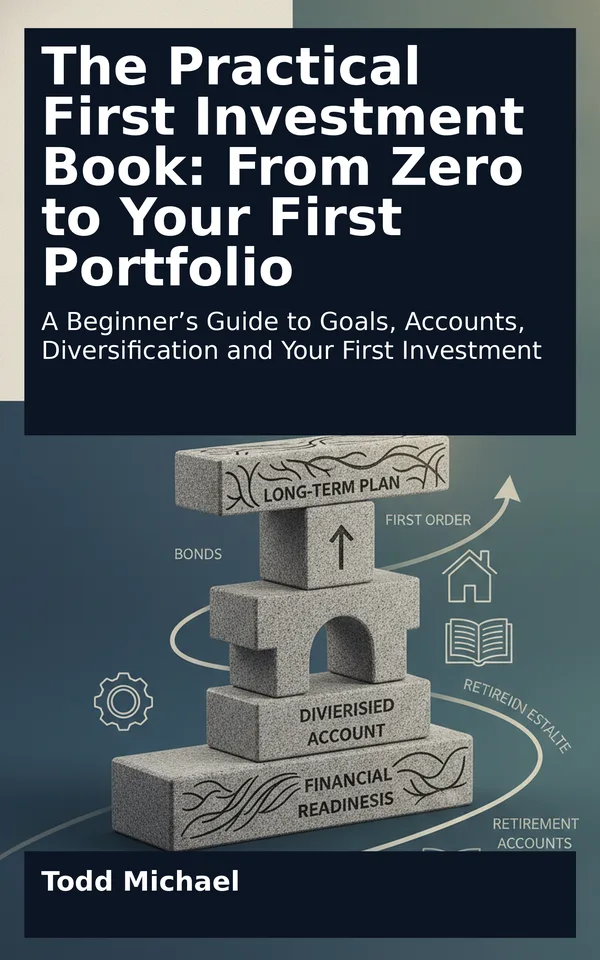
The Practical First Investment Book: From Zero to Your First Portfolio
A Beginner’s Guide to Goals, Accounts, Diversification and Your First Investment
by Todd Michael
Available nowYou do not need to predict the market or pick a winning stock to begin investing. You do need a goal, a financial foundation and a plan you understand.
The Practical First Investment Book walks you through the decisions between “I should invest” and owning your first portfolio. Learn how to assess your cash cushion and debt, match investments to your time frame, compare account options, recognize fees and choose a mix of diversified investments. Follow a hypothetical first purchase from account funding to order confirmation, then build a routine for contributions, reviews and inevitable market declines.
Checklists, decision prompts and clearly labeled hypothetical examples make unfamiliar terms easier to use. This U.S.-focused guide offers general education, not personalized financial, legal or tax advice, and points you toward qualified help when your situation calls for it. Rules and limits change, so readers are shown how to verify current information.
Contents
- 1. What Investing Can—and Cannot—Do
- Saving, Investing and Speculating
- What You Own Matters
- Returns Come With Uncertainty
- A Hypothetical Journey Through Gains and Losses
- Compounding Is a Process, Not a Promise
- The Quiet Effect of Inflation
- What Investing Can and Cannot Do
- Begin With the Job, Not the Product
- 2. Build Your Starting Line
- 3. Give Your Money a Job
- 4. Understand Risk Before You Choose
- 5. Meet the Building Blocks
- 6. Diversification and the Role of Funds
- 7. Choose an Account for the Goal
- 8. Compare Providers and Open an Account
- 9. Make Sense of Fees and Taxes
- 10. Design Your First Portfolio
- 11. Place Your First Investment Order
- 12. Automate, Track and Keep Records
- 13. Stay the Course—and Know When to Adjust
- 14. Your First-Portfolio Action Plan
- Other Books by Todd Michael
Read a sample: Saving, Investing and Speculating
Saving means setting money aside for later use. In everyday financial planning, the word often refers to keeping money in a bank or credit union account where it is readily accessible and its dollar balance does not normally move up and down with financial markets.
Savings can be useful when you expect to need money soon or when you need it available for an unexpected expense. Depending on the account, you may earn interest. Eligible deposits at insured banks and credit unions may also receive federal deposit insurance, subject to applicable limits and conditions. Verify the institution’s coverage and the current rules rather than assuming every financial product is insured.
Investing means committing money to an asset with the expectation that it may produce income, grow in value, or both. Investments can also lose value. A stock, for example, represents an ownership interest in a company. A bond generally represents money lent to an issuer. A fund can pool money to hold a collection of investments.
The distinction is not that saving is sensible and investing is reckless. They serve different jobs. Savings may offer easier access and greater stability in dollar terms, while investing offers the possibility of higher long-term growth in exchange for uncertainty. The balance that makes sense depends on when the money will be needed and what would happen if its value fell.
Speculation overlaps with investing, but the emphasis is different. A speculator typically takes substantial risk in the hope of profiting from an uncertain price change. Buying something mainly because you expect someone else to pay more for it next week is closer to speculation than building a diversified portfolio for a distant goal.
There is no bright line that labels every purchase forever. A person can buy the same asset as part of a considered long-term plan or as a short-term wager. The useful questions are: What is the reason for buying it? What supports its value? How much could be lost? And does the outcome depend on a price move you cannot reliably predict?
A beginner does not need to avoid uncertainty altogether. The aim is to take uncertainty deliberately, with money that fits the purpose and with consequences you can afford to face.