Everyday Guidebooks
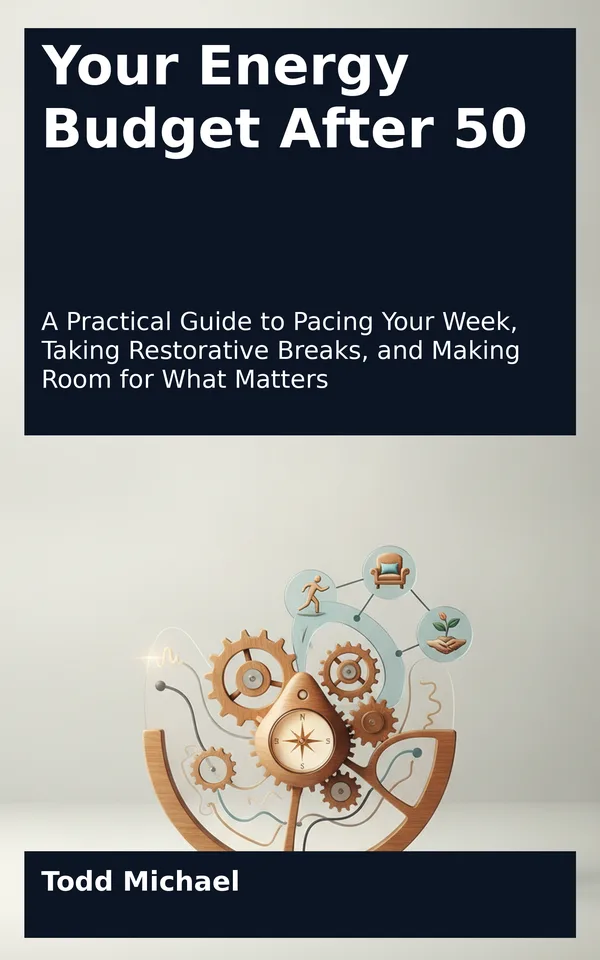
Cover of Your Energy Budget After 50

Health & Fitness

Your Energy Budget After 50

A Practical Guide to Pacing Your Week, Taking Restorative Breaks, and Making Room for What Matters

by Todd Michael

Available now

Some days, the calendar looks manageable—until the errands, conversations, decisions, and unexpected interruptions add up. Your Energy Budget After 50 offers a practical way to see where your energy goes and make small changes that fit your real life.

This healthy aging guide walks you through mapping an ordinary week, spotting patterns in your energy, and testing gentler ways to pace demanding days. You’ll learn how to plan useful breaks, make transitions between activities less rushed, and protect time for movement, rest, and commitments you genuinely enjoy. Worksheets, examples, and low-pressure experiments help you adapt the ideas to work, caregiving, household responsibilities, and changing schedules.

There’s no perfect routine to follow and no promise that a planner can solve every cause of fatigue. Instead, you’ll find a compassionate framework for making informed choices—and guidance on when persistent or unexplained fatigue deserves a conversation with a healthcare professional.

Contents
  1. 1. A Different Way to Think About Energy
  2. The Usefulness—and Limits—of a Budget
  3. Energy Is More Than Physical Stamina
  4. The Calendar Does Not Tell the Whole Story
  5. An Energy Budget Is Not a Test of Character
  6. A More Flexible View of Rest
  7. Ordinary Fluctuations and Fatigue That Needs Attention
  8. What “Enough” Can Look Like
  9. Begin with Curiosity
  10. 2. Take a Snapshot of Your Ordinary Week
  11. 3. Notice Your Personal Energy Patterns
  12. Start With Curiosity, Not a Score
  13. Choose a Few Check-In Points
  14. Make the Notes Useful, Not Exhaustive
  15. Notice Alertness Across the Day
  16. Pay Attention to Effort, Not Just the Clock
  17. Give Recovery a Little Attention
  18. Read the Pattern Gently
  19. Turn One Observation Into a Small Choice
  20. 4. Recognize the Hidden Costs of a Day
  21. 5. Sort What Matters from What Can Shift
  22. 6. Pace the Demanding Parts
  23. 7. Make Breaks Work for You
  24. 8. Build Breathing Room Between Activities
  25. 9. Leave Room for Movement and Rest
  26. 10. Protect the Commitments You Enjoy
  27. 11. Share the Load and Set Boundaries
  28. 12. Plan for Unpredictable and Heavy Weeks
  29. 13. Run Your Own Pacing Experiments
  30. 14. Create a Sustainable Weekly Energy Budget
  31. Other Books by Todd Michael

Read a sample: 1. A Different Way to Think About Energy

You wake up with a fairly ordinary day ahead. There are dishes in the sink, a call to return, and an appointment in the afternoon. Perhaps you also hope to take a walk or spend an hour on something you enjoy. None of these plans seems unreasonable on its own.

By late afternoon, though, the day feels heavier than you expected. The appointment involved a longer wait than usual. The call brought up a problem you could not solve right away. You stopped for groceries on the way home, then realized you still needed to put them away and decide what to make for dinner. The walk no longer sounds refreshing. It sounds like one more thing to do.

A day like this does not mean you are lazy, disorganized, or “getting old” in some simple, unavoidable way. It may mean that the day contained more demands than were visible when you first looked at the calendar.

This book offers a different way to look at those demands. Think of your energy as something you can plan around: not a fixed amount that must be guarded perfectly, but a changing resource that deserves some attention. The aim is not to make every hour productive. It is to create a week with enough room for responsibilities, recovery, movement, and the people and activities that matter to you.

That may require changing a plan. It may also require changing your expectations of what a plan is supposed to do.

More Health & Fitness

Cover of A Diet for Over 50 That Travels WellA Diet for Over 50 That Travels WellAvailable nowCover of Composting for Beginners at Home With Limited StrengthComposting for Beginners at Home With Limited StrengthAvailable nowCover of Tai Chi Walking for Weight Loss and Well-BeingTai Chi Walking for Weight Loss and Well-BeingAvailable nowCover of Cycling After 50Cycling After 50Available nowCover of The Hillside Walking PlanThe Hillside Walking PlanAvailable nowCover of Walking for Weight Loss on a TreadmillWalking for Weight Loss on a TreadmillAvailable now

About Todd Michael

Todd Michael is an American author and the founder of ToddMichael.tv. He writes practical, plain-English books on money, health, preparedness, technology, games, humor and more.

About the author Todd Michael · Todd Michael’s author site

Part of the ToddMichael.tv network.





