More Books
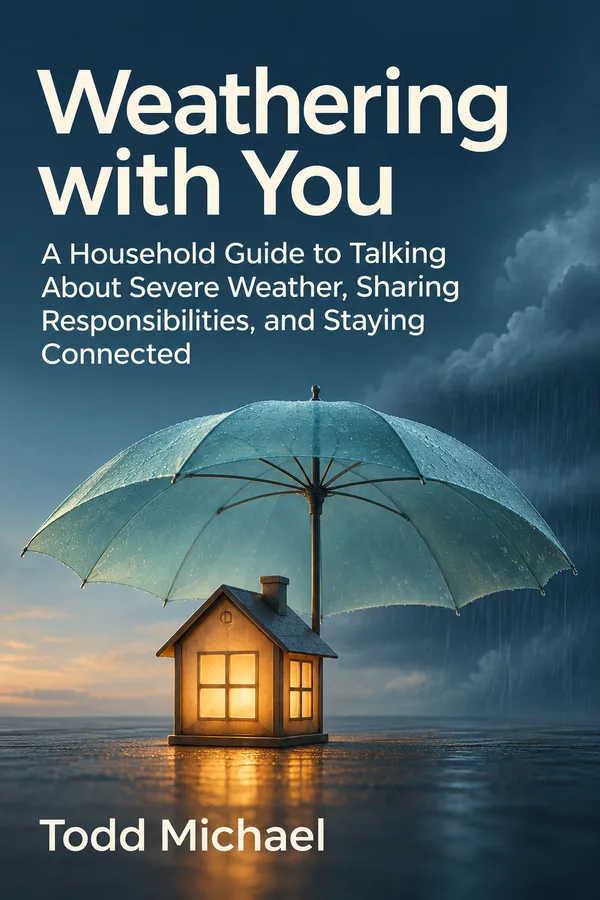
Weathering with You
A Household Guide to Talking About Severe Weather, Sharing Responsibilities, and Staying Connected
by Todd Michael
Available nowWhen severe weather threatens, the hardest question may not be what the forecast says—it may be whether everyone at home agrees on what to do.
Weathering with You helps families and housemates start those conversations before a warning adds urgency. Whether one person wants to act early and another prefers to wait, this guide offers practical ways to listen, compare concerns, and make decisions without treating disagreement as a character flaw.
Inside, you'll find sample conversations, household discussion prompts, and adaptable planning tools to help you:
• Talk honestly about different comfort levels with risk
• Divide responsibilities fairly and name backup helpers
• Agree on how and when to communicate
• Revisit a plan when schedules, needs, or forecasts change
• Check on one another after a warning
No household can control the weather. But together, you can build a clearer, kinder way to respond.
Contents
- 1. Why Weather Plans Are Conversations
- A plan is more than a list
- The difference between knowing and assuming
- Who belongs in the conversation?
- Start with an ordinary day
- Decide what needs a shared answer
- Make room for different reactions
- Try a first household conversation
- A plan you can return to
- 2. What Each Person Brings to the Forecast
- 3. Understanding Warnings Together
- 4. Starting the Conversation Without Starting a Fight
- 5. When Your Risk Tolerances Differ
- 6. Deciding Who Does What
- 7. Making a Communication Plan
- 8. Including Different Needs and Circumstances
- 9. Agreeing on Triggers and Next Steps
- 10. Talking When a Warning Arrives
- 11. When Circumstances Change
- 12. Resolving Friction Under Pressure
- 13. Checking on One Another After a Warning
- 14. Review, Practice, and Keep the Plan Alive
- Other Books by Todd Michael
Read a sample: 1. Why Weather Plans Are Conversations
Nina is halfway through making dinner when her phone sounds an unfamiliar alert. A severe thunderstorm warning has been issued for the area. She reads the message twice, turns down the stove, and calls into the next room.
“Did you get that?”
Her partner, Luis, is on a work call. He raises a finger to show he has heard her but keeps talking into his headset. Nina’s mother, June, is upstairs. Their roommate, Malik, was due home twenty minutes ago, but his bus is sometimes late.
Nina looks at the windows, then at her phone. She remembers hearing that strong winds are possible. She does not know whether Malik has seen the warning. She does not know whether June heard the alert over the television. She thought Luis would bring the porch cushions inside if a storm was coming, but she never actually asked him.
None of these uncertainties is unusual. They are the small gaps that appear when people share a home but have not yet shared their expectations.
“Luis,” Nina says, trying not to sound impatient, “I need to know if you saw the warning.”
He mutes his call. “I saw it. I thought you were checking on your mom.”
“I am. I also thought you were going to bring the cushions in.”
“I didn’t know you wanted me to.”
For a moment, both of them are irritated. Nina feels alone with a list of decisions she has only just begun to recognize. Luis feels as though he is being held responsible for an agreement he never made.
Then Nina takes a breath. “Okay. I’m going to check on Mom and look at the official update. Can you message Malik and see where he is?”
“Yes,” Luis says. “I can do that now.”
This exchange does not give the household a perfect plan. It does show what a plan needs to accomplish: help people understand what is happening, identify the next useful action, and make sure important tasks do not disappear into the space between “I thought you knew” and “Nobody told me.”
Severe weather can arrive with more urgency than a household’s usual decisions. A question that might be easy to settle on a quiet evening—who checks on June, how to reach Malik, what to do about work—can become harder when an alert sounds and everyone is doing something else. A conversation before that moment cannot remove uncertainty, but it can make the uncertainty easier to manage together.