Everyday Guidebooks
Cover of Tournament Poker

Poker & Game Strategy

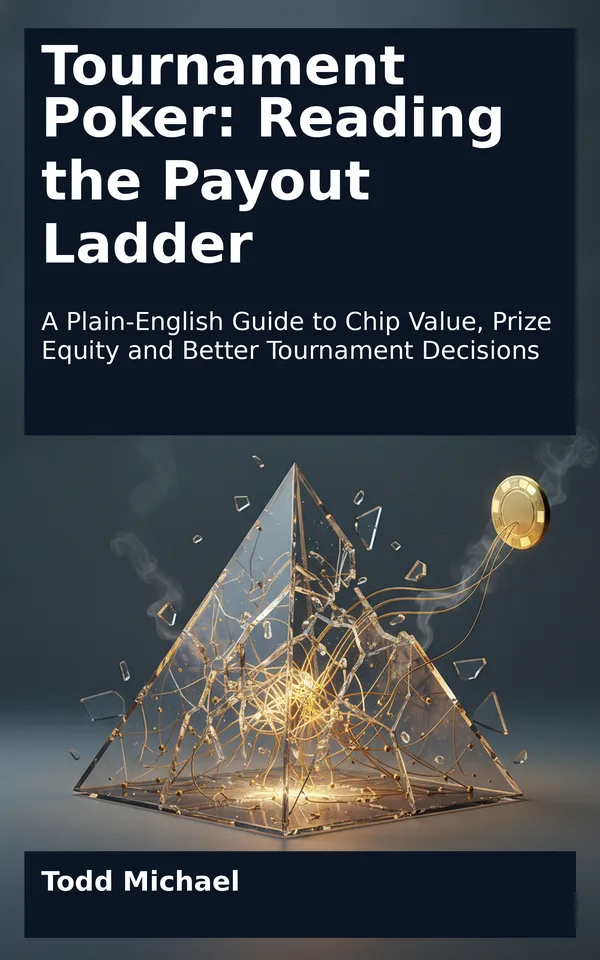
Tournament Poker: Reading the Payout Ladder

A Plain-English Guide to Chip Value, Prize Equity and Better Tournament Decisions

by Todd Michael

Available now

If you've searched for poker tournament how to win, you may already know that collecting chips is only part of the challenge. Tournament payouts can make the same chip gamble attractive in one situation and costly in another.

Tournament Poker: Reading the Payout Ladder explains why. With approachable examples and step-by-step exercises, Todd Michael shows how prize structures affect chip value, how to estimate prize equity with the independent chip model, and why a positive chip expectation does not always mean a positive prize-money expectation.

You'll learn to compare outcomes, recognize pressure created by different stack sizes, and question the assumptions behind a calculation. Worked examples cover more than the final table, including changing payout structures and practical decisions earlier in a tournament.

No model can predict every opponent or guarantee a win. This book gives you a clearer framework for understanding the trade-offs before you commit your chips.

Contents
  1. 1. Chips Are Not Cash
  2. What a Tournament Chip Represents
  3. Chip Expectation: The Average of Possible Outcomes
  4. Prize Equity: A Share of What Remains
  5. Why the Payout Ladder Matters
  6. A Decision Is a Comparison
  7. The Model Is a Map, Not the Tournament
  8. Thinking in Decisions, Not Guarantees
  9. 2. Anatomy of a Payout Ladder
  10. 3. The Arithmetic of Chip Gambles
  11. 4. Why Chip Value Changes
  12. 5. Independent Chip Model, Step by Step
  13. 6. From Chip Outcomes to Prize Equity
  14. 7. When a Chip Gain Costs Money
  15. 8. Stack Size and Risk Premium
  16. 9. Pressure Before the Money
  17. 10. Payouts Beyond the Bubble
  18. 11. Putting Opponents Into the Calculation
  19. 12. What the Model Leaves Out
  20. A Snapshot, Not a Schedule
  21. Position Has Value Beyond One Hand
  22. Skill and Future Decisions
  23. The Value of Winning the Pot
  24. More Than One Table
  25. Satellites: The Prize Is Different
  26. Bounties: A Prize Inside the Hand
  27. Reentries, Rebuys, and Other Variations
  28. How Much Should the Limitations Change Your Decision?
  29. A Model for Judgment
  30. 13. A Practical Decision and Review Routine
  31. 14. Practice Reading the Ladder
  32. Other Books by Todd Michael

Read a sample: 1. Chips Are Not Cash

Three players remain in a no-limit hold’em tournament. The prize table pays $180 for first, $120 for second, and $0 for third. Each player has 1,000 tournament chips, and all 3,000 chips are still in play.

You are one of the three. A hand reaches the river with no chips yet committed to the pot. For this stripped-down illustration, ignore blinds, antes, and any earlier betting. You move all in for 1,000 chips. One opponent calls for 1,000, and the third player folds without putting chips into the pot.

The pot therefore contains exactly 2,000 chips: your 1,000 and the caller’s 1,000. The player who folded keeps all 1,000 chips and cannot win this pot. There are no ties in the example. Assume that, from the perspective of the decision being evaluated, you have a 55% chance of winning against the caller’s hand.

The two possible outcomes are:

- You win: You take the 2,000-chip pot and have 2,000 chips. The caller has zero chips, is eliminated in third place, and receives $0. The player who folded retains 1,000 chips. You and that player continue heads-up for the $180 and $120 prizes; neither finishing position is settled yet. - You lose: The caller takes the pot and has 2,000 chips. You have zero chips, are eliminated in third place, and receive $0. The player who folded retains 1,000 chips. The caller and that player continue heads-up for the $180 and $120 prizes.

This gamble gains chips on average. Your expected stack after the hand is 55% of 2,000 plus 45% of zero, or 1,100 chips. Compared with your starting stack of 1,000, the gamble is worth an average of 100 chips under the stated assumptions.

But a chip gain does not automatically tell you what the gamble is worth in prizes. To explore that question, we need an estimate of the prize value of the stacks.

Suppose we use the independent chip model, usually called ICM. In this illustration, ICM treats players’ chances of finishing in each available position as functions of their current stack sizes, without assigning anyone an advantage for skill, position, future blinds, or other playing conditions.

Before the hand, the three stacks are equal. Under ICM, each player is equally likely to finish first, second, or third. Your estimated prize equity is therefore one-third of the $180 first prize, plus one-third of the $120 second prize, plus one-third of the $0 third prize: $100.

If you win the all-in, the caller has already finished third for $0. Two players remain, with you holding 2,000 of the 3,000 chips. In a two-player ICM calculation, your chance of finishing first is two-thirds and your chance of finishing second is one-third. Your estimated prize equity is therefore two-thirds of $180 plus one-third of $120, or $160. The other remaining player’s estimate is $140.

If you lose, you finish third and receive $0. The caller and the player who folded then have the same respective stacks of 2,000 and 1,000; their ICM equities are $160 and $140. Their eventual first- and second-place finishes have not yet been determined.

Combining your two possible outcomes gives an estimated prize value of 55% of $160 plus 45% of $0, or $88. That is $12 less than your $100 ICM equity before the gamble.

The numbers describe a wager that is favorable in chips but unfavorable in estimated prize money. They do not establish that every real decision with a 55% chance of winning should be avoided. The example deliberately holds the pot and probabilities simple so you can see the difference between the two calculations.

More Poker & Game Strategy

Cover of The GTO PlaybookThe GTO PlaybookAvailable nowThe Safe KingComing soonCover of Texas Holdem PokerTexas Holdem PokerAvailable nowCover of Poker Tournament Play Without the GuessworkPoker Tournament Play Without the GuessworkAvailable nowCover of Poker Strategy GuidesPoker Strategy GuidesAvailable nowCover of Tournament PokerTournament PokerAvailable now

About Todd Michael

Todd Michael is an American author and the founder of ToddMichael.tv. He writes practical, plain-English books on money, health, preparedness, technology, games, humor and more.

About the author Todd Michael · Todd Michael’s author site

Part of the ToddMichael.tv network.