Everyday Guidebooks
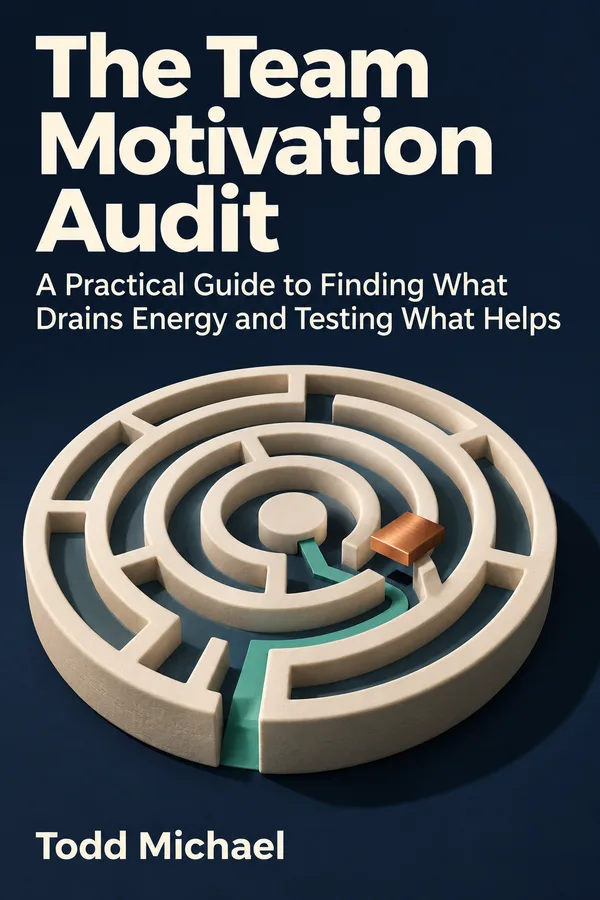
Cover of The Team Motivation Audit

Business, AI & Entrepreneurship

The Team Motivation Audit

A Practical Guide to Finding What Drains Energy and Testing What Helps

by Todd Michael

Available now

When a team seems disengaged, the answer is not always another incentive, pep talk, or productivity target. The real obstacle may be a goal no one understands, a process that wastes hours, or a decision that never gets made.

The Team Motivation Audit gives managers a practical way to look beyond assumptions and find out what is happening. Learn how to ask questions employees can answer honestly, notice patterns without treating people as problems, and distinguish a concern affecting one person from a barrier shared across the team. Then choose a small change, agree on what to observe, and adjust based on what you learn.

With conversation prompts, audit worksheets, realistic examples, and a repeatable review process, this guide turns leadership how to motivate your team into a question you can investigate rather than a formula you have to guess.

Contents
  1. 1. Motivation Is a Signal, Not a Diagnosis
  2. Start With What You Can Observe
  3. A Team That Looks Disengaged
  4. Motivation Lives in a Context
  5. Why Incentives Cannot Carry the Whole Load
  6. An Audit Is an Inquiry, Not a Verdict
  7. Your Role in the Evidence
  8. From Concern to a Better Question
  9. 2. Set the Boundaries of Your Audit
  10. 3. Look at the Work Before Labeling People
  11. 4. Ask Questions That Invite Useful Answers
  12. Begin With the Work, Not the Diagnosis
  13. Build a Small Set of Prompts
  14. Replace Leading Questions With Curious Ones
  15. Follow the Answer to a Useful Example
  16. Listen Without Defending
  17. Do Not Promise the Fix in the Room
  18. Choose the Right Setting
  19. Capture Meaning, Not Just Words
  20. Turn Listening Into the Next Inquiry
  21. 5. Make Feedback Safer and More Credible
  22. 6. Audit Goals, Priorities, and Decisions
  23. 7. Audit Workload, Tools, and Processes
  24. 8. Audit Autonomy, Support, and Growth
  25. 9. Understand Recognition Without Guessing
  26. 10. Separate Individual Concerns From Shared Barriers
  27. 11. Choose a Problem Worth Testing
  28. 12. Run a Small, Fair Experiment
  29. 13. Review Results and Close the Loop
  30. 14. Build a Repeatable Motivation Audit
  31. The Motivation Audit Worksheet
  32. Other Books by Todd Michael

Read a sample: 1. Motivation Is a Signal, Not a Diagnosis

The meeting ends, and nobody has volunteered to take on the new project. A deadline has slipped. The team’s questions are shorter than they used to be, and a suggestion box that once filled with ideas has gone quiet.

A manager might look at these signs and conclude that the team has lost its motivation. That conclusion is understandable. It is also incomplete.

The behaviors are visible. Their causes are not. Silence in a meeting might reflect disengagement, but it might also reflect uncertainty about priorities, fatigue from repeated changes, concern about speaking candidly, or a belief that the decision has already been made. A missed deadline could signal a lack of attention, a dependency outside the team’s control, or a plan that never accounted for the work required. Sometimes several explanations are true at once.

This distinction matters because the diagnosis shapes the response. If a manager decides the problem is attitude, the response may be a pep talk, a warning, or a new incentive. If the problem is an approval process that stops work for days, none of those responses addresses the obstacle. They may even make the situation worse by suggesting that employees should compensate for a problem they have repeatedly tried to describe.

A motivation audit begins with a more useful question: What conditions might be affecting people’s ability or willingness to do their best work?

The answer will not always be comfortable, and it will not always point to a simple fix. The purpose of the audit is not to prove that every concern is caused by management or that every employee is responding appropriately. It is to replace quick judgments with a disciplined inquiry into the work, the environment, and the experiences of the people doing it.

More Business, AI & Entrepreneurship

Cover of AIAIAvailable nowCover of The New Gold RushThe New Gold RushAvailable nowCover of Public Speaking Under the ClockPublic Speaking Under the ClockAvailable nowCover of The Small Business Bookkeeping BacklogThe Small Business Bookkeeping BacklogAvailable nowCover of Leadership Intelligence for Succession PlanningLeadership Intelligence for Succession PlanningAvailable nowCover of Sales EQ for Difficult Internal HandoffsSales EQ for Difficult Internal HandoffsAvailable now

About Todd Michael

Todd Michael is an American author and the founder of ToddMichael.tv. He writes practical, plain-English books on money, health, preparedness, technology, games, humor and more.

About the author Todd Michael · Todd Michael’s author site

Part of the ToddMichael.tv network.