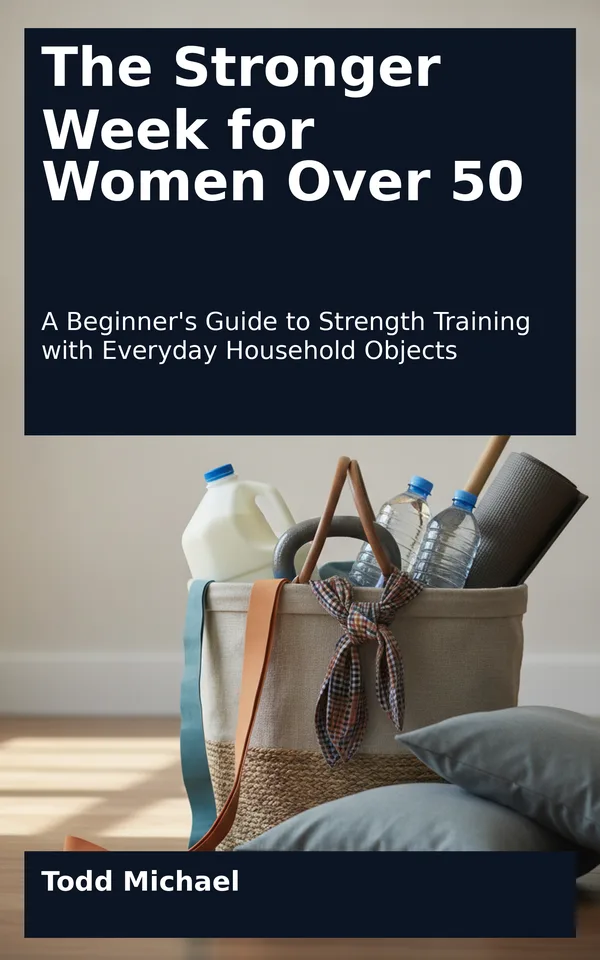
Read a sample: 1. A Stronger Week Starts Here
You do not need to transform your life by next Monday. You do not need a matching exercise outfit, a room full of equipment, or a history of athletic achievement. To begin building a stronger week, you need a little space, a willingness to learn, and a plan that respects the life you already have.
Strength training is the practice of asking your muscles to work against resistance. That resistance might come from your own body, a sturdy surface, or an ordinary object chosen with care. In this book, you will learn simple movement patterns using things you may already have at home. A stable chair can help you practice sitting and standing with control. A securely closed container can become a manageable weight. A firm countertop can provide a place to practice a pushing movement.
The aim is not to make household chores harder or turn every object into exercise equipment. It is to use a few suitable objects deliberately, in a clear space, as part of a repeatable routine. Some objects will be useful; others will not be safe or comfortable for the job. Learning the difference is part of the plan.
You may be coming to this book because getting up from a low seat feels more demanding than it once did, because you want to carry a bag with greater confidence, or because you simply want a dependable way to care for yourself. Perhaps nothing in particular feels difficult, and you would like to stay active and capable as the years go on. All of those are worthwhile reasons to begin.
Your starting point does not need an apology.
A beginner strength routine gives you regular opportunities to practice useful movements: standing up, bending at the hips, lifting, carrying, pushing, pulling, and holding. These are familiar actions, but familiarity does not mean you must perform them quickly or under a heavy load. In training, you can slow them down, pay attention, and choose a level of challenge that suits you.
Over time, appropriate strength training can help build or maintain muscular strength and support everyday function. It can also give you a clearer sense of what your body can do and how to adjust when a task feels awkward. Your experience will depend on your starting point, health, consistency, recovery, and many other factors. There is no single result you must achieve for your effort to count.
Think of the routine as a practice rather than a test. In a test, you might feel pressure to prove yourself on the first day. In a practice, the first day is for gathering information. You notice what feels steady, what needs more attention, and what you would like to try again. A small, well-controlled effort is useful information. So is discovering that you need a different chair, a lighter object, or advice before attempting a movement.
The word stronger can mean different things at different times. It might mean completing a few controlled repetitions that once felt unfamiliar. It might mean recognizing when an object is too awkward to lift and choosing a better one. It might mean returning to your routine after a busy month without trying to make up for every missed session. These are practical skills, not consolation prizes.
There is no standard beginner over 50. One reader may walk regularly but have never lifted anything for exercise. Another may be returning after an injury or a long period of inactivity. Someone else may be comfortable getting around the house but uncertain about balance, grip, or getting up from a chair. Two people of the same age can have very different needs, and one person's needs can change from week to week.
Instead of comparing yourself with an imagined beginner, take stock of what is true for you now. Consider your usual activity, any movements you tend to avoid, and how you generally feel after a physically demanding day. Notice practical matters, too. Is there a clear area where you can move without rushing? Do you have a sturdy chair without wheels? What time of day gives you enough energy and privacy to concentrate?
You do not need to answer these questions perfectly. Their purpose is to help you choose a sensible entry point. If your days are already crowded, a short session may be more realistic than an ambitious one. If a particular movement feels unfamiliar, you may spend your first practice learning its setup rather than adding weight. If you have an existing condition, symptoms, a recent injury, or activity restrictions that make you unsure what is appropriate, seek individualized guidance from a qualified health professional before beginning or adapting the plan. Chapter 2 will help you think through preparation and when to ask for that guidance.
A realistic starting point is not necessarily the easiest thing you can imagine, nor is it the hardest thing you can manage once. It is a level you can approach with attention, control, and enough energy left to recover. You should be able to finish a beginner practice feeling that you have worked, without feeling that you had to force your way through it.
That may mean starting without an added household load. It may mean doing fewer repetitions than an example suggests, resting longer, or using an appropriate support. It may also mean postponing a movement until you have an option that suits you. The…