Read a sample: 1. The People Inside the Weather
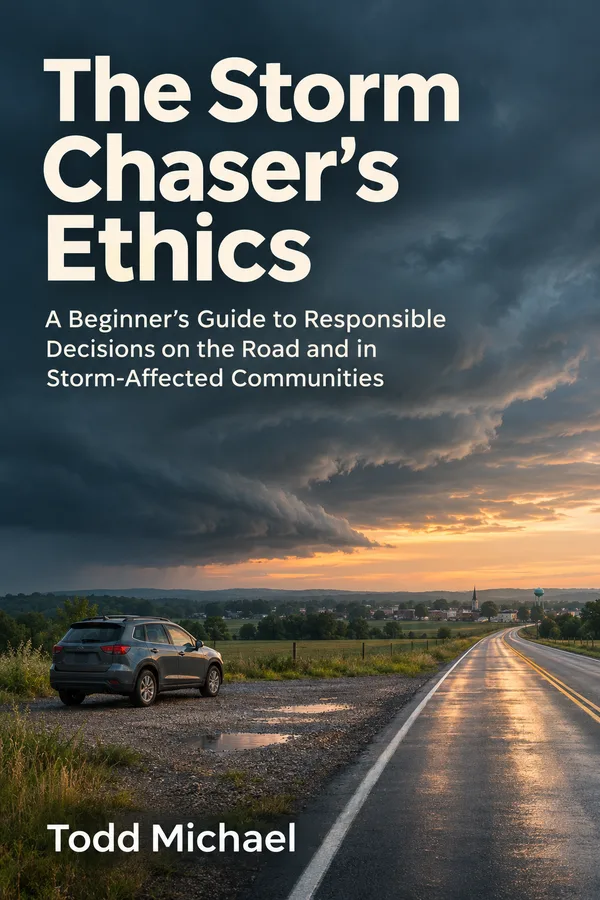
The cloud has been growing for the better part of an hour. From the highway, you can see its dark base stretching across the horizon, with a pale shaft of rain falling beyond the fields. You turn onto a smaller road for a clearer view and find a place where the grass shoulder looks wide enough to hold your car.
Two other vehicles are already stopped there. Their occupants have cameras pointed toward the sky. Across the road, a pickup sits at the mouth of a gravel driveway, waiting to turn out. Farther back, a person stands beside a barn, looking in the same direction as the photographers.
You have only a few seconds to decide whether to stop. The view is excellent. The road is quiet at this moment, and you have driven a long way to see a storm like this. You also notice that the shoulder narrows near the driveway and that a large farm vehicle is approaching from behind.
Nothing about the scene announces an obvious moral dilemma. There is no confrontation, no damaged building, no person calling for help. Yet your choice matters. If you stop, you add another vehicle and another set of movements to a place that is already serving several purposes. If you continue, you give up a promising view. Neither choice makes you a good or bad person by itself. What matters is whether you see the whole situation clearly enough to make a responsible decision.
Storm chasing begins with an understandable fascination. Severe weather can reveal motion, scale, color, and power that are difficult to appreciate from a forecast map or a screen. For many people, seeing a storm develop is also a way to learn: the sky becomes more than a collection of symbols, and the relationship between a forecast and an actual landscape becomes tangible.
But a storm does not develop over an empty page. The fields, roads, houses, businesses, schools, and utility lines beneath it belong to a working landscape. People are trying to get home, protect animals, close shops, pick up family members, finish a shift, or simply understand what the weather might mean for them. An observer may be passing through for an afternoon. Someone else may spend the next several days dealing with the consequences.
That difference in perspective is the starting point for this book.
When you are looking for a storm, it is natural to organize the world around the view. A hill becomes an obstruction. A road becomes a route toward better visibility. A driveway entrance looks like an inviting place to turn around. A cluster of vehicles may seem to confirm that you have found the right spot.
Each observation might be useful, but each is incomplete. The hill may be part of someone’s pasture. The road carries people whose destinations have nothing to do with the storm. The driveway is an entrance someone may need without warning. The vehicles may be stopped there because their drivers made quick decisions under the same pressure you feel.
Responsible chasing asks you to hold both pictures in mind: the weather you came to observe and the ordinary community that continues around you. You do not need to know everyone’s circumstances or feel guilty for being interested in the sky. You do need to recognize that your interest does not give your needs automatic priority.
Consider the pickup waiting at the driveway in the opening scene. Perhaps its driver wants to join the road. Perhaps the driver is checking conditions before going somewhere else. You cannot know from a glance, and you should be cautious about inventing a story. What you can see is that a vehicle is positioned at an entrance and that another stopped car nearby could make movement more difficult. That observable possibility is enough to influence your decision.
The distinction is useful throughout a chase. You do not have to prove that a resident will be inconvenienced before you avoid blocking an entrance. Nor do you have to imagine a disaster behind every vehicle. Look for the practical ways your presence could affect people, then choose an action that leaves them room to carry on.
A public road is shared space. That means a visitor may have a legitimate reason to travel it, but so do the people who use it every day. Public access does not erase the road’s other functions or make every available-looking stopping place a good one.
The same is true of a town. A gas station is not merely a place to refuel between storm cells. It is also where employees work and customers buy what they need. A parking area is not automatically a gathering point for weather enthusiasts. A residential street is not just a convenient line on a map; it may be where people are trying to get children indoors or check on neighbors.
Being a visitor is less about your license plate than your relationship to the place. You may live nearby and still arrive in a neighborhood where you do not know the routines or needs of the people around you. You may be far from home and have permission to use a particular space. In either case, the useful question is not “Do I belong here?” as a test of identity. It is “What responsibilities come with being here right now?”
That question should not lead to paralysis.…