Everyday Guidebooks
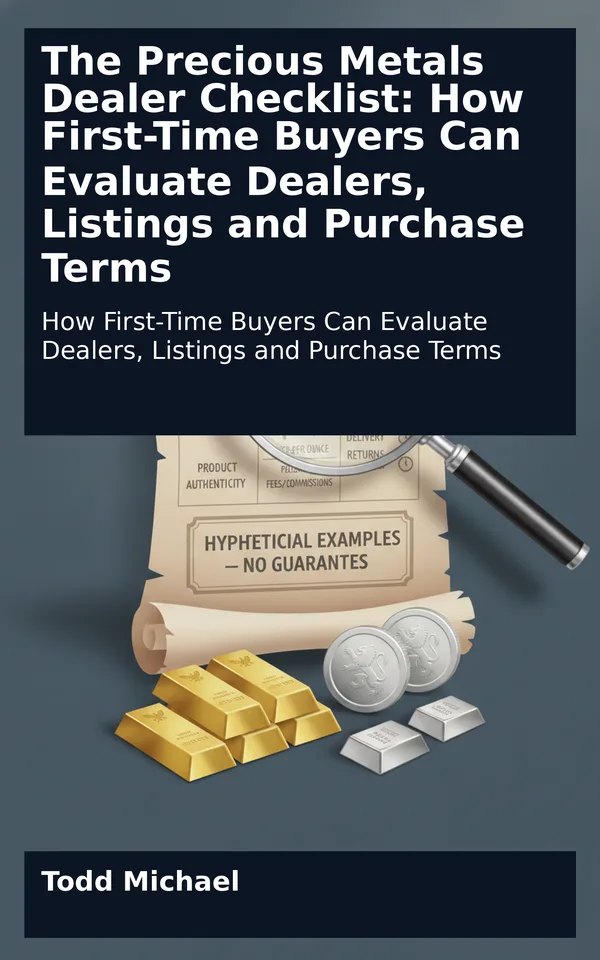
Cover of The Precious Metals Dealer Checklist

Money, Investing & Precious Metals

The Precious Metals Dealer Checklist: How First-Time Buyers Can Evaluate Dealers, Listings and Purchase Terms

How First-Time Buyers Can Evaluate Dealers, Listings and Purchase Terms

by Todd Michael

Available now

A polished website or persuasive salesperson is not enough reason to send money for precious metals. Before your first purchase, learn how to investigate the seller and understand the deal in writing.

This precious metals guide walks you through researching dealers, reading bullion listings and comparing quotes on the same terms. You'll learn what to ask about payment methods, order confirmation, shipping, insurance, delivery delays and returns—and how to recognize pressure tactics and other warning signs. Checklists and clearly labeled hypothetical examples help you organize what you find without assuming that any single sign proves a dealer is trustworthy.

Whether you're considering a local shop or an online seller, you'll finish with a repeatable process for deciding whether to proceed, ask more questions or walk away. This book provides general information, not personal financial, legal or tax advice; consult a qualified professional when your circumstances require it.

Contents
  1. 1. Before You Choose a Dealer
  2. 2. Build a Shortlist You Can Investigate
  3. 3. Check the Business Behind the Website
  4. 4. Read Reviews and Complaint Records Critically
  5. 5. Decode a Bullion Listing
  6. Start With the Product, Not the Price
  7. Identify the Metal and the Form
  8. Understand Purity and Fineness
  9. Distinguish Total Weight From Metal Content
  10. Check the Unit of Measurement
  11. Read the Quantity and Price Together
  12. Separate the Photograph From the Promise
  13. Examine Condition, Packaging, and Grading Claims
  14. Treat Availability as a Separate Specification
  15. Work Through an Ambiguous Listing
  16. Turn the Description Into a Usable Record
  17. 6. Spot Sales Pitches That Deserve a Pause
  18. 7. Request Quotes You Can Compare
  19. 8. Calculate the Full Purchase Cost
  20. 9. Understand Payment Risks Before Sending Money
  21. 10. Read the Order and Cancellation Terms
  22. Follow the Order From Quote to Acceptance
  23. Understand What a Price Lock Actually Covers
  24. Check Minimums and Conditions Before Checkout
  25. Separate Cancellation From Return
  26. Read Every Cancellation Charge Together
  27. Notice Who Can Cancel—and on What Terms
  28. Give Dispute Language a Separate Reading
  29. Preserve the Terms You Actually Saw
  30. The Decision Before You Commit
  31. 11. Check Shipping, Delivery and Risk of Loss
  32. 12. Compare Returns, Exchanges and Buyback Claims
  33. 13. Make the Decision and Place the Order
  34. 14. Resolve Problems and Keep Your Checklist Current
  35. Start With the Facts You Can Establish
  36. Contact the Dealer With a Specific Request
  37. Watch Time Limits Without Rushing Blindly
  38. Escalate in an Orderly Way
  39. Recognize a New Risk During the Dispute
  40. Close the File Thoughtfully

Read a sample: 1. Before You Choose a Dealer

A precious metals purchase can begin with a simple question: “Where should I buy?” Before you answer it, pause over a more useful question: “What decision am I trying to make?”

Choosing a dealer is only one part of buying physical metal. You also need to know what you are considering, how much you are prepared to spend, what information you need before paying, and what would make you step away. A dealer may have an attractive listing but unclear delivery terms. Another may answer questions promptly but quote a product different from the one you requested. Neither a polished website nor a friendly conversation settles the whole decision.

This book helps you investigate dealers, listings and purchase terms before committing money. It does not tell you whether gold, silver or another precious metal belongs in your financial plan. That is a separate decision, and it deserves attention before a sales pitch or a short-lived quote starts driving your choices.

You do not need to become an expert in every coin or bar before you begin. You do need a repeatable way to ask questions, preserve answers and recognize when the evidence is not good enough.

Two decisions often become tangled together:

1. Whether to buy physical precious metals at all. 2. If you decide to explore a purchase, whether a particular transaction is acceptable.

The first concerns your circumstances and goals. Physical metal can fluctuate in market value, and buying and selling typically involve costs. Unlike money held in a bank account, a coin or bar does not itself pay interest. Ownership also brings practical questions about storage, access, loss and eventual sale. A purchase that feels manageable today could be inconvenient if you later need the money quickly.

Consider your cash needs, debts, existing investments and ability to absorb a loss. Think about why you want physical metal rather than another way to obtain exposure to its price. If your reason depends on an expectation that prices will rise, recognize that the expectation may not prove correct. If it depends on having a tangible object, ask where you would keep it and how you would sell it.

The second decision is narrower. It asks whether a specific seller is offering a product you understand, at a total cost you can verify, under terms you are willing to accept. Careful transaction research can reduce some avoidable uncertainties, but it cannot make the broader financial decision for you.

A reputable-looking dealer cannot determine how much you can afford. A low quoted price cannot establish that buying is appropriate for your goals. Conversely, deciding that you want a modest amount of physical metal does not require you to accept the first available seller or an unclear offer.

This book is educational, not individualized financial, legal or tax advice. A qualified financial professional can help you consider a purchase in the context of your overall situation. A qualified attorney or tax professional can help with questions that depend on your facts and current rules. When choosing an adviser, ask how that person is paid and whether they have an interest in the transaction. The responsibility for deciding whether to proceed remains yours.

You can begin dealer research without settling every detail, but a preliminary purchase description will keep your investigation focused. Write down what you know and mark the rest as questions rather than filling gaps with assumptions.

Your starting description might cover:

- Purpose: Why are you considering physical metal, and what would cause you to reconsider? - Metal and form: Are you interested in gold, silver or another metal? Are you considering coins, bars or both? - Amount: What maximum total outlay are you willing to consider, including charges beyond the listed product price? - Destination: Where would the purchase be delivered or collected? - Timing: Are you gathering information, or are you prepared to place an order if the terms meet your requirements? - Practical needs: Do you have preferences about payment, delivery, storage or the ability to sell later? - Open questions: Which product specifications and purchase terms do you still need to understand?

Be especially careful with the amount. A product’s advertised price is not necessarily the amount you will pay. Shipping, payment-related charges and applicable tax may change the total. Your own storage costs may also matter, even if they are not part of the dealer’s invoice. Leave room for those uncertainties instead of treating your entire available sum as the product budget.

For example, hypothetically, a buyer is comfortable spending no more than $1,000 in total. If a written quote lists $920 for products and $35 for shipping, the subtotal is $955. That leaves $45 within the buyer’s limit for any other applicable charges. It does not establish that the order will cost $955: the buyer still needs to determine whether tax or other fees apply. If the final total exceeds the limit, the buyer can change the order or decline it.

A maximum is a boundary, not a target. You can choose to spend less, postpone the decision or buy nothing.

Research has costs too. The most obvious is time, but you may also encounter travel expenses, fees for professional advice or charges for services you did not expect to need. Setting a research budget helps you investigate deliberately without allowing the process to consume more resources than the potential purchase warrants.

Your budget…

More Money, Investing & Precious Metals

Cover of The Practical Gold BookThe Practical Gold BookAvailable nowCover of The Practical Gold Book, Volume 2The Practical Gold Book, Volume 2Available nowCover of The Practical Silver BookThe Practical Silver BookAvailable nowCover of The Practical Crypto BookThe Practical Crypto BookAvailable nowCover of Shielding Your WealthShielding Your WealthAvailable nowCover of Personal Finance AdvancedPersonal Finance AdvancedAvailable now

About Todd Michael

Todd Michael is an American author and the founder of ToddMichael.tv. He writes practical, plain-English books on money, health, preparedness, technology, games, humor and more.

About the author Todd Michael · Todd Michael’s author site

Part of the ToddMichael.tv network.





