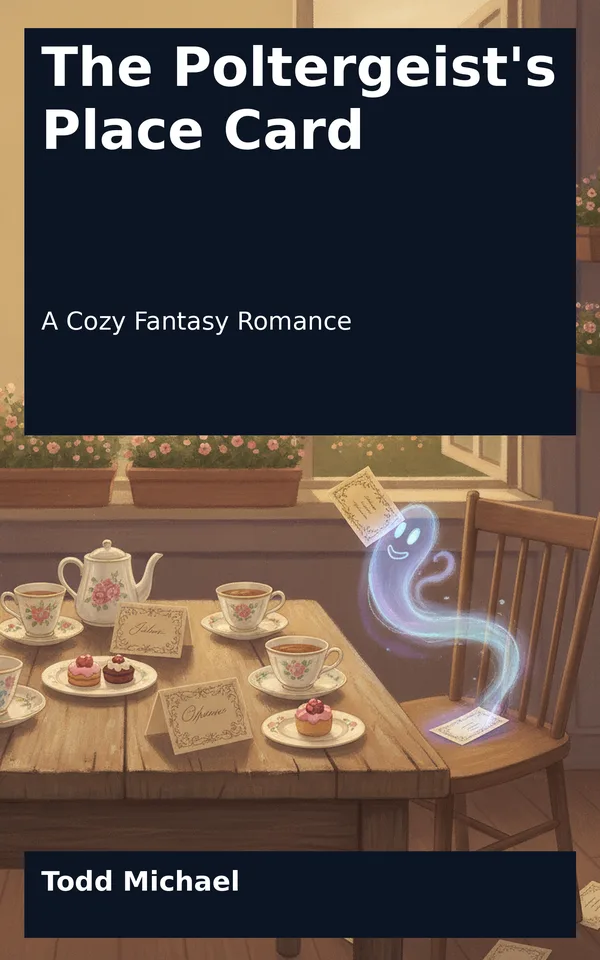
Read a sample: 1. A Wedding for Wren Street
The first sign that the tea shop approved of the engagement was the sugar bowl moving three inches to the left.
Mara watched it travel along the counter, slow and deliberate, until it came to rest beside the small vase of early daffodils. The lid lifted a fraction, settled again, and gave a pleased little rattle.
“Thank you,” she said.
From the other side of the counter, her sweetheart looked up from the loose hinge he was fixing. “I didn’t say anything.”
“Not you.”
“I was about to say something lovely.”
“You still can.”
Elias considered her over the top of the cupboard door. A curl of dark hair had fallen across his forehead, and there was a pale shaving of wood caught against his sleeve. “You’ve put the good sugar bowl out.”
Mara leaned on the counter. “That’s your lovely remark?”
“It’s a very good bowl.”
“It has a chip.”
“That’s how you know it’s yours.”
She tried not to smile, but he knew her too well for that to work. He set down his screwdriver, reached across the counter, and caught her hand. The ring on her finger was simple gold, warm now from being worn. He had slipped it there three nights ago in the little kitchen above the shop, with a kettle whistling and a pan of onions threatening to burn.
He had not got down on one knee. He had meant to, apparently, but she had said yes before he could move the kitchen chair out of the way.
Mara liked that version better.
“You could have told me the sugar bowl was listening,” Elias said.
“I thought it was obvious.”
The bowl shivered, and a spoon inside it tapped twice against the rim.
The tea shop’s ghost had been part of their lives longer than Elias had. He had been there when Mara first took the lease, when she had stood among the dusty tables wondering whether the little room on Wren Street would ever feel like hers. At first he had confined himself to small acts: a curtain twitching in a still room, a cup turning its handle toward a customer’s reaching hand. Once, when a tray had tipped, every saucer on it had slid safely back into place.
Mara had thanked the empty air, because it seemed rude not to. The next morning, the chairs had been arranged in a neat circle around the biscuit tin.
They had reached an understanding since then. He could move anything that wasn’t hot, sharp, or likely to break. He could not hide the till key, however amusing he found the search. In return, Mara spoke to him as she went about her day and left the radio on low when she closed.
She called him Pip, after the single apple pip he had once deposited in her shoe for reasons known only to himself. He had never objected. His approval usually took the form of two taps, and his displeasure was generally impossible to mistake.
“Did you hear that, Pip?” Mara asked. “Elias thinks the sugar bowl is very good.”
Two taps.
“Traitor,” Elias said.
He released her hand and went back to the hinge. Mara fetched a cloth to polish the front window, though she had already polished it that morning. The shop was closed on Mondays, and on a sensible Monday she might have counted stock or ordered more flour. Today her thoughts kept slipping away from every task she started.
She rubbed a stubborn mark on the glass and watched Wren Street come and go beyond it. A cyclist passed with a basket full of parcels. Across the road, the florist was coaxing two pots of primroses into the sun. Someone had tied a blue ribbon to the handle of the bookshop door, though Mara couldn’t make out why.
Ordinary things. Dear things.
In the reflection, Elias straightened and tested the cupboard door. It swung shut without a squeak.
“There,” he said. “We can keep the cups in now.”
“An improvement.”
“I like to think my work changes lives.”
He picked up his tools, and she saw the small, familiar marks on his hands: a nick at the base of one thumb, a faint scar across a knuckle. She had watched those hands mend a wobbly table, build shelves for the kitchen, and carefully peel an orange for her when she was too tired to manage it herself. The thought of marrying him arrived again with the same bright surprise it had carried all weekend.
Elias caught her looking.
“What?” he asked.
“Nothing.”
“That’s rarely true.”
Mara put the cloth down. “I was wondering when we should tell everyone.”
“About the cupboard?”
“About the engagement.”
He glanced toward the window, where the gold letters of the shop’s name were painted in reverse. “My sister has probably told everyone she met on the walk home yesterday.”
“You asked her not to.”
“I asked her to give us until Monday.”
Mara checked the clock.
“It’s Monday,” he said.
A teaspoon slid out of the draining rack and fell into the sink with a cheerful clatter.
“Pip agrees,” Mara said.
“Pip may have told my sister himself.”
They had told a few people already, of course: Elias’s sister, Mara’s mother, the friend who ran the florist across the road and had seen the ring while selling Mara a bunch of daffodils. Each telling had made…