Read a sample: 1. A Counter Full of Wishes
On the morning the ghost came to her shop, Elin found a knot in the blue ribbon.
It was a small knot, no larger than a pea, tucked six turns into the spool of silk. She eased it loose with the point of a bone needle, careful not to bruise the weave. The ribbon slipped through her fingers with a soft, dry whisper and lay flat again.
“There,” she told it. “No need to make a crisis of things.”
The ribbon, having been restored to order, offered no opinion.
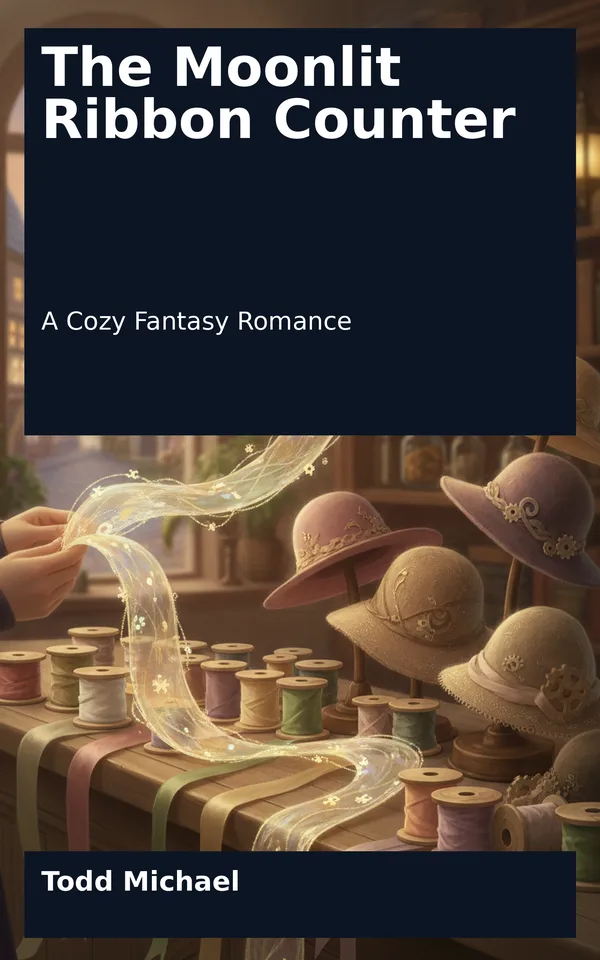
Sunlight reached across the counter and illuminated the jars along the wall: buttons like cloudy sweets, pins with pearl heads, paper flowers waiting to be wired to combs. Above them hung ribbons in every width and color Elin could find room to stock. Some were plain cotton, sturdy enough to tie around a basket. Others were silk or velvet, gauze or grosgrain, and a few had edges so fine they seemed to have been cut from the shadows between leaves.
Her mother had called it a sensible shop with an unreasonable amount of ribbon in it. Elin considered this a compliment.
She wound the blue silk back onto its spool, put a kettle on the little stove behind the counter, and opened the front door to the mild morning. Across the lane, the baker was carrying out a tray of buns. The scent of orange peel drifted in, closely followed by Mrs. Vale, who brought a square parcel and an expression of grave concern.
“Is something wrong?” Elin asked.
“I’ve wrapped it three times.”
“That does sound serious.”
“The corners wouldn’t stay tucked.” Mrs. Vale set the parcel down. Its brown paper was folded with admirable neatness, though a piece of string had cut a dent across the middle. “It’s a book of gardening sketches for my sister. She’s been poorly, and I thought she might like something to look at while she rests.”
Elin reached for the parcel, then paused. “May I?”
“Please. If you can get that string off without tearing the paper, you’re cleverer than I am.”
Elin slipped her scissors beneath the string and snipped it. Mrs. Vale watched as if this were the most delicate operation imaginable.
“I want her to feel better,” she said.
Elin understood the wish beneath those words. She had heard it in many forms: over jars of soup, woolen shawls, little boxes containing ginger sweets. Love was often most eloquent when it had run out of useful things to do.
“I can put your care into the ribbon,” she said. “It may remind her she’s loved. I can’t make her well.”
“I know.” Mrs. Vale smoothed one of the paper corners with her thumb. “I don’t need the ribbon to do the doctor’s work. I’d like her to know I’m thinking of her, even when I’m not there.”
“That I can help with.”
They chose a soft green cotton, the color of new leaves before they darkened. Mrs. Vale held one end while Elin drew the other over the parcel. A wish was easier to carry when its giver had a hand in the making. Elin laid her fingers along the ribbon and listened—not with her ears, exactly, but with the quiet part of herself that noticed when a thread was ready to take a stitch.
Warmth gathered under her fingertips. It was no brighter than the warmth left in a cup after tea, and just as ordinary once one knew to expect it.
The bow settled against the paper. Mrs. Vale touched it, smiled a little, and went away with the parcel held carefully under her arm.
By the time Elin had poured her tea, the next customer had arrived. Tamsin, who worked at the cooper’s yard, deposited a tin of sugared almonds on the counter and took off her cap.
“I need the strongest ribbon you’ve got,” she announced.
“For the tin, or for the wish?”
“Both, if possible.” Tamsin leaned closer. “My brother has been courting a woman from the next village. I thought I’d give her these and wish that she’ll say yes when he finally asks her to marry him.”
Elin regarded the tin. Someone had painted violets around its lid, though one flower had acquired a thumbprint before the paint dried.
“Are the almonds from you or from your brother?”
“From me. She likes almonds.”
“That’s a promising beginning.” Elin turned the tin so the violets faced them. “Does your brother know you’re arranging his proposal?”
“He does not.”
“And does the woman know you mean to help her decide?”
Tamsin’s ears went pink. “When you put it like that.”
“I can’t tie her answer into a ribbon. It has to be hers to give.”
Tamsin considered this, tapping one finger against the lid. “Well, he is very slow about asking. Perhaps what I really want is for them to be able to talk plainly to each other.”
“That’s a generous wish. It won’t make the conversation easy, but it can travel with the gift.”
“And if she says no?”
“Then she’ll have said what she means.”
Tamsin sighed. “You’re very inconvenient when you’re sensible.”
“So my mother tells me.”
They settled on a narrow violet ribbon. Tamsin held the tin while Elin tied it, and the wish entered the weave with a faint lift of the bow’s two loops. It would not put words…