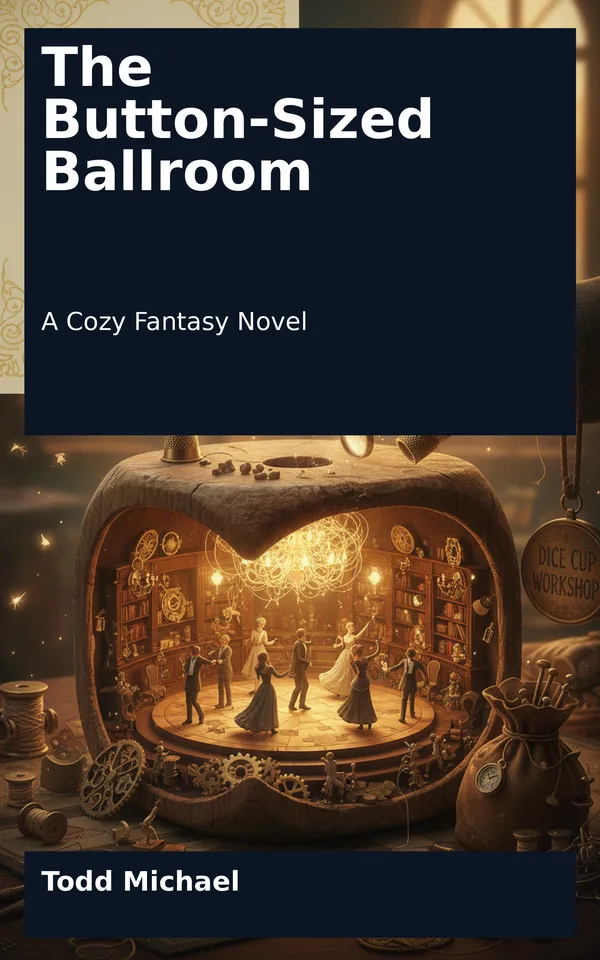
Read a sample: 1. The Workshop on Cup Lane
On mornings when the wind came up Cup Lane, the sign above the Dice Cup Workshop knocked against its bracket three times before settling down. Mara Thimble had tried oiling the hinge, tightening the screws, and asking it politely to stop. The sign had accepted the oil, worked the screws loose again, and informed her that three knocks were traditional.
So when the knocking began that morning, Mara looked up from unlocking the door and said, “Good morning to you too.”
The painted dice on the sign showed two sixes. They always showed two sixes before breakfast. Afterward, depending on the weather and their opinion of the day, they might show anything at all.
Inside, the workshop smelled of beeswax, tea leaves, and the faint peppery scent of spells that had been warmed too often. Mara stepped around a tower of boxed games, set her satchel beneath the counter, and opened the shutters. Pale light spilled over the long workbench at the back, catching on brass hinges, glass counters, and the row of tools arranged above it.
The tools were arranged by purpose rather than size. The smallest hammer hung beside the largest needle because both were useful for persuading stubborn things without frightening them. A crooked pair of tweezers rested alone on a hook labeled NO LIVE DRAGONS. This was less a rule than a reminder of an afternoon Mara preferred not to repeat.
She lit the stove with a snap of her fingers. The first spark missed the kindling and landed in the ash pan.
“An excellent start,” she told it.
The second spark caught. While the kettle warmed, she pinned up the day’s repair list.
A chess knight with an injured leg. A word game that had begun making personal remarks. A musical game that would not stop playing once wound. Orin’s clockwork racing board, if Orin could be persuaded to leave it instead of supervising every turn of her screwdriver.
And, at the bottom, an old playing piece wrapped in a handkerchief. No name for the game, no matching board, and no description beyond cracked; makes a noise sometimes.
Mara had received it late the previous evening, just as she was closing. Mrs. Fen, who kept the secondhand shop at the corner, had found it in the pocket of a coat that had come in with an estate lot. She had brought it over because the crack worried her, and because, as she had explained, “A thing that has lasted that long deserves someone who’ll look before throwing it out.”
Mara had agreed. She usually did.
She poured tea into a thick blue cup, then turned the sign on the door from CLOSED to OPEN. The bell above it rang, although no one had entered. It liked to get the first word.
The lane was already coming awake. Across the way, Ada was setting out loaves in the window of her bakery, arranging the round ones in a pyramid that would not survive the first customer. Farther down, someone was sweeping yesterday’s leaves into a pile while the wind made suggestions about where they ought to go instead.
Mara had just taken her first sip when the door opened.
Orin came in carrying a board game under one arm and a toolbox under the other. He was a broad man with silver hair, patient hands, and the expression of someone who had recently been argued with by a spring.
“I brought my own tools,” he said.
“I see that.”
“In case you needed them.”
“I have tools.”
“You do.” He glanced toward her workbench. “Some of them are even where they belong.”
Mara took the racing board from him before he could begin rearranging them. Its painted track wound around miniature hills and through a tunnel whose entrance had been decorated with a fierce-looking paper dragon. Four little racers stood at the starting line. One was a brass mouse in goggles; another was a snail with a spoiler attached to its shell.
“The blue car still won’t finish?” she asked.
“It finishes beautifully. Then it continues around the board, out of the box, and across the kitchen table.”
“Perhaps it enjoys winning.”
“It drove into my marmalade.”
“That does sound excessive.”
Orin set down his toolbox. “I thought it might be the return spring.”
“You thought that yesterday.”
“Yesterday I hadn’t considered the governor.”
Mara gave him a look.
“And today,” he said, “I have considered it very thoroughly.”
She laid the board on a clear patch of bench and wound the blue car with its tiny key. It sprang forward, rattled past the brass mouse, shot through the tunnel, and crossed the finish line. Then it kept going. Mara caught it just before it reached the edge.
The car’s wheels spun furiously against her palm.
“Ambitious,” she said.
“Obstinate.”
“Those aren’t always different things.”
She turned the car over and examined its underside through a magnifying lens. A hair-thin wire had slipped free of its catch. She could have used a finding charm to locate the trouble, but her eyes had managed it, and a charm would have left the car fizzing for an hour.
Magic, Mara had learned, was often most useful when it knew when to sit down.
She touched the loose wire with the tip of a silver pin. “There you are.”
Orin leaned over her shoulder. “That catch is worn.”
“It…