Read a sample: 1. A Bell for Millbrook
The bell arrived between the gingerbread and the buns, which was not where Nell Rowan had expected to put it.
She stood behind the counter with a tray of orange buns in her oven-gloved hands and watched two men maneuver a wooden crate through the front door of Rowan’s Bakery. A gust of cold air followed them, lifting the corner of a paper snowflake in the window.
“Mind the table,” she said.
“We’ve got it,” called the taller man.
The crate caught the table.
Nell set down the tray. “The table has it too.”
After a little shuffling, an apology to the table, and an adjustment to the men’s grip, the crate reached the patch of floor Nell had cleared beside the window. It was a respectable patch, formerly occupied by a small round table and two mismatched chairs. The chairs were now in the kitchen, where Nell had already walked into one twice.
Outside, Millbrook’s high street was silver with old snow. Fresh flakes drifted past the window, settling on the shoulders of people hurrying between the shops. The festival lanterns had not yet been hung, but lengths of evergreen appeared over doorways, and someone had tied a red scarf around the stone goose outside the library.
The taller deliveryman straightened and rubbed his hands. “That’s the last of it.”
“I hope you haven’t brought the bell in pieces,” Nell said.
He grinned. “Last delivery of the morning. The bell’s all there.”
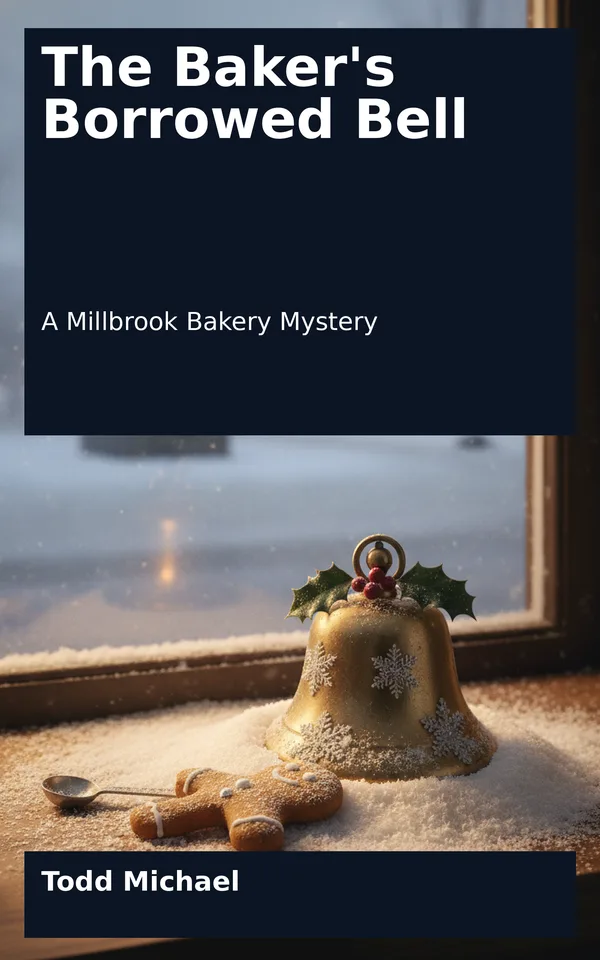
His companion pried off the crate’s lid. Nestled inside was a bronze bell, broad at the lip and darkened with age except where hands had polished its raised decorations. A spray of holly curled around one side. Above it, an inscription named the Millbrook Winter Festival, though the letters had softened enough that Nell had to lean closer to read them.
For the last several years, the bell had spent most of its time at the Millbrook Heritage Room, a modest museum housed above the library. It came out for the winter procession and the occasional school visit. This year, the museum’s heating system had chosen December as the ideal time to fail, and the festival committee had asked Nell whether she could give the bell a temporary home.
She had pictured something that would fit on a shelf beside the gingerbread village.
“This,” she said, “is larger than I remembered.”
“Most things are when they turn up in your bakery,” said a voice behind her.
Nell turned to find Ada Finch at the door, her cheeks pink from the cold and her knitted hat pulled down to her eyebrows. As committee secretary, Ada carried a notebook, three pens, and the expression of a woman perpetually on her way to solve somebody else’s problem. Today she also carried a long padded cover over one arm.
“It looked perfectly manageable in the museum,” Ada said.
“The museum doesn’t have to bake four dozen buns around it.”
Ada considered the crate. “You may need to make that five dozen. The school choir has added two more singers.”
“Do the singers eat more than the rest of us?”
“They’re twelve.”
“Five dozen, then.”
The deliverymen lifted the bell out together and set it on the low wooden stand the committee had supplied. It made a soft, substantial sound as it settled. The stand had a shallow rim to keep it from sliding, and a small brass plaque on the front explained its part in the festival.
Nell stepped back. Against the frosted window, the bell looked handsome and a little solemn, as if it had come to inspect the quality of her pastry.
Ada draped the padded cover over the stand. “That’s for when we move it again. It keeps the decorations from getting scratched.”
“Where does it go until then?”
“I thought perhaps underneath.” Ada crouched to tuck the folded cover on the lower shelf. “There. Out of sight.”
One of the deliverymen produced a length of red ribbon. Nell helped tie it around the stand while Ada adjusted the plaque until it faced precisely forward. The result was festive, provided nobody looked too closely at the flour Nell had missed beneath the window.
A bell above the door gave its own small jingle. A man entered, carrying a thermos and wearing a dark wool coat with snow melting on the shoulders. He was somewhere past middle age, with a neat gray mustache and the upright posture of someone accustomed to waiting for other people to arrive on time.
“Martin,” Ada said. “You found us.”
“I followed the crate.”
“This is Nell Rowan. Nell, Martin Hale has volunteered to stay with the bell tonight.”
Nell wiped her hand on her apron before offering it. “I’m grateful. I was beginning to think I’d have to take it home and put it at the foot of my bed.”
Martin shook her hand gravely. “It would make a poor hot-water bottle.”
His mouth twitched just enough to show he knew it.
He walked around the stand, looking at the bell without touching it. “It’s in good condition.”
“Were you expecting otherwise?” Nell asked.
“I’ve learned not to expect anything until I’ve had a look.”
Ada gave a small sigh. “Martin likes things accounted for.”
“An attractive quality in a guard,” Nell said.
“I’m not much of a guard,” Martin replied. “I’ve been told my responsibilities are to sit here, discourage anyone from…