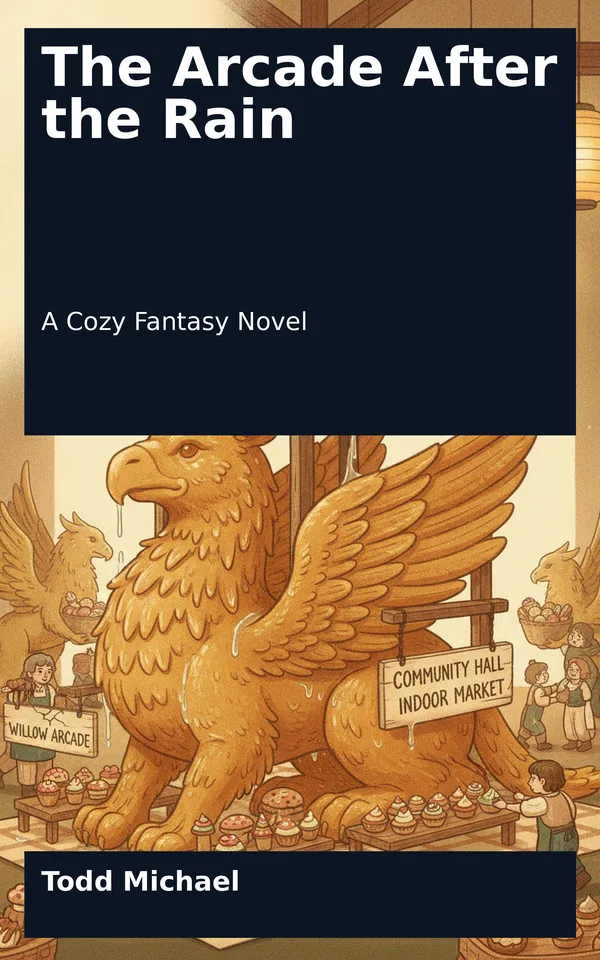
Read a sample: 1. Honey Cakes and Weather Signs
The first honey cake of the morning came out of Bram Featherstone’s oven with a small, determined hill in its middle.
Bram set the tin on the cooling rack and regarded it with one golden eye. The cake regarded nothing at all, being a cake, but it smelled of warm butter and orange peel and had risen handsomely enough to inspire confidence.
“An excellent start,” he told it.
He brushed the top with honey while it was still hot. The glaze sank into the crust, leaving a shine like late sunlight on a wooden table. Outside his shop, beyond the arched windows of Willow Arcade, the actual sunlight had apparently decided to spend the day elsewhere.
Clouds hung low over the street. They had the heavy, folded look of blankets brought in from a washing line just before a storm.
Bram turned back to his workbench. There were three more tins waiting, a bowl of batter flecked with orange zest, and a row of little paper flags he had cut the previous evening. Each flag was meant to stand in a cake, announcing HONEY AND ORANGE in his neatest lettering. The ink had bled slightly on the first attempt, making ORANGE look as though it had caught a chill. He had kept that one for his own breakfast.
The weekend market began tomorrow. Every autumn, when the weather turned and people began thinking seriously about soups and scarves and gifts that could be tucked away until winter, Willow Arcade filled from end to end. Customers came for their usual bread and ribbon and flowers, then stayed to meet friends, sample something unexpected, and argue pleasantly over whether it was too early for spiced biscuits.
For Bram, the weekend meant honey cakes. He made them throughout the year, but at market time he baked enough to cover his front table in shining rounds, small loaves, and bite-sized squares for tasting. The scent usually drew people halfway down the arcade before they remembered what they had come to buy.
He liked that part. He liked watching a person stop, sniff the air, and alter their plans.
He slid the next tins into the oven with a padded mitt over one foreclaw. His feathers were carefully tied back from his face with a blue cloth, though a stubborn tuft above his left ear had escaped. His wings, folded close against his sides, took up most of the space between the workbench and the shelves. The shop had been designed for a baker who needed less room to turn around, but Bram had learned its dimensions by heart.
A soft thump at the door announced Nessa before she appeared.
She came in backward, nudging the door with her hip and carrying a shallow wooden tray. Inside were six small notebooks, their covers wrapped in marbled paper the color of river stones. Nessa was a bookbinder, and she handled most things as though they might eventually be asked to hold a secret.
“I need a dry place for these for ten minutes,” she said.
Bram cleared a corner of the counter. “Has your shop become damp?”
“Not yet. Oren is outside it with a ladder, looking at the roof. I thought I’d save him the trouble of knocking my display over.”
She set the tray down and flexed her fingers. A thread of green silk clung to the cuff of her cardigan.
“Is something wrong with the roof?” Bram asked.
“He says he’s checking the gutters before the rain gets serious.” Nessa glanced toward the window. “He also said the gutters were perfectly capable of behaving themselves if they chose, which suggests he’s worried about them.”
Oren had been caretaker of the arcade for longer than Bram had been baking there. He spoke to hinges, pipes, and troublesome locks in the firm, disappointed tones of a man addressing relatives who should know better. Sometimes they improved.
Nessa lifted the corner of the cloth covering Bram’s cooling rack. “Is that the first?”
“It is.”
“Then you’ll want an impartial opinion.”
“You gave me an impartial opinion yesterday.”
“And I’ve had time to reconsider.”
Bram cut a narrow slice and handed it over. Nessa took a bite, closed her eyes, and made a sound that was not at all impartial.
“More orange this year?” she asked.
“A little.”
“Good. Last year the honey was very pleased with itself.”
“It had reason.”
“It did. But now it has company.”
She took another bite, then looked past him at the workbench. Three more bowls were stacked beneath it, and a sack of flour stood open beside the pantry door.
“How much are you making?”
“Enough.”
“Bram.”
He scraped batter from the side of the bowl. “I’ve made a list.”
“That wasn’t my question.”
He hesitated, which was answer enough. His list ran onto a second sheet, and he had scheduled tomorrow’s dough before dawn. He had also promised Mrs. Pell six extra loaves for the volunteer tea and told the candle maker he would fetch her order of wrapping twine on his way home.
Nessa’s eyes moved to the ink smudge on his foreleg. “You’ve written the times on yourself again.”
Bram turned his wrist. There, just above the feathers, was 3:30—rolls, written because he had been afraid of losing the list.
“It’s a convenient place for a reminder.”
“It’s a convenient place for a wrist.” She brushed crumbs…