Everyday Guidebooks
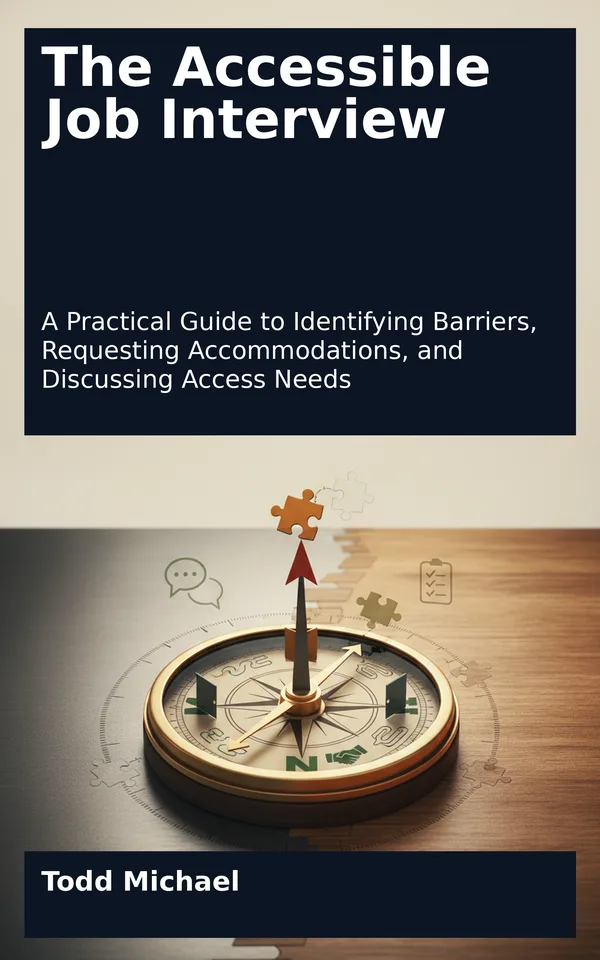
Cover of The Accessible Job Interview

Business, AI & Entrepreneurship

The Accessible Job Interview

A Practical Guide to Identifying Barriers, Requesting Accommodations, and Discussing Access Needs

by Todd Michael

Available now

An interview should give you a fair chance to show what you can do. But what if the schedule, location, technology, or assessment format creates a barrier before you can begin?

The Accessible Job Interview helps you recognize those barriers and plan a practical conversation with a prospective employer. Whether you are preparing for a job interview for beginners or returning to the hiring process after years away, you will find adaptable tools for asking questions, requesting accommodations, and following up with confidence.

Inside are sample emails and conversations for scheduling changes, accessible interview formats, skills assessments, and unexpected problems. You will also learn how to describe the support you need without making a diagnosis the focus, document agreed arrangements, and consider your next steps if a request is unclear or declined.

Prepare to discuss access in your own words—and keep the conversation focused on your ability to contribute.

Contents
  1. 1. A Fair Chance to Show Your Skills
  2. The interview is not the whole job
  3. Meet Maya
  4. Start with the activity
  5. Needs can be specific, uncertain, or changing
  6. You can ask without telling your whole story
  7. A first conversation, not a perfect performance
  8. Your personal preparation worksheet
  9. Move from preparation to participation
  10. 2. Map the Hiring Process
  11. Start With the Path You Can See
  12. The Application and Initial Contact
  13. The Screening Conversation
  14. The Hiring Manager Interview
  15. Panels, Groups, and Multiple Conversations
  16. Tests, Work Samples, and Presentations
  17. The On-Site Visit
  18. Final Conversations and Changing Plans
  19. Find the Right Source for Each Question
  20. A Worked Example: One Candidate’s Map
  21. Build Your Own Map
  22. 3. Identify Your Barriers and Useful Supports
  23. Look at the Activity, Not a Label
  24. Physical and Environmental Barriers
  25. Sensory Barriers
  26. Communication Barriers
  27. Cognitive and Processing Barriers
  28. Technological Barriers
  29. Scheduling and Stamina Barriers
  30. Build Your Prioritized List
  31. Choose What to Investigate First
  32. 4. Know the Basics Before You Ask
  33. 5. Decide What to Share and When
  34. 6. Write an Effective Accommodation Request
  35. Start With the Decision You Want Made
  36. The Four Parts of a Useful Request
  37. Choose a Subject Line That Helps
  38. An Initial Request After an Invitation
  39. When the Invitation Arrives at Short Notice
  40. Writing to a Recruiter or Hiring Contact

Read a sample: 1. A Fair Chance to Show Your Skills

You have prepared for the interview. You understand the role, have examples of your work, and can explain why the opportunity interests you. Then the invitation arrives, and a practical question interrupts your preparation: Will you be able to participate in the interview as arranged?

Perhaps the invitation describes a video call but says nothing about captions. Perhaps the office address is provided without information about the entrance. Perhaps an assessment is mentioned, but its format and duration are unclear. These details may seem minor to someone who has never had to plan around them. For you, they may determine whether you can hear the questions, enter the room, use the assessment platform, or stay focused long enough to demonstrate your skills.

An access barrier is a condition that makes it harder for someone to participate. It may arise from the environment, the schedule, the technology, the way information is presented, or a combination of factors. The same condition will not affect everyone in the same way. A busy reception area may be manageable for one person and a significant obstacle for another. A phone interview may be convenient for one applicant and inaccessible to someone who needs visual information to communicate.

An access-first approach starts with a different question from “How do I make myself fit this process?” It asks, “What conditions would let me take part and show what I can do?” That question does not guarantee a particular outcome. It gives you a practical starting point.

This book will help you identify what you need to know, decide what you want to request, and communicate with prospective employers. You do not need a perfect plan before you begin. You can work from what you know now, gather more information, and revise your approach as the hiring process unfolds.

More Business, AI & Entrepreneurship

Cover of AIAIAvailable nowCover of The New Gold RushThe New Gold RushAvailable nowCover of Leadership Intelligence for Succession PlanningLeadership Intelligence for Succession PlanningAvailable nowCover of Remote Jobs and the Scam TestRemote Jobs and the Scam TestAvailable nowCover of The Entrepreneur Mindset for Patient DecisionsThe Entrepreneur Mindset for Patient DecisionsAvailable nowCover of Price Without ApologyPrice Without ApologyAvailable now

About Todd Michael

Todd Michael is an American author and the founder of ToddMichael.tv. He writes practical, plain-English books on money, health, preparedness, technology, games, humor and more.

About the author Todd Michael · Todd Michael’s author site

Part of the ToddMichael.tv network.




