Everyday Guidebooks
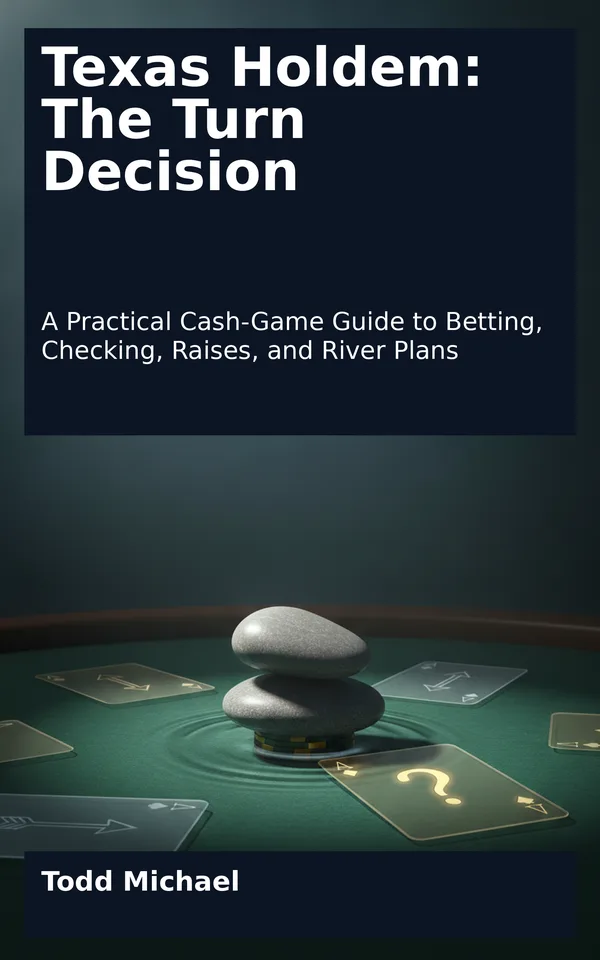
Cover of Texas Holdem

Poker & Game Strategy

Texas Holdem: The Turn Decision

A Practical Cash-Game Guide to Betting, Checking, Raises, and River Plans

by Todd Michael

Available now

The flop gave you a plan. Then the turn card changed everything.

In texas holdem cash games, the fourth community card can complete a draw, weaken a top pair, or create a valuable bluffing opportunity. Texas Holdem: The Turn Decision shows you how to reassess the situation before putting more chips into the pot.

Using realistic no-limit hold'em examples, Todd Michael walks you through betting for value, choosing bluffs, checking vulnerable hands, and responding when an opponent bets or raises. You'll learn to consider position, pot size, remaining stacks, board texture, and the hands each player can reasonably hold. Each decision connects to a practical river plan, so you can anticipate which cards and actions may change your next move.

Whether you play live or online, this focused guide gives you a repeatable way to think through one of poker's most consequential streets—without promising a shortcut to guaranteed wins.

Contents
  1. 1. Why the Turn Changes the Hand
  2. The Assumptions at the Table
  3. One Card, Several Changes
  4. A Repeatable Turn Decision
  5. A Complete Hand: Top Pair on a Changing Board
  6. The River Plan Changes With the River
  7. Build the Habit, Not a Script
  8. 2. From Flop Story to Turn Range
  9. 3. Reading the New Card
  10. 4. Pot Odds, Equity, and Stack Commitments
  11. 5. Betting for Value
  12. 6. Choosing Turn Bluffs
  13. 7. Bet Sizing With a Purpose
  14. 8. When Checking Is the Better Play
  15. 9. Facing a Turn Bet
  16. 10. Facing a Turn Raise
  17. 11. Playing the Turn in Position
  18. 12. Playing the Turn Out of Position
  19. 13. Opponent Tendencies and Multiway Pots
  20. 14. Turn Decisions Lab
  21. Other Books by Todd Michael

Read a sample: The Assumptions at the Table

The examples in this book use no-limit hold’em cash games. Chips represent money at the table, and a player may bet or raise up to the amount remaining in that player’s stack, subject to the rules of the game. Unlike a tournament, there is no increasing blind schedule or prize structure to consider in these hands. The decisions focus on the money currently at stake and the possible future betting within the hand.

Unless an example says otherwise, assume a typical nine-handed table, no ante or straddle, and a $1 small blind and $2 big blind. For clarity, the worked hands ignore rake and other possible house deductions. Real games may take money from pots, which can affect especially close decisions.

We will describe stack sizes in dollars and, where useful, in big blinds. At $1/$2, a $200 stack is 100 big blinds. The effective stack is the most either player can win from the other in a heads-up pot. If you have $300 and your opponent has $120, the effective stack is $120. You cannot win more than your opponent has available, and they cannot win more than that amount from you in the hand.

Examples necessarily give opponents plausible tendencies or ranges. These are working assumptions, not claims that every player at a given stake behaves the same way. A real opponent’s actions may contain surprises. Your job is to make the best decision available from the information you have, then revise your assumptions as you learn more.

More Poker & Game Strategy

Cover of The GTO PlaybookThe GTO PlaybookAvailable nowThe Safe KingComing soonCover of Texas Holdem PokerTexas Holdem PokerAvailable nowCover of Poker Tournament Play Without the GuessworkPoker Tournament Play Without the GuessworkAvailable nowCover of Poker Strategy GuidesPoker Strategy GuidesAvailable nowCover of Tournament PokerTournament PokerAvailable now

About Todd Michael

Todd Michael is an American author and the founder of ToddMichael.tv. He writes practical, plain-English books on money, health, preparedness, technology, games, humor and more.

About the author Todd Michael · Todd Michael’s author site

Part of the ToddMichael.tv network.