Everyday Guidebooks
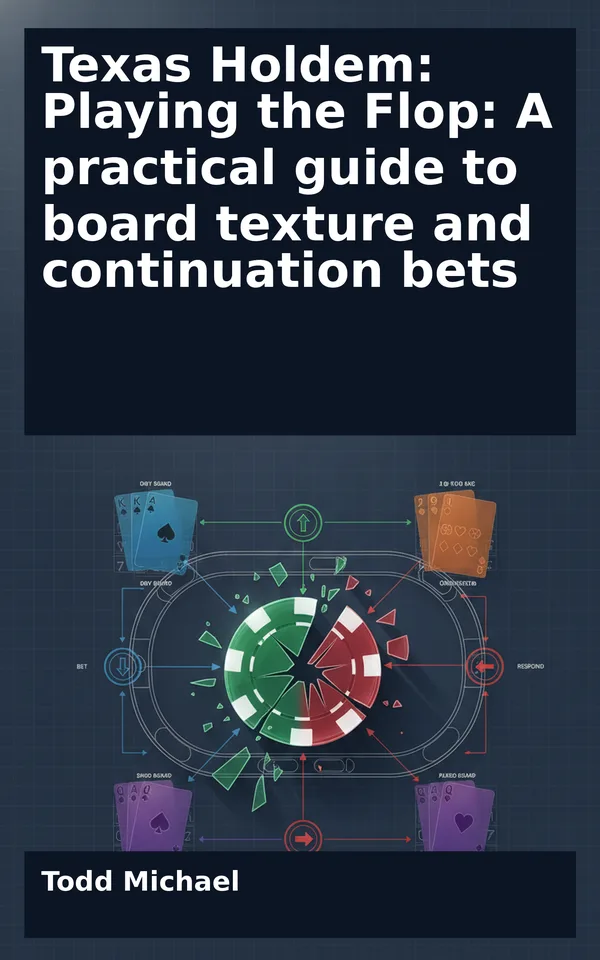
Cover of Texas Holdem

Poker & Game Strategy

Texas Holdem: Playing the Flop: A practical guide to board texture and continuation bets

by Todd Michael

Available now

A flop can look favorable to your hand and still favor your opponent's range. This practical texas holdem guide helps you look beyond your two cards and make more considered decisions when the first three community cards appear.

Learn how preflop action shapes plausible ranges, why position matters, and what makes dry, connected, and paired boards play differently. Clearly marked hypothetical hands walk through continuation bets, checks, and responses to opposing bets, including decisions with strong hands, draws, and marginal holdings. Simple review questions help you apply the same reasoning to hands you play yourself.

Written for players who know the basics, this book favors useful explanations over memorized rules or promises of winnings. It offers general information, not personal financial, legal, medical, or tax advice; consult a qualified professional when appropriate. Poker rules and applicable limits can change, so check current public sources before playing.

Contents
  1. 1. A Decision Framework for the Flop
  2. What a Range Really Means
  3. Begin With the Preflop Story
  4. Read the Board Before Reading Your Hand
  5. Advantage Is Relative
  6. What a Continuation Bet Tries to Accomplish
  7. A Repeatable Flop Process
  8. Hypothetical Hand: Pocket Jacks on an Ace-High Flop
  9. Decisions Are Not Results
  10. Scope and Responsible Play
  11. 2. Building Plausible Preflop Ranges
  12. Start With Position
  13. Opening Ranges: What the First Raise Tells You
  14. Calling an Open: A Different Selection of Hands
  15. Reraises: Narrow the Story, Not Your Attention
  16. Stack Depth and Tournament Context
  17. From Hand Categories to Combinations
  18. Weight Hands When the Action Is Mixed
  19. A Practical Range-Building Routine
  20. Take the Range to the Flop
  21. 3. Reading the Three Community Cards
  22. Begin With the Ranks
  23. Read the Suits
  24. Follow the Connections
  25. Immediate Draws and Backdoor Possibilities
  26. Paired Boards Change the Picture
  27. Texture Is Not Your Hand
  28. A Neutral-Description Checklist
  29. Practice: Classify Before You Act
  30. From Description to Range Analysis
  31. 4. Range Advantage and Strong-Hand Advantage
  32. 5. The Purpose of a Continuation Bet
  33. 6. Checking as a Deliberate Choice
  34. 7. Dry Boards: Fewer Immediate Draws
  35. 8. Connected Boards: Competing for Equity
  36. 9. Paired Boards: Trips, Full Houses, and Air
  37. 10. Facing a Flop Bet
  38. 11. Position, Stack Depth, and Pot Type
  39. 12. Adapting to Opponents Without Guessing
  40. 13. Worked Flop Decision Lab

Read a sample: What a Range Really Means

A range is the collection of hands a player could plausibly hold at a particular point in a hand. It is not a guess at one exact holding.

Suppose a player raises before the flop and another player calls. The raiser might have a strong pair, two high cards, a suited ace, or some other hand consistent with that player’s opening habits. The caller may have pairs, suited cards, and high-card hands, although the precise mix depends on position and the players involved.

Those descriptions are deliberately broad. A tight player’s opening range can differ from a loose player’s. A call from the big blind can represent a different selection of hands from a call made with several players still to act. The aim is not to memorize one range and impose it on every opponent. The aim is to make a reasonable starting assumption.

Ranges also change as a hand develops. When a player calls a flop bet, some hands become more plausible than they were before the call, while others may become less plausible. A player who raises a flop bet may represent a different mixture again. None of these actions proves an exact holding: a call can come from a strong hand, a draw, or a marginal made hand, depending on the player and situation.

Your own range matters too. An observant opponent is not responding only to the cards you actually hold. They are responding to the hands your actions could represent. If you raised before the flop, reached an ace-high board, and bet, your opponent may have to consider that you could hold an ace—even when your actual hand contains no ace.

Thinking in ranges does not mean treating every possible hand as equally likely. A hand can be possible without being common. As you gain experience, you can make finer distinctions about how often a player might arrive with a particular holding or choose a particular action. For now, separating plausible hands from merely imaginable ones is a valuable start.

More Poker & Game Strategy

Cover of The GTO PlaybookThe GTO PlaybookAvailable nowThe Safe KingComing soonCover of Texas Holdem PokerTexas Holdem PokerAvailable nowCover of Poker Tournament Play Without the GuessworkPoker Tournament Play Without the GuessworkAvailable nowCover of Poker Strategy GuidesPoker Strategy GuidesAvailable nowCover of Tournament PokerTournament PokerAvailable now

About Todd Michael

Todd Michael is an American author and the founder of ToddMichael.tv. He writes practical, plain-English books on money, health, preparedness, technology, games, humor and more.

About the author Todd Michael · Todd Michael’s author site

Part of the ToddMichael.tv network.