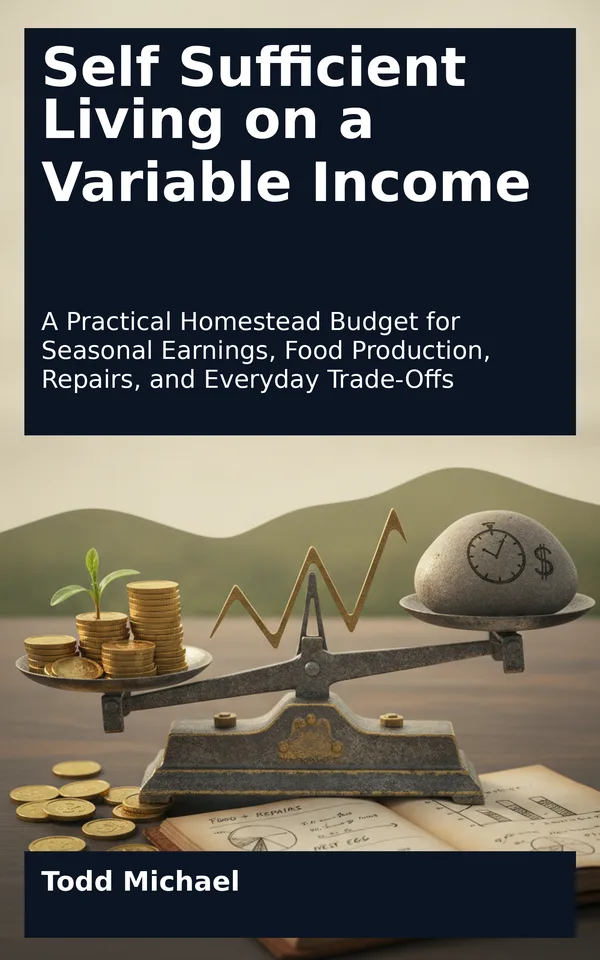
Read a sample: 1. A Homestead Budget That Bends
The garden is ready for plants, the truck needs tires, and a client has just postponed a payment. None of these events is unusual on its own. Together, they can make an otherwise ordinary week feel like a test of whether your household can keep its plans intact.
A homestead budget is not meant to prevent every uncomfortable choice. It is meant to help you see those choices early enough to make them deliberately. When income changes from month to month, a useful budget must do more than record what you spent. It must account for the distance between when money arrives and when it is needed, as well as the work required to turn that money into food, repairs, and a functioning home.
That calls for a plan that bends. You may plant fewer beds when work is scarce, postpone a fence when the well pump needs attention, or buy vegetables during a season when tending a larger garden would cost too much time. None of those choices means you have abandoned self-sufficiency. They may be exactly what keeps your household moving toward it.
Self-sufficiency is easy to imagine as a list: grow the food, raise the animals, repair the equipment, preserve the harvest, and buy as little as possible. A list like that can be inspiring, but it can also turn every purchase into a perceived failure and every unfinished project into a source of guilt.
A more useful definition begins with what your household wants to be able to do.
Perhaps you want to provide some fresh food, reduce your exposure to a fluctuating grocery bill, or know how to handle small repairs without waiting for help. Perhaps your priority is having enough savings to stay home with a sick child, buy heating fuel before winter, or turn down a poorly paid job. These are forms of resilience too, even if they do not look like rows of canning jars.
Consider self-sufficiency as a combination of resources:
- Money gives you choices when supplies, repairs, or outside help are needed.
- Skills allow you to complete useful work and judge when a task exceeds your ability.
- Food and materials can reduce dependence on a last-minute purchase.
- Time and energy make it possible to use those resources.
- Relationships connect you with people who have knowledge, equipment, goods, or services you do not.
The balance will differ from one household to another. A renter with a sunny porch may focus on herbs, savings, and a well-stocked pantry. A family with acreage may devote more attention to fencing and equipment. Someone working long seasonal shifts may value low-maintenance perennials and reliable neighbors more than a large annual garden.
You do not need to reject the market to make practical use of it. Buying flour, hiring an electrician, borrowing a trailer, or paying a mechanic can protect resources you would otherwise spend elsewhere. The goal is not to eliminate dependence; it is to understand it and make it more manageable.
A helpful question is: What would make our household less vulnerable during a difficult month? The answer might be a productive garden. It might also be a smaller debt payment, dependable transportation, or enough cash to buy groceries without using a credit card. Start with the answer that matters to your household, not the one that makes the most impressive picture.
A regular monthly paycheck makes budgeting simpler because the timing of income is relatively predictable. Seasonal work, freelance projects, variable shifts, contract payments, and sales from a small enterprise may bring in an adequate amount over a year while leaving particular months painfully short.
Imagine a household that earns more during the growing and tourist seasons and less in winter. On paper, the year may appear workable: the stronger months bring in enough to cover many of the weaker ones. In practice, the household can still run short if summer earnings are spent before winter bills arrive.
The reverse problem happens too. Spring may require seeds, soil amendments, fuel, or equipment repairs before seasonal work pays its first invoice. A household can be busy preparing to earn money and produce food while cash is moving out faster than it comes in.
This is a timing problem, but timing is only part of it. Variable income can be uncertain in amount as well as arrival date. A promised project may be reduced. Weather can interrupt outdoor work. A customer may pay later than expected. Hours can disappear just when a household expense increases.
A flexible budget makes room for these possibilities without assuming the worst will always happen. It separates money already received from money that is merely expected. It gives strong-month earnings jobs that may not come due until much later. And it treats upcoming costs as real even when no bill has arrived yet.
That does not mean you need enough cash today to solve every future problem. It means you begin naming those problems and deciding which deserve attention first. The income calendar in the next chapter will help you look at the year as a whole rather than judging your finances by the balance in one good or bad month.
Income is not the only thing that moves in cycles. Homestead expenses and labor often gather in particular seasons.
Spring may bring planting supplies, repairs to tools, and long days of preparation. Summer can…