Everyday Guidebooks
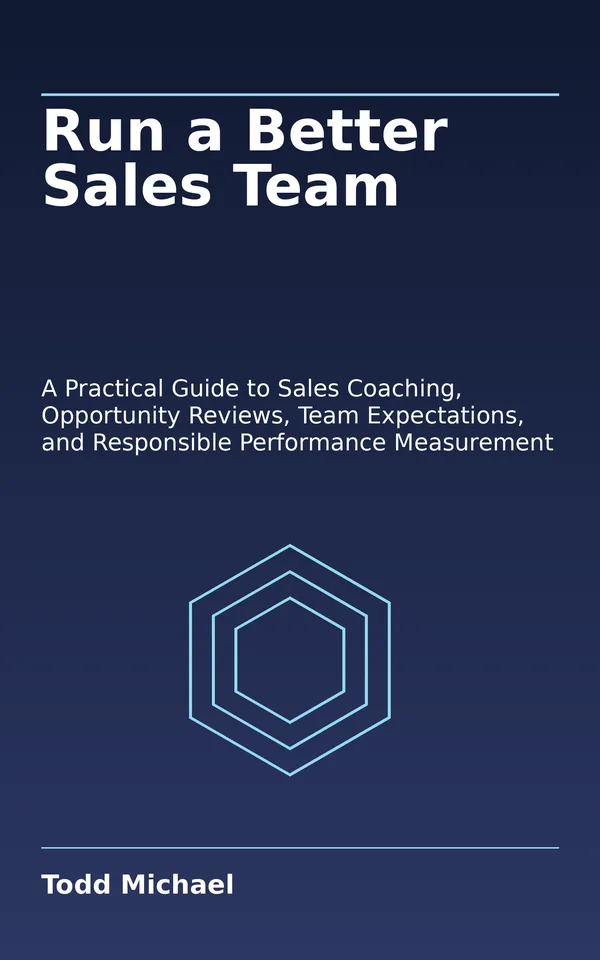
Cover of Run a Better Sales Team

Business, AI & Entrepreneurship

Run a Better Sales Team

A Practical Guide to Sales Coaching, Opportunity Reviews, Team Expectations, and Responsible Performance Measurement

by Todd Michael

Available now

A strong sales team needs more than targets and pipeline meetings. It needs a manager who can make expectations clear, spot problems early, and help representatives improve without taking over their deals.

Run a Better Sales Team gives new managers a practical approach to sales leadership, from establishing team standards to coaching an individual through a difficult opportunity. You’ll learn how to run focused reviews, ask better questions, choose useful measures, and respond when performance falls short. Realistic examples and adaptable conversation guides show how to hold people accountable while giving them the support and feedback they need to grow.

Whether you have just moved into management or are looking for a more consistent way to lead, this book will help you build a team rhythm that respects customers, develops skills, and keeps attention on the work that matters.

Contents
  1. 1. The Sales Manager’s New Job
  2. Your Results Now Depend on Other People’s Work
  3. The Rescue Habit
  4. A Better Conversation Before the Customer Call
  5. Accountability Is More Than Asking for a Number
  6. What Only You Can Do
  7. Assess Where Your Attention Will Help Most
  8. Make the Shift Visible
  9. 2. Set Expectations People Can Use
  10. 3. Build a Rhythm for the Work
  11. 4. See the Pipeline Clearly
  12. 5. Run an Opportunity Review
  13. Choose the Right Opportunities
  14. Begin With the Buyer’s Situation
  15. Map the People and the Decision
  16. Examine Risk Without Demanding Certainty
  17. Challenge the Assumption, Not the Representative
  18. A Worked Review: The Proposal That May Be Early
  19. Finish With a Buyer-Supported Next Step
  20. Keep Ownership Where It Belongs
  21. 6. Coach Instead of Rescue
  22. 7. Make One-on-Ones Count
  23. 8. Develop Skills Through Practice
  24. 9. Choose Measures That Inform
  25. 10. Read Performance in Context
  26. Start With the Result, Not the Story
  27. Look at the Territory You Assigned
  28. Examine the Mix Behind the Total
  29. Account for Experience Without Lowering the Standard
  30. Notice When the Market Has Changed
  31. A Comparison Exercise: Same Numbers, Different Questions
  32. Separate What the Representative Can Influence From What the Organization Must Address
  33. Compare Fairly, Even When Perfect Comparison Is Impossible
  34. End With a Better Question
  35. 11. Give Feedback That Leads to Action
  36. 12. Address Performance Gaps Fairly
  37. 13. Lead the Team Without Gaming the Numbers
  38. Pressure Changes What People Report
  39. Recognize the Common Forms of Gaming
  40. Make Forecasts a Record of Judgment, Not a Test of Loyalty

Read a sample: 1. The Sales Manager’s New Job

On Monday morning, Maya opens her calendar and sees a customer meeting she did not expect to attend. One of her representatives, Daniel, has forwarded an invitation with a short message: “They’re pushing back on price. Can you join and help me close this?”

A month earlier, Maya would have known what to do. She was a strong individual seller. She would have reviewed the proposal, prepared for objections, and taken control of the conversation if it began to drift. Now she manages the team, and Daniel owns the opportunity.

The easy answer is to join the call and handle the objection herself. The difficult question is what that would accomplish beyond this deal. Daniel might get the customer’s agreement, but he might also learn that the way to deal with resistance is to bring in Maya. If she repeats that pattern across the team, her calendar will fill with customer meetings while the representatives become increasingly dependent on her.

The opposite response is not necessarily better. Refusing to help could leave Daniel exposed in an important conversation, particularly if the customer’s concern involves a commitment only Maya can authorize. The job is not to stay out of deals at all costs. It is to decide how to help in a way that protects the customer relationship, supports the opportunity, and develops the person who owns it.

That decision captures the shift from selling to managing. As an individual contributor, you were responsible for producing results through your own work. As a manager, you remain accountable for commercial results, but much of your impact comes through the conditions you create for other people to do their work well.

This chapter will help you identify those conditions, recognize the habits that may no longer serve you, and choose where to focus your attention.

More Business, AI & Entrepreneurship

Cover of AIAIAvailable nowCover of The New Gold RushThe New Gold RushAvailable nowCover of Leadership Intelligence for Succession PlanningLeadership Intelligence for Succession PlanningAvailable nowCover of Remote Jobs and the Scam TestRemote Jobs and the Scam TestAvailable nowCover of The Entrepreneur Mindset for Patient DecisionsThe Entrepreneur Mindset for Patient DecisionsAvailable nowCover of Price Without ApologyPrice Without ApologyAvailable now

About Todd Michael

Todd Michael is an American author and the founder of ToddMichael.tv. He writes practical, plain-English books on money, health, preparedness, technology, games, humor and more.

About the author Todd Michael · Todd Michael’s author site

Part of the ToddMichael.tv network.




