Everyday Guidebooks
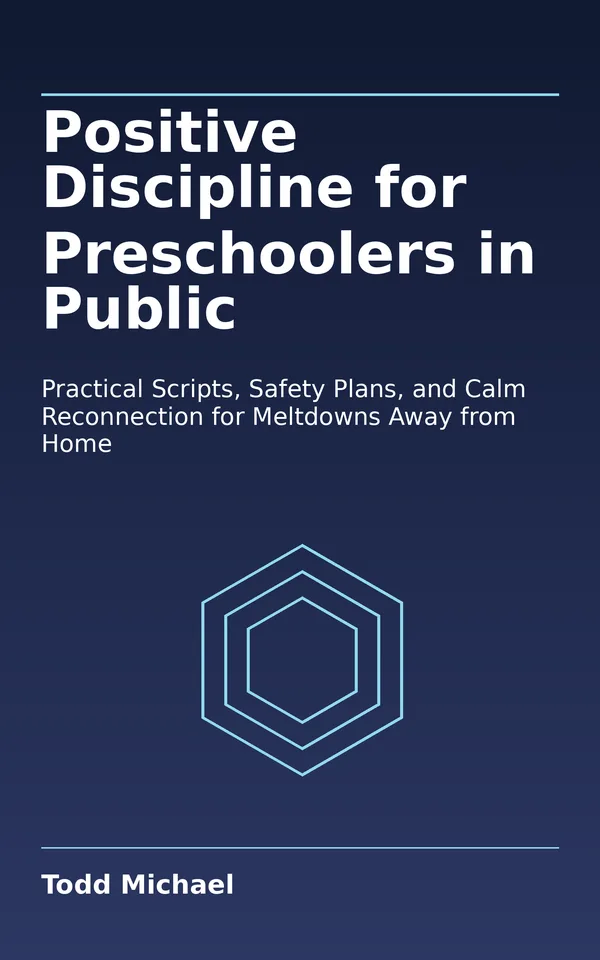
Cover of Positive Discipline for Preschoolers in Public

Self-Help & Relationships

Positive Discipline for Preschoolers in Public

Practical Scripts, Safety Plans, and Calm Reconnection for Meltdowns Away from Home

by Todd Michael

Available now

The groceries are half paid for, your preschooler is on the floor, and strangers are watching. What now?

This practical guide to positive discipline for preschoolers helps you face public meltdowns without relying on shame, threats, or perfect parenting. You’ll learn how to set realistic expectations before an outing, notice early signs of overwhelm, and make a simple exit plan you can actually use. In the moment, short scripts help you set limits, respond to bystanders, and keep your child and others safe. Afterward, you’ll find ways to reconnect, repair, and prepare for next time.

From crowded stores and restaurants to appointments and family gatherings, these adaptable strategies make room for different temperaments, sensory needs, and family circumstances. You cannot prevent every difficult moment—but you can meet it with a plan and help your child learn along the way.

Contents
  1. 1. Why Public Outings Are Hard
  2. A Small Person in a Very Demanding World
  3. What an Outing Asks of Your Child
  4. The Pressure on the Adult Is Real, Too
  5. Distress, Disappointment, and Defiance
  6. Why Reasoning Can Stop Working
  7. Expectations That Fit the Child in Front of You
  8. A Different Way to Measure Progress
  9. From Understanding to a Plan
  10. 2. Make a Plan Before You Go
  11. 3. Practice Skills at Home
  12. Teach One Small Piece at a Time
  13. Waiting: Make the Invisible Time Visible
  14. Staying Close: Practice the Action You Want
  15. Transitions: Practice Ending and Beginning
  16. Asking for Help: Give Your Child a Usable Signal
  17. Let Play Be Play
  18. Notice Effort Without Making It a Performance
  19. Carry One Skill Into the Next Outing
  20. 4. Spot the Early Signs
  21. 5. Set Limits That Make Sense
  22. Start With a Limit You Can Explain
  23. Say It Simply, Then Make Room
  24. Choices That Are Truly Available
  25. When the Answer Is No to a Treat
  26. When a Toy Must Stay Behind
  27. Limits Around Waiting
  28. When It Is Time to Leave
  29. When Your Child Challenges the Limit
  30. 6. When a Meltdown Begins
  31. 7. Safety Comes First
  32. 8. Know When and How to Leave
  33. 9. Handle the Audience
  34. 10. Stores, Restaurants, and Waiting Rooms
  35. 11. Travel, Gatherings, and Special Events
  36. 12. Reconnect and Repair
  37. 13. Adapt the Plan to Your Child and Family
  38. 14. Build Your Family's Outing Playbook
  39. Other Books by Todd Michael

Read a sample: 1. Why Public Outings Are Hard

You have three things on your list. Your preschooler has a different list: push the cart, touch the shiny apples, ask for crackers, and investigate the mysterious noise near the freezer. For the first few minutes, everyone is managing. Then the cart is too hard to steer, the crackers are not the right crackers, and the checkout line is longer than either of you expected.

Your child drops to the floor and cries. Someone looks over. You feel heat rise in your face as you calculate whether you can finish paying, where to put the basket, and how to get everyone safely to the car.

In that moment, it is easy to believe that something has gone terribly wrong. Perhaps you think your child should know better, or that other parents have discovered a secret you missed. Perhaps you are already rehearsing an apology to the cashier.

Pause, if you can. A difficult outing does not mean you are failing, and a preschooler’s public distress does not automatically mean the child is spoiled or deliberately making life difficult. An ordinary errand asks a young child to do a surprising amount: manage impulses, tolerate disappointment, understand changing instructions, wait without knowing exactly how long, and stay close to an adult while interesting things happen everywhere.

Those skills are developing, not finished. Your child needs opportunities to practice them, along with an adult who can provide guidance when the demands exceed what they can manage.

This does not mean every behavior is acceptable or that your family must avoid stores and restaurants until your child is older. It means that the most useful question is often not “How do I make this child behave?” but “What is making this moment hard, and what support and limits are needed now?”

More Self-Help & Relationships

Cover of The Clarity BlueprintThe Clarity BlueprintAvailable nowCover of The Relationship BlueprintThe Relationship BlueprintAvailable nowCover of How a Family Caregiver Can Get PaidHow a Family Caregiver Can Get PaidAvailable nowCover of Toddler ParentingToddler ParentingAvailable nowCover of Make Room for ConfidenceMake Room for ConfidenceAvailable nowCover of Habits of Grace for Family EstrangementHabits of Grace for Family EstrangementAvailable now

About Todd Michael

Todd Michael is an American author and the founder of ToddMichael.tv. He writes practical, plain-English books on money, health, preparedness, technology, games, humor and more.

About the author Todd Michael · Todd Michael’s author site

Part of the ToddMichael.tv network.





