Everyday Guidebooks
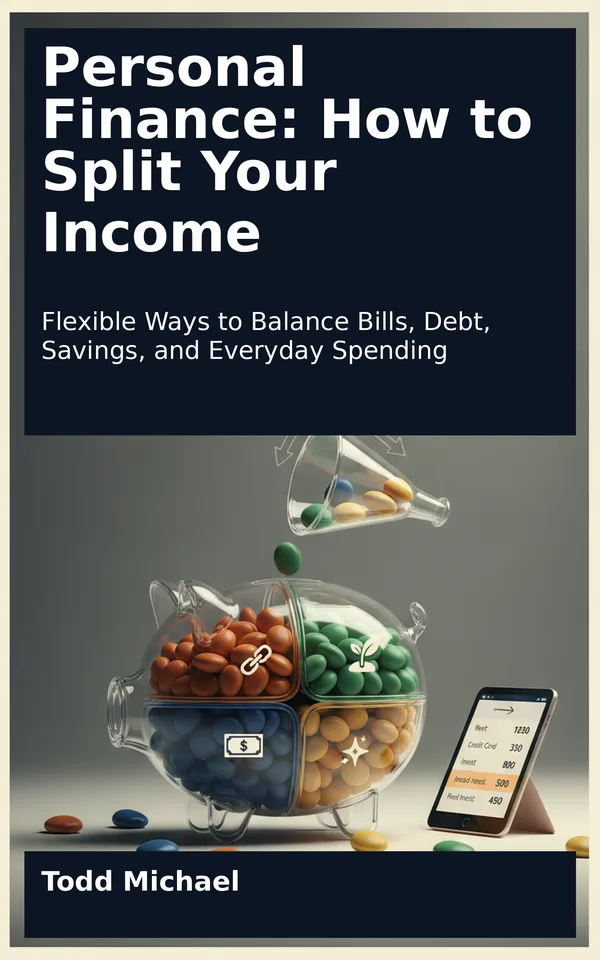
Cover of Personal Finance

Money, Investing & Precious Metals

Personal Finance: How to Split Your Income

Flexible Ways to Balance Bills, Debt, Savings, and Everyday Spending

by Todd Michael

Available now

If you've searched for personal finance how to split your income, you've probably found plenty of percentages—and wondered what to do when they don't fit your life.

This guide starts with the money that actually reaches your account and helps you give it practical jobs. You'll compare several flexible ways to divide your pay among bills, debt, savings, and spending you enjoy. Then you'll see how to adjust those divisions when rent takes a large share, an annual expense is approaching, or a new priority changes the picture.

Step-by-step examples, simple calculations, and reusable checklists help you build a plan without pretending every month is predictable. You'll learn how to handle minimum debt payments, save for irregular costs, review your progress, and make trade-offs when there isn't enough to fund everything at once.

There is no perfect split. There is a workable next step.

Contents
  1. 1. Start With the Money You Take Home
  2. Gross Pay Is Not Your Spending Plan
  3. Find the Amount That Reaches You
  4. Pay Periods and Months Are Different Containers
  5. Timing Matters as Much as the Total
  6. Include More Than One Paycheck Carefully
  7. Treat Uncertain Income as a Possibility, Not a Promise
  8. When You Invoice for Your Work
  9. Make a Starting Income Record
  10. 2. Map Where Your Money Goes
  11. 3. Protect the Essential Bills
  12. 4. Three Ways to Divide Your Income
  13. One Income, Three Views
  14. Method One: Flexible Percentage Ranges
  15. Method Two: A Priority-First Sequence
  16. Method Three: Paycheck-by-Paycheck Assignment
  17. Choosing the View That Helps You Act
  18. 5. Build Your First Paycheck Plan
  19. 6. Make Room for Debt Payments
  20. 7. Give Savings a Specific Job
  21. 8. Plan for the Bills That Do Not Arrive Monthly
  22. 9. Keep Discretionary Spending in the Plan
  23. Make the Allowance Part of the Whole
  24. Preferences Versus Habits
  25. Choose a Starting Amount
  26. Test a Weekly Limit
  27. Test a Per-Paycheck Limit
  28. Give the Allowance a Clear Scope
  29. When You Spend More Than Planned
  30. Let Unspent Money Have a Job
  31. Adjust Without Starting Over
  32. 10. When Housing Takes a Large Share
  33. 11. When the Numbers Do Not Fit
  34. 12. Adjust for Uneven Income and Changing Pay
  35. 13. Rebalance When Priorities Change
  36. 14. Make Your Split Sustainable
  37. Other Books by Todd Michael

Read a sample: Gross Pay Is Not Your Spending Plan

If you are an employee, your gross pay is the amount you earn before payroll deductions. Your take-home pay, often called net pay, is the amount deposited into your account or provided to you after those deductions.

A pay statement may show deductions for income taxes, retirement contributions, health coverage, or other items. The exact deductions vary by employer and circumstance. For a household spending plan, the most useful starting point is generally the net amount you actually receive.

Suppose a hypothetical employee earns $4,000 in gross pay in a month. After $700 in payroll deductions, the employee receives $3,300. The household has $3,300 from those paychecks to assign to current bills, debt payments, savings, and spending—not $4,000.

That distinction does not mean the $700 has vanished without purpose. Some of it may pay for benefits or fund a retirement account. It simply is not part of the deposit available for the household to divide again. Counting a payroll retirement contribution as both a deduction and money available in checking would make the plan look larger than it is.

Your net pay can also change. A benefit election may alter a deduction, hours may vary, or withholding may be adjusted. If your recent deposits differ, do not assume an old paycheck represents what you receive now. Review several recent pay statements or deposits and identify the amount you can reasonably expect to use.

More Money, Investing & Precious Metals

Cover of The Practical Gold BookThe Practical Gold BookAvailable nowCover of The Practical Gold Book, Volume 2The Practical Gold Book, Volume 2Available nowCover of The Practical Silver BookThe Practical Silver BookAvailable nowCover of The Practical Crypto BookThe Practical Crypto BookAvailable nowCover of Shielding Your WealthShielding Your WealthAvailable nowCover of Personal Finance AdvancedPersonal Finance AdvancedAvailable now

About Todd Michael

Todd Michael is an American author and the founder of ToddMichael.tv. He writes practical, plain-English books on money, health, preparedness, technology, games, humor and more.

About the author Todd Michael · Todd Michael’s author site

Part of the ToddMichael.tv network.





