Everyday Guidebooks
Cover of Personal Finance

Money, Investing & Precious Metals

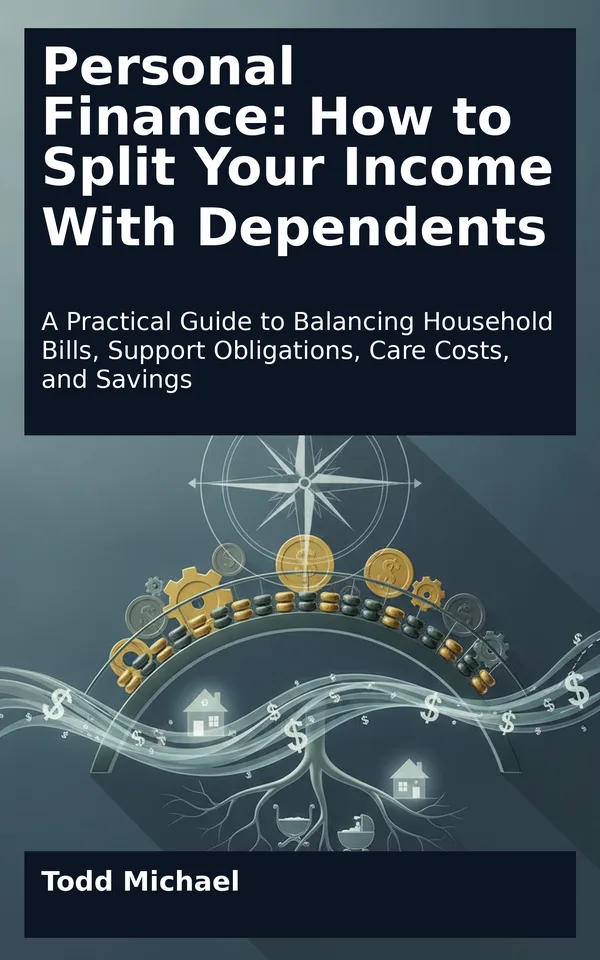
Personal Finance: How to Split Your Income With Dependents

A Practical Guide to Balancing Household Bills, Support Obligations, Care Costs, and Savings

by Todd Michael

Available now

When several people depend on your income, a generic budget percentage rarely tells the whole story. You need a plan that accounts for the bills at home, support obligations, care costs, and the unexpected—without losing sight of your own financial stability.

Personal Finance: How to Split Your Income With Dependents walks you through organizing take-home pay, documenting court-ordered payments, estimating dependent care expenses, and deciding what to fund when priorities compete. Practical examples show how to adjust when income changes, a child’s needs shift, or an aging relative requires more help. Worksheets and paycheck-by-paycheck exercises help you turn the guidance into a plan you can revisit.

If you’ve searched for “personal finance how to split your income,” this book offers a starting point tailored to households with dependents. It also explains when to seek qualified legal or benefits advice rather than relying on a budgeting shortcut.

Contents
  1. 1. Your Income Has More Than One Job
  2. Start With People, Not Percentages
  3. Draw the Boundaries of Your Financial Household
  4. Household Spending and Direct Support
  5. Sort Obligations by What Makes Them Matter
  6. Recognize Costs That Move
  7. Give Your Own Needs a Place
  8. Set Goals That Fit the Actual Starting Point
  9. A First-Page Worksheet
  10. When the List Is Bigger Than the Income
  11. 2. Find Your Usable Income
  12. 3. Map the Essentials at Home
  13. 4. Account for Court-Ordered Support
  14. 5. Calculate the Cost of Care
  15. 6. Build a Paycheck-by-Paycheck Plan
  16. Start With the Money You Can Assign
  17. Put Dates Beside the Amounts
  18. Assign Each Deposit Before It Arrives
  19. A Hypothetical Paycheck Plan
  20. When the Calendar Shows a Gap
  21. Use a Reusable Paycheck Worksheet
  22. Check the Plan Against Real Life
  23. 7. Decide What to Fund When Money Is Tight
  24. 8. Plan for Expenses That Do Not Arrive Monthly
  25. 9. Protect a Place for Savings
  26. 10. Understand Benefits and Available Help
  27. 11. Manage Debt Without Losing the Plan
  28. 12. Adjust When Income or Obligations Change
  29. 13. Coordinate Money Conversations and Records
  30. 14. Put Your Plan Into Practice
  31. Other Books by Todd Michael

Read a sample: 1. Your Income Has More Than One Job

A paycheck may arrive as one number, but it rarely has just one purpose. It may need to keep a roof over your household, pay support for a child who lives elsewhere, cover an older parent’s transportation, and leave something for the unexpected. Even a person who manages money carefully can feel stretched when several people’s needs depend on the same income.

That pressure is not proof that you have failed at budgeting. Sometimes the commitments are genuinely larger than the money available. Sometimes the amounts might work over a month, but the due dates do not line up with payday. And sometimes the difficulty is that important expenses have never been gathered in one place.

This book starts with a broader view of what your money is being asked to do. Before you decide how much to assign to a category, you need to know whom you support, what that support looks like, and which commitments require attention. The goal is not to judge your family or produce a perfect budget on the first try. It is to make your responsibilities visible enough that you can make informed choices.

Your household may not fit a tidy definition. A child might divide time between homes. A relative might live independently but rely on you for groceries. You may pay support through payroll withholding and also buy supplies when your child visits. Someone may help you with rent but depend on you for transportation. These arrangements are real financial relationships, whether or not they fit neatly on a form.

For the purposes of this book, a dependent is someone who relies on your resources or care. That practical description is not a determination of who qualifies as a dependent for taxes, benefits, insurance, or a legal proceeding. Those systems can use different rules. If a decision depends on a formal definition, verify the applicable requirements with the relevant agency or a qualified professional.

More Money, Investing & Precious Metals

Cover of The Practical Gold BookThe Practical Gold BookAvailable nowCover of The Practical Gold Book, Volume 2The Practical Gold Book, Volume 2Available nowCover of The Practical Silver BookThe Practical Silver BookAvailable nowCover of The Practical Crypto BookThe Practical Crypto BookAvailable nowCover of Shielding Your WealthShielding Your WealthAvailable nowCover of Personal Finance AdvancedPersonal Finance AdvancedAvailable now

About Todd Michael

Todd Michael is an American author and the founder of ToddMichael.tv. He writes practical, plain-English books on money, health, preparedness, technology, games, humor and more.

About the author Todd Michael · Todd Michael’s author site

Part of the ToddMichael.tv network.