Read a sample: 1. See the Whole Freelance Money Picture
A client pays an invoice, and for a moment your bank balance looks encouraging. Then you remember the software subscription due next week, the tax payment you have been meaning to plan for, and the rent waiting at home. The payment is real money, but it already has several jobs.
That is the central challenge of freelance finance. You are not simply deciding how to spend what you earn. You are deciding how cash moves through a business, how much needs to stay there, and how much can support your household. Those decisions can be difficult when payments arrive at different times and every dollar seems spoken for.
If your finances feel tangled, that does not mean you are bad with money. A freelancer often has to do work that an employer’s payroll and accounting systems would otherwise handle: anticipate income, track business costs, prepare for taxes, and decide when to get paid. The goal of this book is to make those jobs visible and manageable.
You do not need a perfect budget before you begin. You need a useful picture of where you are today and a simple way to update it as you learn more.
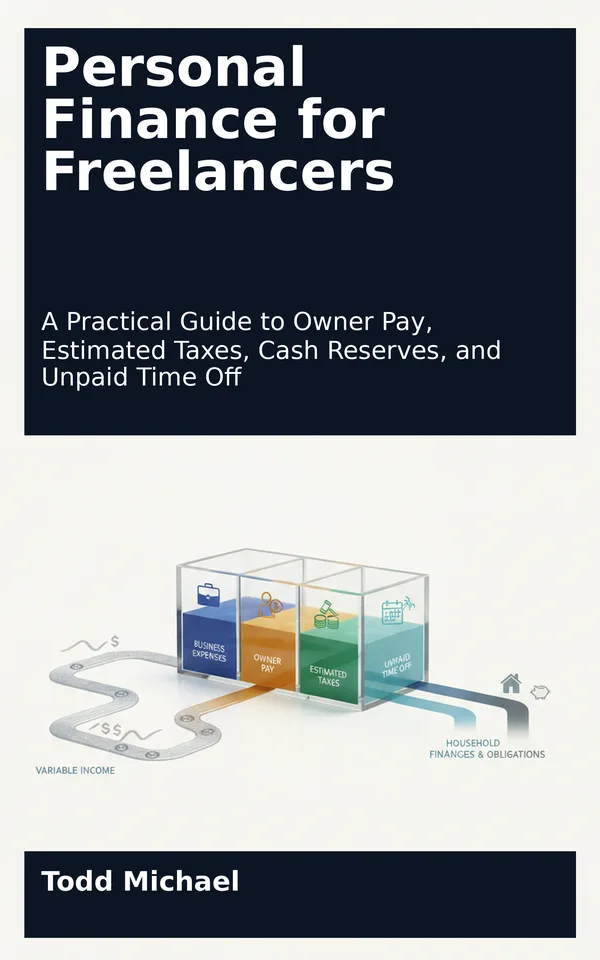
When a client pays you, the money may pass through several stages before it becomes household spending money:
1. Client payment arrives. This is cash you have received, not merely an invoice you have sent.
2. The business keeps enough for its obligations. These may include bills, tools, contractors, debt payments, and other costs of doing the work.
3. You prepare for taxes. Depending on your circumstances, you may need to set aside money for federal, state, or local taxes.
4. You consider reserves and upcoming gaps. Some cash may need to remain available for delayed payments, irregular expenses, or planned time away.
5. You pay yourself. Money moves from the business side of your finances to the household side.
6. Your household uses that money. It supports essentials, flexible spending, savings, and personal obligations.
This is a map, not a rigid order in which every dollar must be assigned the instant it arrives. A bill may be due tomorrow while an owner-pay transfer is needed today. A tax set-aside may grow with each payment, while a reserve grows more gradually. The point is to recognize the competing claims before treating the entire client payment as available to spend.
Consider a hypothetical freelance designer named Maya. A client pays her $4,000. Over the coming weeks, she expects $600 in business expenses and decides to earmark $900 toward taxes based on an estimate she is using for planning. She also wants to keep $500 available for an upcoming business bill. That leaves $2,000 from this payment for owner pay:
- Client payment received: $4,000
- Expected business expenses: $600
- Tax set-aside: $900
- Cash held for an upcoming business bill: $500
- Remaining for owner pay: $2,000
The arithmetic is straightforward: $4,000 minus $600, $900, and $500 equals $2,000. But Maya’s actual decision would also depend on what was already in her accounts, what else was due, and when her next payment was likely to arrive. The $900 is an illustrative planning amount, not a recommendation or a calculation of her tax liability.
The example shows why a client payment and a paycheck are not the same thing. Maya may have earned the payment through her work, but some of the cash must remain available for obligations connected to that work. The amount she can responsibly transfer is a separate decision.
Freelancers often describe a good month by the amount they invoiced. That number can be useful, but it does not tell the whole cash story.
Suppose, in another hypothetical month, Maya completes $5,000 of work and sends the invoice on the last day of the month. If the client has not paid yet, she may have earned that income under her agreement, but she cannot use the unpaid invoice to cover a bill due tomorrow. Until cash arrives, the invoice is an expected collection—not money in the bank.
The reverse can also happen. Maya may receive payment this month for work she completed earlier. Her bank balance rises now, even though the work was done in a prior period. Neither view is wrong; each answers a different question.
- Work earned or invoiced helps you understand the business you are generating.
- Cash received tells you what has actually arrived.
- Cash available after obligations helps you decide what can be transferred or spent.
These distinctions matter most when timing is tight. An expected payment can be late. A project can pause. A client can ask for a correction before processing an invoice. Your plan does not need to assume the worst, but it should make room for the fact that expected cash and available cash are different things.
Later, you will build an incoming-cash calendar and a short-term forecast. For now, simply notice whether you tend to make decisions based on invoices sent, money received, or the balance visible in your account. That habit is part of your starting picture.
Many freelancers begin with money flowing through one account. A client pays in, a grocery purchase goes out, and a business subscription appears somewhere in between. If that is your situation, there is no need to stop and reconstruct your entire financial history today.
The immediate task is to distinguish the…