Everyday Guidebooks
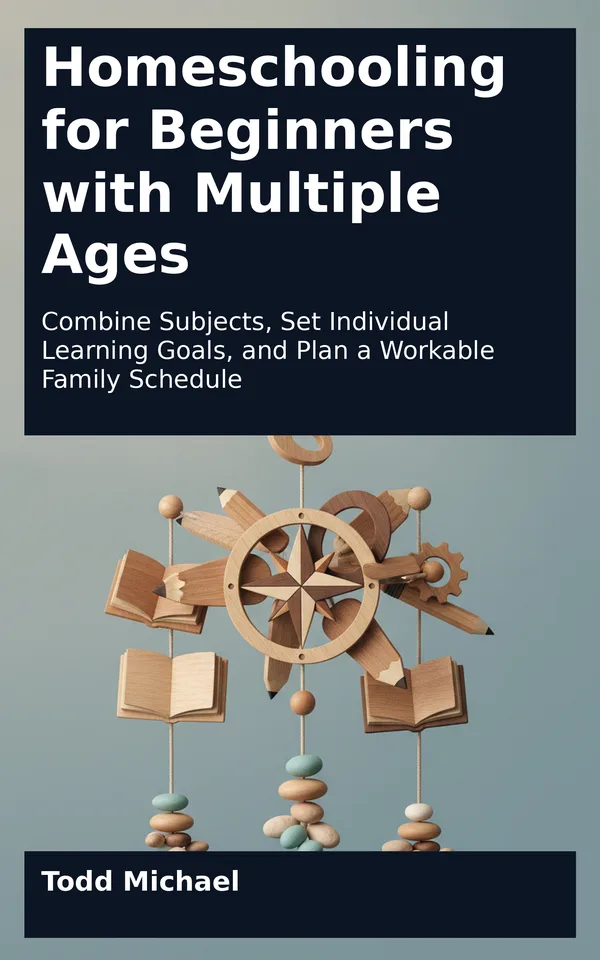
Cover of Homeschooling for Beginners with Multiple Ages

Home & Lifestyle

Homeschooling for Beginners with Multiple Ages

Combine Subjects, Set Individual Learning Goals, and Plan a Workable Family Schedule

by Todd Michael

Available now

Teaching children of different ages at home does not mean you need a separate lesson plan for every child and every subject. With a clear plan for shared learning and individual practice, you can make room for each learner without spending the entire day juggling textbooks.

Created for parents searching for homeschooling for beginners, this guide helps you decide which subjects to combine and how to set appropriate expectations for reading, writing, and math. You will learn to shape one shared lesson into activities for different ages, organize materials, and give each child the attention they need.

Sample daily schedules show how to alternate direct teaching with independent work, including options for families with young children or limited teaching time. Planning examples, observation prompts, and troubleshooting strategies help you adjust when a routine is not working.

Start with a workable plan, then adapt it as your family learns and grows.

Contents
  1. 1. A Family Classroom, Not Several Classrooms
  2. One Household, Several Learners
  3. What Learning Together Can Look Like
  4. What Needs Individual Attention
  5. A Different Kind of School Day
  6. What Beginners Can Reasonably Expect
  7. The Decisions Behind Your First Plan
  8. From a Daily List to a Family Rhythm
  9. Begin with the Family You Have
  10. 2. Know Your Learners and Your Constraints
  11. 3. Choose What to Teach Together
  12. 4. Turn One Topic into Several Learning Paths
  13. A Sample Unit: Where Does Rainwater Go?
  14. 5. Reading: Individual Goals, Shared Stories
  15. 6. Writing: Different Expectations, One Rich Topic
  16. 7. Math: Protecting Time for Individual Instruction
  17. 8. Build Independent Work Gradually
  18. 9. Plan a Day That Alternates Attention
  19. 10. Make the Week Work in Real Life
  20. 11. Materials, Space, and Affordable Choices
  21. 12. Notice Progress and Adjust Expectations
  22. Begin With the Goals You Already Have
  23. Collect Less, but Choose Carefully
  24. Write Observations You Can Use
  25. Review Reading, Writing, and Math
  26. Decide What to Change
  27. A Review in Practice
  28. Let Progress Inform the Next Plan
  29. 13. When the Plan Stops Working
  30. 14. Your First Four Weeks and Beyond
  31. Other Books by Todd Michael

Read a sample: 1. A Family Classroom, Not Several Classrooms

On a Tuesday morning, Maya puts a bowl of water on the kitchen table beside a handful of leaves, a small stone, and a cork. Her eight-year-old, Leo, predicts that the stone will sink. His eleven-year-old sister, Anna, thinks about the shape of the cork before making her prediction. Their four-year-old brother, Sam, drops a leaf into the bowl and watches it drift.

They are all exploring the same question: What floats, and what sinks? They are not expected to do the same work.

Leo sorts the objects into two groups and tells Maya what he noticed. Anna records the results and suggests another object to test. Sam joins for a few minutes, then moves to the floor with a towel and a set of nesting cups. Later, Maya sits with Leo for reading practice while Anna begins a math assignment she has learned how to start on her own. After a break, Maya checks Anna’s math and helps her with a new problem while Leo listens to a familiar story.

This imagined family’s morning is not perfectly quiet or perfectly balanced. Water spills. Sam needs help. Anna asks a question while Maya is listening to Leo read. Still, the family has a workable structure: some learning happens together, and some skills receive individual attention.

That distinction can make homeschooling children of different ages feel less like running several classrooms at once. You do not need to prepare a completely separate day for every child. You also do not need to force everyone through the same lesson at the same pace. A family classroom makes room for both shared experiences and different expectations.

More Home & Lifestyle

Cover of The Jewelry Box RevivalThe Jewelry Box RevivalAvailable nowCover of The Troubleshooting Composting GuideThe Troubleshooting Composting GuideAvailable nowCover of Composting Guidelines for Garden LeavesComposting Guidelines for Garden LeavesAvailable nowCover of Beekeeping Guide to Swarm Prevention and ResponseBeekeeping Guide to Swarm Prevention and ResponseAvailable nowCover of Homeschooling Guidelines for Community LearningHomeschooling Guidelines for Community LearningAvailable nowCover of Permaculture for Beginners in a Small YardPermaculture for Beginners in a Small YardAvailable now

About Todd Michael

Todd Michael is an American author and the founder of ToddMichael.tv. He writes practical, plain-English books on money, health, preparedness, technology, games, humor and more.

About the author Todd Michael · Todd Michael’s author site

Part of the ToddMichael.tv network.





