Everyday Guidebooks
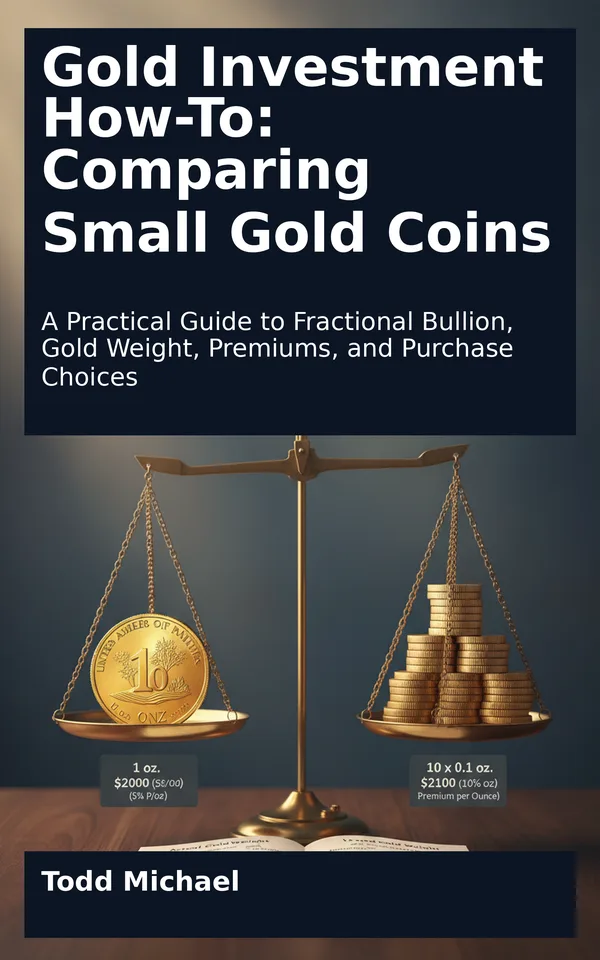
Cover of Gold Investment How-To

Money, Investing & Precious Metals

Gold Investment How-To: Comparing Small Gold Coins

A Practical Guide to Fractional Bullion, Gold Weight, Premiums, and Purchase Choices

by Todd Michael

Available now

Searching for gold investment how to guidance that goes beyond a list of coins? This practical guide shows you how to compare the gold you actually receive with the price you actually pay.

Learn why a coin's face value, total weight, and gold content are different; calculate premiums in dollars and percentages; and account for shipping and other purchase costs. Step-by-step examples put several fractional coins beside a larger coin, using consistent weights and prices so you can see what smaller denominations cost.

You'll also explore the practical trade-offs of buying in stages, holding separate pieces, and choosing denominations that fit your budget. Worksheets help you record quotes, check your arithmetic, and make comparisons without relying on a prediction about what any coin will sell for later.

Written for U.S. buyers, this book offers a clear decision process—not a promise that gold will rise or that any particular coin is the best investment.

Contents
  1. 1. The Small-Coin Decision
  2. 2. Reading a Gold Coin Specification
  3. 3. Troy Ounces, Grams, and Fractions
  4. The ounce used for gold
  5. Converting troy ounces to grams
  6. Converting grams to troy ounces
  7. Fractions on a common scale
  8. Exercise: Add a group of small coins
  9. Exercise: Compare mixed denominations
  10. Exercise: Compare grams with a fraction
  11. Keep rounding under control
  12. Avoid the gross-weight shortcut
  13. Build a repeatable calculation
  14. From weight to value
  15. 4. Spot Price and Melt Value
  16. Spot Price as a Reference Point
  17. The Basic Melt-Value Calculation
  18. Use Actual Gold Weight, Not Gross Weight
  19. When Gold Weight Is Given in Grams
  20. Melt Value Is Not a Cash Offer
  21. Why the Quote Time Matters
  22. Comparing Offers Against One Spot Price
  23. Equal Gold Weight, One Reference Value
  24. A Practical Record for Each Calculation
  25. Your Baseline, Not Your Decision
  26. 5. Calculating the Premium
  27. 6. The True Purchase Total
  28. 7. Comparing Fractional Denominations
  29. 8. Many Small Coins or One Larger Coin?
  30. 9. Buying Now or Accumulating in Stages
  31. 10. What Smaller Pieces Make Possible
  32. 11. Reading Offers and Comparing Quotes
  33. 12. Common Comparison Mistakes
  34. Mistake 1: Treating Face Value as Gold Value
  35. Mistake 2: Using Gross Weight as Actual Gold Weight
  36. Mistake 3: Mixing Grams, Troy Ounces, and Everyday Ounces
  37. Mistake 4: Comparing Premiums Calculated Against Different Spot Prices
  38. Mistake 5: Leaving Fees Outside the Comparison
  39. Mistake 6: Comparing Unequal Amounts of Gold as Though They Were Equal
  40. Mistake 7: Applying a Per-Coin Fee Only Once

Read a sample: 1. The Small-Coin Decision

A small gold coin can make a gold purchase possible when a larger coin is beyond your budget. It can also cost more for each ounce of gold you receive. Both facts matter, and neither settles the decision by itself.

Imagine standing in front of two hypothetical offers. One is for several small gold coins; the other is for one larger coin. The smaller coins have a lower price individually, while the larger coin requires more money in a single purchase. Which is the better choice?

The answer depends on what you are comparing. If the goal is to obtain a particular amount of gold at the lowest purchase cost, you need to compare actual gold weight and the total amount paid. If the goal is to make a purchase within a limited budget, the larger coin may not be a realistic option today. If having separate pieces matters to you, the smaller coins offer a kind of flexibility that one larger coin cannot provide in the same form.

This book gives you a way to separate those considerations. It does not ask you to predict where gold prices will go or assume what a dealer will pay when you eventually sell. The starting point is more immediate: understand what you would receive, what you would pay, and what choices the denomination would leave you with.

A fractional gold bullion coin contains less than one troy ounce of gold. Common descriptions include one-tenth ounce, one-quarter ounce, and one-half ounce. A one-ounce bullion coin is not fractional in this sense, although it can serve as a useful comparison.

The word bullion generally refers to precious-metal products valued principally for their metal content rather than for an unusual date, rarity, or collectible feature. That distinction is useful, but it is not a guarantee that every coin sold as bullion has the same market or the same price. Products differ, as do sellers’ charges and buyers’ preferences.

For the comparisons in this book, the important weight is the coin’s actual gold weight: the amount of gold it contains. It is not necessarily the same as the coin’s total physical weight. Some coins contain other metals along with gold, so their gross weight is greater than their gold content. A coin described as containing one-quarter troy ounce of gold should be compared on that gold content, not simply on the weight of the whole piece.

A troy ounce is the unit commonly used to quote gold. It is different from the everyday ounce used for many household measurements. You do not need to memorize conversions before making your first comparison, but you do need to keep the units consistent. Chapter 3 works through those conversions.

The face value stamped on a coin is a separate detail. It is not a reliable shortcut to the coin’s gold content or purchase price. Before comparing prices, check the product specifications rather than relying on the number printed on the coin or the apparent size of the piece.

A small coin is usually cheaper per coin than a larger coin of the same general type because it contains less gold. That does not mean it is cheaper per ounce of gold.

Consider this hypothetical offer, with all figures chosen for illustration:

- One coin containing one-tenth troy ounce of gold costs $340. - One coin containing one-half troy ounce of gold costs $1,600. - The quoted prices are the complete purchase totals for this example, with no additional charges.

The first coin costs much less at the register. But if you divide each price by its actual gold weight, you get a different view:

- $340 ÷ 0.10 troy ounce = $3,400 per troy ounce of gold - $1,600 ÷ 0.50 troy ounce = $3,200 per troy ounce of gold

In this example, the smaller coin has the lower purchase price but the higher cost per ounce. That difference is important, yet it does not automatically make the larger coin the right purchase. A buyer with $400 available cannot buy the hypothetical half-ounce coin at its stated price. Comparing a possible purchase with an unaffordable one can reveal a trade-off, but it cannot make the larger purchase fit the budget.

The calculation also does not say what either coin will be worth later. It tells you how much gold the hypothetical purchase price buys at the time of comparison. That is a useful fact on its own.

Throughout the book, cost per ounce means purchase cost divided by actual gold weight, expressed in troy ounces, unless the discussion states otherwise. It is a way to put different-sized coins on a common scale. It is not a forecast of a future sale price.

The central comparison becomes especially clear when the two choices contain the same total amount of gold.

Suppose these are hypothetical, complete purchase totals:

- Five coins, each containing one-tenth troy ounce of gold, cost $340 each, for a total of $1,700. - One coin containing one-half troy ounce of gold costs $1,600.

The five small coins contain 5 × 0.10, or 0.50 troy ounce of gold. The larger coin also contains 0.50 troy ounce of gold. The small-coin group costs $100 more in total.

Because the gold weights match, you can see the purchase-cost difference without first adjusting for different quantities of gold. The hypothetical buyer would pay that extra $100 for the small-coin group…

More Money, Investing & Precious Metals

Cover of The Practical Gold BookThe Practical Gold BookAvailable nowCover of The Practical Gold Book, Volume 2The Practical Gold Book, Volume 2Available nowCover of The Practical Silver BookThe Practical Silver BookAvailable nowCover of The Practical Crypto BookThe Practical Crypto BookAvailable nowCover of Shielding Your WealthShielding Your WealthAvailable nowCover of Personal Finance AdvancedPersonal Finance AdvancedAvailable now

About Todd Michael

Todd Michael is an American author and the founder of ToddMichael.tv. He writes practical, plain-English books on money, health, preparedness, technology, games, humor and more.

About the author Todd Michael · Todd Michael’s author site

Part of the ToddMichael.tv network.




