Everyday Guidebooks
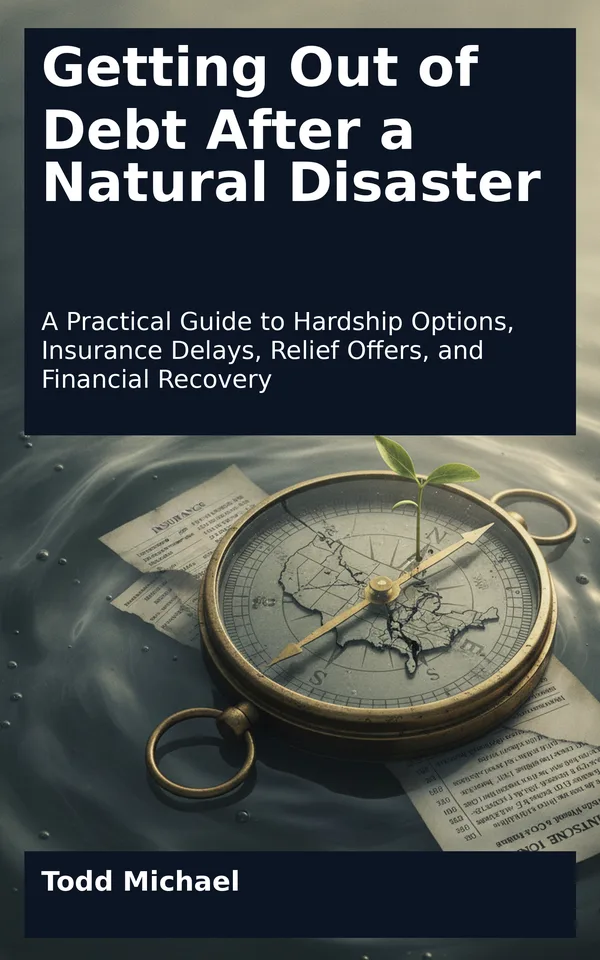
Cover of Getting Out of Debt After a Natural Disaster

Money, Investing & Precious Metals

Getting Out of Debt After a Natural Disaster

A Practical Guide to Hardship Options, Insurance Delays, Relief Offers, and Financial Recovery

by Todd Michael

Available now

When a natural disaster disrupts your home, income, and bills, the usual debt advice may not fit. This practical guide helps you make financial decisions when the numbers keep changing and every payment feels urgent.

Learn how to document losses and disaster expenses, organize bills, and decide which payments need attention first. Prepare for conversations with mortgage servicers, landlords, lenders, and other creditors; compare hardship and relief offers; and understand how delayed insurance payments can affect your cash flow. You’ll also find ways to spot debt-related scams and keep a recovery plan flexible as circumstances change.

If you’ve searched for “getting out of debt for dummies,” this book offers a disaster-specific starting point, with plain-English explanations, sample questions, and practical worksheets. Assistance and creditor options vary by location, disaster, and individual circumstances. This guide helps you investigate what may apply to you without relying on promises of guaranteed aid or debt forgiveness.

Contents
  1. 1. Financial Recovery Starts With Stability
  2. 2. Document the Damage and the Costs
  3. 3. Build a Changing Financial Snapshot
  4. Begin With Money You Can Actually Use
  5. Separate Expected Income From Possibilities
  6. Put Reimbursements and Aid in Their Own Lane
  7. List Essential Expenses for the Same Period
  8. List Debts Without Assuming a Pause
  9. A Worksheet You Can Revise
  10. Example: A Renter Facing an Income Gap
  11. Example: A Homeowner With a Pending Claim
  12. Make Revision a Small, Regular Task
  13. 4. Decide What to Pay First
  14. Start With the Next Stretch of Time
  15. Protect the Basics That Make Recovery Possible
  16. Compare Consequences, Not Just Balances
  17. Build a Payment Calendar
  18. Partial Payments and Promised Payments
  19. Read the Notice Before You Rank the Bill
  20. Adjust When the Facts Change
  21. 5. Prepare to Contact Creditors
  22. 6. Housing Payments and Secured Debts
  23. Start With the Payments You Can Actually Make
  24. Mortgage Payments: Ask What Happens After the Pause
  25. Rent: Clarify the Lease and the Condition of the Home
  26. Auto Loans: Protect Transportation Without Ignoring the Debt
  27. Compare the Offer With Your Recovery Budget
  28. Confirm, Calendar, and Keep Watching
  29. 7. Credit Cards, Medical Bills, and Other Debts
  30. 8. When Insurance Money Is Delayed
  31. Make the Claim Visible
  32. Find Out What Is Holding Up the Claim
  33. Separate Coverage Questions From Cash Questions
  34. Understand the Deductible and the Payment Calculation
  35. Temporary Living Costs Need Their Own Record
  36. Plan Around Money You Cannot Yet Use
  37. Ask How a Payment Will Be Issued
  38. When the Insurer’s Answer Does Not Match Your Records
  39. Set a Follow-Up Rhythm
  40. 9. Find and Evaluate Available Assistance

Read a sample: 1. Financial Recovery Starts With Stability

A natural disaster can turn ordinary financial decisions into urgent questions. The rent is due, but you are paying for a motel. A credit card bill arrives while you are waiting to hear whether your employer can reopen. Your mortgage servicer expects a payment, but you do not yet know what insurance will cover or when a claim might be paid.

If you cannot answer all those questions today, you are not failing. You are working with incomplete information after an event that may have disrupted your home, income, transportation, records, and routines at the same time.

Financial recovery starts with stability, not a perfect budget. The first task is to protect your household’s immediate needs and create enough breathing room to make the next decision. Some bills may require attention quickly; others can wait long enough for you to gather information or ask about alternatives. The challenge is learning the difference without assuming that a missed payment has no consequences—or that every payment must be made before you buy food.

This chapter gives you a staged map for the first part of recovery. You do not have to complete the stages in order or finish one before beginning another. If your situation changes, return to the most urgent stage and adjust.

Before deciding how much to send to creditors, identify what your household needs to remain sheltered, fed, connected, and able to earn or receive income. Depending on your circumstances, that may include:

- A safe place to stay and a way to pay for it. - Food, water, medication, and essential supplies. - Transportation to work, medical care, school, or a safer location. - Phone or internet access needed to communicate, work, or manage claims. - Necessary utilities and insurance payments. - Care for children, older adults, or family members with disabilities.

This is not a universal ranking of every bill. A missed car payment may threaten transportation you need for work. A missed housing payment can create serious consequences even if you are temporarily unable to live in your home. An insurance premium may be important to maintaining coverage, but the effect of a missed payment depends on the policy and applicable rules.

The point is to consider what a payment protects and what could happen if it is delayed. A bill that creates the most anxiety is not necessarily the one that should receive your last available dollar.

If you are in immediate danger or need urgent medical help, seek appropriate emergency assistance first. Financial paperwork can wait until you are in a position to address it. Once you can, ask a trusted person, a local community organization, or an official disaster information source about immediate shelter and essential services. Availability and eligibility vary, so confirm the details before depending on a particular resource.

You do not need a complete household budget to take a useful first look. For now, answer four questions as best you can:

1. What money can we use now? Consider accessible cash and account balances, allowing for transactions that have not yet cleared. 2. What income is reasonably expected soon? Note whether a paycheck is confirmed, uncertain, delayed, or interrupted. 3. What must we pay for in the immediate future? Include necessities and any deadlines with serious consequences. 4. What money might arrive, but is not available yet? Insurance proceeds, assistance, reimbursements, and help from others belong here until you can actually use them.

Keep the last category separate from money in hand. An expected claim payment may be delayed, reduced, directed to more than one party, or needed for repairs rather than ordinary bills. An assistance application may be denied or may provide less than you hoped. These possibilities do not mean you should give up on a claim or application. They mean your immediate plan needs another foundation.

For example, imagine a hypothetical household with $900 currently available. It expects a $700 paycheck, but the employer has not confirmed when work will resume. The household also needs approximately $500 for food, transportation, medication, and temporary lodging over the coming days. Its starting point is the $900 it can access—not $1,600 or an assumed insurance payment. After setting aside the estimated $500, roughly $400 remains for other needs and payments, subject to any pending transactions or expenses the household has not yet identified.

That rough calculation is not a final budget. It reveals a problem early enough for the household to contact creditors, look for available help, and reconsider commitments before the remaining money is gone.

If accounts are inaccessible, records are missing, or you are unsure which payments have already gone through, write down what you know and mark the rest as uncertain. A short list on paper is sufficient. Chapter 3 will help you build a more complete financial snapshot and revise it as information changes.

Disaster recovery rarely proceeds in a neat sequence. You may receive a collection notice while still arranging temporary housing, or an insurer may ask for documents before you can return to the property. A staged map helps you decide what deserves attention now and what can be postponed until you have more information.

Focus on safety, shelter, essential supplies, access to money, and urgent communications. Find out whether your bank, employer, landlord, mortgage servicer, insurer, or utility provider has a way to reach customers affected by the disaster. Use contact information from…

More Money, Investing & Precious Metals

Cover of The Practical Gold BookThe Practical Gold BookAvailable nowCover of The Practical Gold Book, Volume 2The Practical Gold Book, Volume 2Available nowCover of The Practical Silver BookThe Practical Silver BookAvailable nowCover of The Practical Crypto BookThe Practical Crypto BookAvailable nowCover of Shielding Your WealthShielding Your WealthAvailable nowCover of Personal Finance AdvancedPersonal Finance AdvancedAvailable now

About Todd Michael

Todd Michael is an American author and the founder of ToddMichael.tv. He writes practical, plain-English books on money, health, preparedness, technology, games, humor and more.

About the author Todd Michael · Todd Michael’s author site

Part of the ToddMichael.tv network.




