Everyday Guidebooks
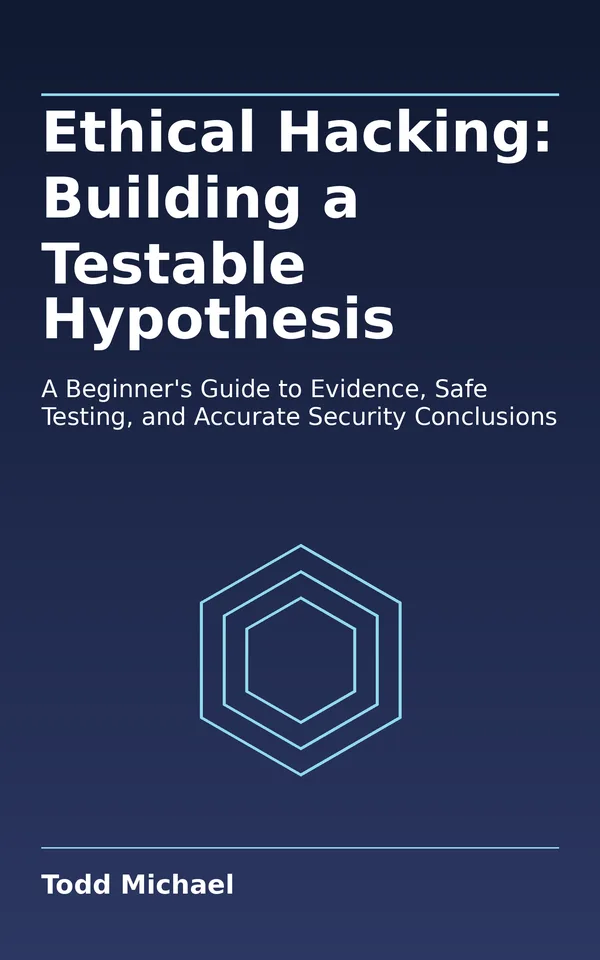
Cover of Ethical Hacking

Cybersecurity & IT

Ethical Hacking: Building a Testable Hypothesis

A Beginner's Guide to Evidence, Safe Testing, and Accurate Security Conclusions

by Todd Michael

Available now

Searching for ethical hacking how to get started? Begin with the skill that makes every tool more useful: asking a security question you can actually test.

Ethical Hacking: Building a Testable Hypothesis shows you how to move from a suspicious observation to a focused claim, decide what evidence would support or disprove it, and choose a test that fits the risk and your permission. Through fictional systems and worked examples, you will practice recognizing assumptions, setting boundaries, recording results, and separating what you observed from what you merely suspect.

Exercises cover access controls, web applications, network services, and configurations without assuming you have permission to test real systems. You will also learn how to report uncertainty and recommend a sensible next step when the evidence is incomplete.

For certification students and newcomers alike, this is a practical foundation for careful, authorized security work—not a promise of exam coverage or a collection of attack recipes.

Contents
  1. 1. Think Before You Test
  2. A worked example: The visible report link
  3. Observation, inference, and finding
  4. Common shortcuts that distort a test
  5. Practice the pause
  6. Carry the question forward
  7. 2. Permission, Scope, and Stop Conditions
  8. 3. From Observation to Security Concern
  9. Describe the Event Before Explaining It
  10. Move From Observation to Concern
  11. Identify the Asset, Not Just the Screen
  12. Separate Possible Consequence From Observed Impact
  13. Missing Context Is Part of the Work
  14. Three Short Scenarios
  15. Concern, Finding, and the Space Between
  16. Practice Separating What You Know
  17. A Better Starting Point
  18. 4. Write a Claim That Can Be Tested
  19. 5. Plan Evidence Before Acting
  20. 6. Choose a Proportionate Test
  21. 7. Design Controls and Comparisons
  22. What a Baseline Can—and Cannot—Tell You
  23. Build a Comparison Around the Question
  24. Controls Are Anchors, Not Guarantees
  25. Change One Condition at a Time
  26. Recognize Confounding Factors
  27. Configuration Comparisons Need Context
  28. Repeatability Without Unnecessary Repetition
  29. When the Comparison Does Not Resolve the Question
  30. Practice: Improve the Comparison
  31. Suggested Reasoning
  32. 8. Keep Evidence Useful and Accountable
  33. 9. Worked Case: An Access-Control Concern
  34. 10. Worked Case: A Web Application Behavior
  35. 11. Worked Case: A Network Service
  36. 12. Worked Case: Configuration and Change
  37. 13. Interpret Results Without Overclaiming
  38. 14. Report the Finding and Practice the Process
  39. A Report Is Part of the Test
  40. Build a Concise Finding

Read a sample: 1. Think Before You Test

A security test begins before you open a terminal, launch a scanner, or sign in to an application. It begins with a question: What do I think might be happening, and what could I observe to find out?

That question sounds simple, but it changes the way you work. Without it, a tester can collect pages of output and still be unable to explain what was tested. With it, even a modest observation can become useful evidence—provided the test was authorized, the conditions were clear, and the conclusion stays within what the observation shows.

Imagine that an employee mentions seeing a link to a finance report in a company portal. The employee does not work in finance. Is confidential information exposed? Perhaps. The link might lead to a report the employee is allowed to view, or it might lead to an access-denied page. The title might be visible even though the report is protected. It might even be a training example with no sensitive content.

Each explanation suggests a different concern. None is established merely because the link appeared.

Ethical hacking is not a contest to produce the most alarming interpretation. It is disciplined investigation under agreed boundaries. The goal is to help an organization understand a security question well enough to make a sound decision.

Security tools can perform valuable tasks: send requests, compare responses, inspect configurations, and organize observations. They cannot, by themselves, decide what you were authorized to test or whether a result proves the claim you had in mind.

Suppose a tool reports that an application returned a successful response. That result may be accurate, but it leaves important questions:

- Was the response produced by the intended application and account? - Did it contain the protected information, or only a general page? - Was the account supposed to have access? - Were the request and the data within the approved scope? - Would a different explanation fit the same response?

A tool result is an observation to interpret, not a finished security conclusion. Likewise, a failed request does not automatically establish that a control is effective. The test might have used the wrong address, an expired session, or an account whose role was not what the tester believed.

Beginners often focus on learning commands because commands have visible outputs. Judgment develops differently. It requires you to pause, state what an output would mean, and notice what it would not mean. The two skills complement each other: technical fluency helps you carry out an appropriate test, while testing judgment helps you choose and interpret it.

A security concern is a reason to ask whether something may be wrong. A hypothesis turns that concern into a claim that can be evaluated under specified conditions.

Consider the difference:

> Concern: A non-finance employee can see a finance report link.

> Hypothesis: When the designated non-finance test account follows the link to the approved sample finance report, the portal will display the report’s contents instead of denying access.

The second statement is narrower. It identifies an account, an action, a particular resource, and an observable result. It is not a claim that every finance report is exposed or that every non-finance employee can access one.

A useful hypothesis also has a meaningful alternative. In this example, the portal might deny access to the sample report. It might display a generic error, redirect to a sign-in page, or behave in another way that leaves the question unresolved. Thinking about alternatives before testing reduces the temptation to treat any response as confirmation.

Hypotheses do not need elaborate language. They need enough precision to guide a fair test and enough humility to allow an unexpected result. “The portal is insecure” is too broad to evaluate with one action. “The designated account can open the approved sample report under the stated conditions” gives a tester something specific to investigate.

Before any test, though, there is another question: May I perform it? A testable claim is not permission to act. Authorization must cover the target, accounts, actions, timing, and handling of any evidence. If a necessary boundary is unclear, the next action is to ask the responsible owner, not to probe until the boundary becomes clear.

More Cybersecurity & IT

Cover of The White Hat Bible, Volume 1The White Hat Bible, Volume 1Available nowCover of The White Hat Bible, Volume 2The White Hat Bible, Volume 2Available nowCover of The White Hat Bible, Volume 3The White Hat Bible, Volume 3Available nowCover of The White Hat Bible, Volume 4The White Hat Bible, Volume 4Available nowThe White Hat Bible, Volume 5Available nowCover of The White Hat Pocket GuideThe White Hat Pocket GuideAvailable now

About Todd Michael

Todd Michael is an American author and the founder of ToddMichael.tv. He writes practical, plain-English books on money, health, preparedness, technology, games, humor and more.

About the author Todd Michael · Todd Michael’s author site

Part of the ToddMichael.tv network.




