Everyday Guidebooks
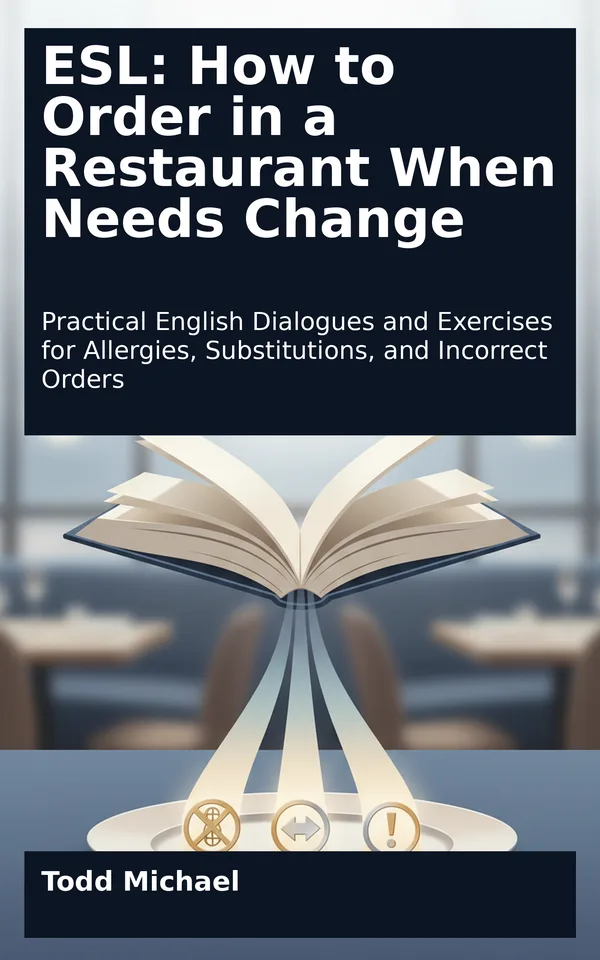
Cover of ESL

More Books

ESL: How to Order in a Restaurant When Needs Change

Practical English Dialogues and Exercises for Allergies, Substitutions, and Incorrect Orders

by Todd Michael

Available now

You know what you want to order—but what can you say when you have a food allergy, need a substitution, or receive the wrong meal?

ESL: How to Order in a Restaurant When Needs Change gives you useful English for these real restaurant situations. Follow short model dialogues, learn phrases you can adapt, and build confidence through written practice. You'll work on asking about ingredients, explaining an allergy clearly, requesting a different side or ingredient, and politely correcting an order.

Exercises help you choose words, complete conversations, and write your own responses. Answers are included so you can check your work independently. You'll also practice what to say when you don't understand an answer or need to confirm a change before eating.

Created for adult English learners, this focused guide is a practical choice if you're searching for esl how to order in a restaurant and want more than a basic list of menu words.

Contents
  1. 1. Your Restaurant English Toolkit
  2. 2. Understanding Ingredients and Menu Descriptions
  3. 3. Explaining a Food Allergy Clearly
  4. 4. Asking About Preparation and Cross-Contact
  5. Practice
  6. Looking ahead
  7. 5. Requesting a Substitution
  8. 6. When a Change Has a Cost or Is Unavailable
  9. Asking About an Extra Charge
  10. When the Answer Is No
  11. Useful Responses for Making a Choice
  12. Branching Dialogue: The Same Request, Different Answers
  13. Understanding Price Language
  14. Keep Your Reason Clear
  15. Exercise 1: Match the Question and Answer
  16. Exercise 2: Complete the Conversation
  17. Exercise 3: Choose a Clear Response
  18. Exercise 4: Put the Conversation in Order
  19. Exercise 5: Follow the Branch
  20. Exercise 6: Write Your Own Conversation
  21. A Final Confirmation
  22. 7. Combining an Allergy Request With a Change
  23. 8. Confirming the Order Before the Kitchen Prepares It
  24. 9. Recognizing and Describing an Incorrect Order
  25. 10. Asking for a Correction
  26. 11. When the Conversation Gets Difficult
  27. 12. Restaurant Scenarios From Start to Finish
  28. 13. Independent Practice and Personal Phrase Builder
  29. 1. Choose the Purpose
  30. 2. Build a Clear Sentence
  31. 3. Choose a Response
  32. 4. Put the Conversation in Order
  33. 5. From Short Notes to Useful English
  34. 6. Follow the Conversation as It Changes
  35. 7. Make Your Personal Phrase Builder
  36. 8. Create a Short Reference Card
  37. 9. Final Review: Write a Complete Exchange
  38. 14. Answer Key and Model Responses
  39. Other Books by Todd Michael

Read a sample: 1. Your Restaurant English Toolkit

A restaurant conversation does not have to be perfect. You do not need a large vocabulary or a perfect accent to ask a useful question. A few clear phrases can help you read a menu, place an order, and speak up when you need help.

This chapter gives you a simple map of a restaurant exchange. You will learn words you may see on a menu and practice polite ways to get a server’s attention. You will also begin to notice which phrases already feel comfortable and which ones you want to practice.

Take your time with the activities. You can write your answers in a notebook, say them aloud, or do both. The answer key in Chapter 14 includes answers and sample responses.

Before you study the chapter, try these questions. Do not worry if you are unsure. This is a way to notice what you already know, not a test you need to pass.

Choose the best answer for each question.

1. You want a server to help you. What can you say? a. “Excuse me.” b. “Good night.” c. “You’re welcome.”

2. You are ready to order a soup. Which sentence works? a. “I’d like the soup, please.” b. “The soup is ready to pay.” c. “Can you soup?”

3. You do not understand a word on the menu. What can you ask? a. “What does this mean?” b. “Where is my bill?” c. “Are you finished?”

4. A menu says a sandwich comes with a side. What is a side? a. A small dish served with the main food b. A person who takes your order c. The price of a drink

5. Your server speaks too quickly. What can you say? a. “Could you speak more slowly, please?” b. “Could I have the menu, please?” c. “That’s all, thank you.”

6. You would like to pay. What can you ask for? a. The bill or the check b. The ingredient c. The main course

Now think about your confidence. Which of these can you say without looking at the page?

- I’d like a table for two, please. - Could I see the menu, please? - I’d like the chicken, please. - What is in the soup? - Could you repeat that, please? - Could we have the check, please?

Mark each phrase in your notebook as comfortable, needs practice, or new to me. At the end of the chapter, you can look at your list again. If every phrase is new, that is a useful starting point.

Restaurant conversations can happen in different ways. In some places, you sit at a table and a server takes your order. In others, you order and pay at a counter. You may receive a paper menu, read a board, or look at a menu on a phone.

The following path is common, but you do not need to memorize every step.

1. Arrive and ask for a table. “A table for two, please.” 2. Look at the menu. “Could I see the menu, please?” 3. Ask a question, if needed. “What is in the vegetable soup?” 4. Order food and drinks. “I’d like the soup and a glass of water, please.” 5. Check or discuss the order. “Does the sandwich come with a side?” 6. Ask for help during the meal. “Excuse me, could I have a spoon, please?” 7. Ask to pay. “Could we have the bill, please?”

A server is a person who helps customers at a table, takes orders, and brings food or drinks. You may also hear waiter or waitress. In this book, we usually use server.

A customer is a person who buys food or services. In the dialogues, you are often the customer.

Your conversation may be shorter than this path. You may not need to ask for a table or ask for a menu. You may also need an extra step: asking about an ingredient, requesting a change, or explaining that an order is incorrect. Later chapters give you more practice with those situations.

Read this dialogue once for the main idea. Then read it again and notice what the customer says at each step.

Server: Good evening. How many people?

Customer: Two, please.

Server: Right this way. Here are your menus. Can I get you something to drink?

Customer: Water, please.

Server: Still or sparkling?

Customer: Still, please.

Server: Are you ready to order?

Customer: Almost. What is in the vegetable soup?

Server: It has carrots, potatoes, onions, and beans.

Customer: Thank you. I’d like the vegetable soup and the bread, please.

Server: Of course. And for you?

Customer’s companion: I’d like the chicken and rice, please.

Server: Certainly.

Later, during the meal:

Customer: Excuse me. Could I have another napkin, please?

Server: Of course.

At the end of the meal:

Customer: Could we have the check, please?

Server: Certainly. I’ll bring it to your table.

The customer does not use long sentences. “Water, please” and “Still, please” are both natural short answers. The customer also asks a question before ordering. You can take time to understand a dish before choosing it.

In the dialogue, still water means water without bubbles. Sparkling water has bubbles. A napkin is a piece of paper or cloth used to wipe your mouth or hands.

In English, please and thank you are useful, but politeness does not require a long explanation. The following…

More More Books

Cover of Dog Breeds for Real LifeDog Breeds for Real LifeAvailable nowCover of How to Find the Right Dog Breed for Your HouseholdHow to Find the Right Dog Breed for Your HouseholdAvailable nowCover of Digital Nomad Ideas for Accessible Remote WorkDigital Nomad Ideas for Accessible Remote WorkAvailable nowCover of The Bathhouse Keeper's Day OffThe Bathhouse Keeper's Day OffAvailable nowCover of A Hurricane Guide for CaregiversA Hurricane Guide for CaregiversAvailable nowThe Fountain Pen FamiliarComing soon

About Todd Michael

Todd Michael is an American author and the founder of ToddMichael.tv. He writes practical, plain-English books on money, health, preparedness, technology, games, humor and more.

About the author Todd Michael · Todd Michael’s author site

Part of the ToddMichael.tv network.




