Read a sample: 1. The Appeal of a Silver Dime Collection
A silver dime asks you to look closely. At first, it may seem too small and ordinary to reward much attention: a thin coin, gray from handling, with a portrait on one side and an unfamiliar arrangement of leaves or symbols on the other. Turn it beneath a light, however, and the differences begin to emerge. One dime carries a formal portrait of Liberty framed by a wreath. Another shows Liberty in a winged cap. A third bears Franklin D. Roosevelt’s familiar profile.
Each belongs to a series with its own dates, mintmarks, design details, and collecting challenges. Together, the Barber, Mercury, and silver Roosevelt dimes offer a compact introduction to American coinage and to the decisions that make collecting personal.
You do not need a rare coin to begin. You might have inherited a small envelope of dimes, noticed an older-looking coin in a family box, or decided that a collection of manageable size would be more satisfying than an unfocused assortment. Whatever brought you here, your first useful question is not “What is this worth?” but “What would I enjoy learning and collecting?”
A collector and a person accumulating silver may buy some of the same coins, yet approach them with different priorities. A collector may willingly choose one worn dime over another because its date fills a gap or its design remains attractive. Someone primarily seeking silver exposure may care more about the total silver content and the amount paid for it. Neither approach is inherently superior, and many people combine them. Knowing which goal matters most to you makes it easier to judge whether a purchase belongs in your collection.
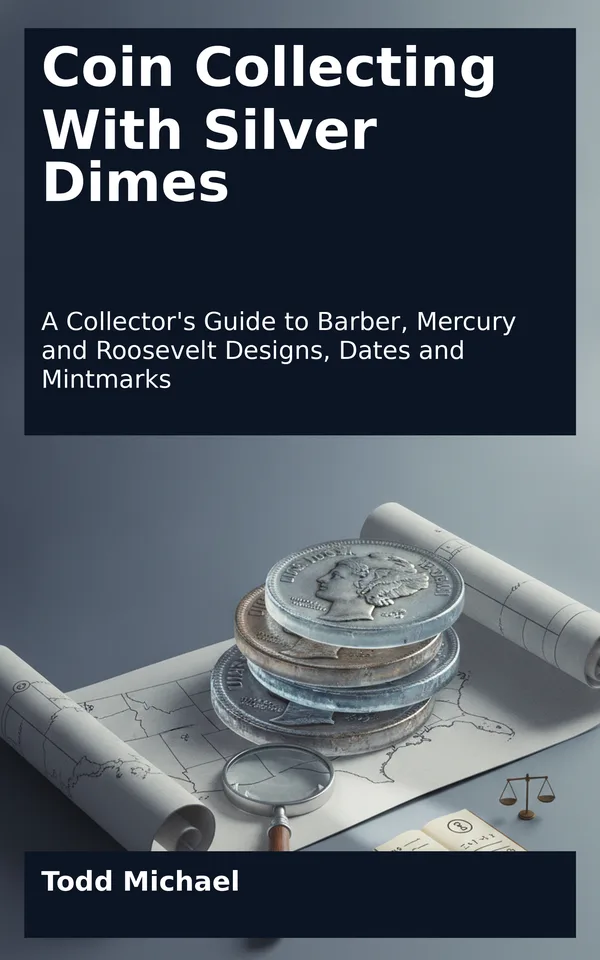
The Barber dime, produced from 1892 through 1916, is the oldest of the three series covered in this book. Its obverse, or front, presents Liberty in a portrait often described as classical and formal. Its reverse, or back, places the denomination within a wreath. Named for designer Charles E. Barber, the coin can look restrained beside more dramatic American designs. That restraint is part of its appeal: the portrait, lettering, and wreath reward careful attention, especially when circulation has softened their details.
Barber dimes give a collection a direct connection to an earlier period of everyday commerce. Many surviving examples show substantial wear. A worn coin is not automatically undesirable; it may be an approachable way to study a design and acquire an older piece. But wear can also make the date or other identifying features difficult to read. The pleasure of finding an old dime must therefore be balanced against whether the coin is identifiable and appealing enough for your purpose.
The Mercury dime followed in 1916 and continued through 1945. Its popular name is a misidentification: the portrait represents Liberty wearing a winged cap, not the Roman god Mercury. The wings suggest freedom of thought, while the reverse combines a fasces—a bundle of rods surrounding an ax—with an olive branch. These compact elements give the coin a distinctive visual character and plenty to examine.
Mercury dimes appeal to collectors for several reasons. Their design is lively and readily recognizable, and many circulated examples remain available to beginners. At the same time, a complete collection organized by date and mintmark presents challenges that a simple representative set does not. A collector can enjoy the series without resolving to own every issue.
The Roosevelt dime began in 1946 and remains familiar as a circulating design, although its composition has changed. For the regular circulation issues discussed in this book, the silver period runs from 1946 through 1964. The portrait of President Roosevelt is paired with a reverse showing a torch between branches. These coins can offer an inviting place to start because the design is recognizable and many silver-era examples are available in circulated condition.
The date matters when identifying a Roosevelt dime. A later circulating dime may look broadly similar to an earlier silver one, but the familiar portrait alone does not establish its composition. There are also special silver issues outside the 1946–1964 regular circulation run. We will make those distinctions more carefully when we reach the Roosevelt chapters.
For now, it is enough to recognize that these three series are connected by denomination but differ in design, history, availability, and the kinds of decisions they offer. You can collect all three, specialize in one, or simply keep a few examples that interest you.
A silver dime has several kinds of appeal at once. It is a piece of metal, an object made for use, a dated artifact, and a small work of design. A coin collector can pay attention to all of these qualities without needing to rank them the same way every time.
The date tells you when the coin was issued. A mintmark, when present, identifies the mint facility associated with its production. Collectors often use the combination of date and mintmark to distinguish one issue from another. Two dimes with the same date may therefore occupy separate places in a collection if they have different mintmarks.
Condition adds another dimension. A coin that circulated for years may show flattened high points, softened lettering, scratches, or discoloration. Another example of the same date and mintmark may retain more detail but cost more. Even among coins with similar amounts of wear, one may look pleasing to you while another does not. Grading provides a shared vocabulary for describing condition, but it does…