Read a sample: 1. Start With a Blank Page
A blank page can feel like an invitation or a test. When the subject is money, it may feel more like the second. You might wonder whether you have enough to budget, whether you need to account for every purchase, or whether one forgotten bill will make the whole effort useless.
It won’t. A budget is not a test of character. It is a written plan for money you expect to receive and the jobs you hope that money can do. When real life turns out differently, the page gives you a place to see the difference and decide what to do next.
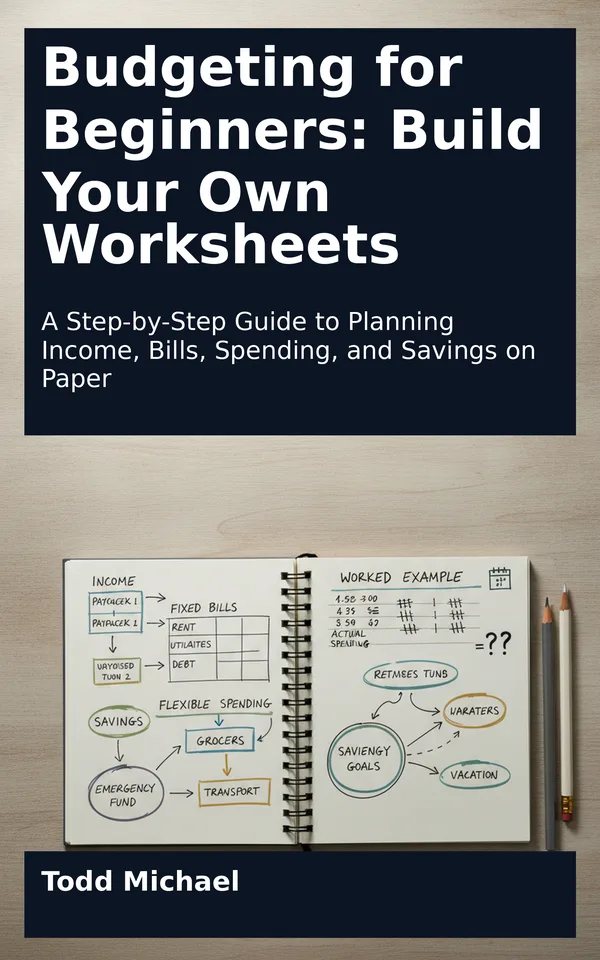
This book will help you build that plan by hand. You do not need special forms, a spreadsheet, or perfect records. You will draw four simple worksheets: one for income, one for fixed bills, one for flexible spending, and one for savings goals. Each page answers a different question, and together they give you a clearer view than a collection of numbers kept in your head.
You will also follow a hypothetical household as it makes a first plan, records what happens, finds a discrepancy, and revises its choices. The household’s numbers are examples, not targets. Your income, obligations, and priorities will be different, and your pages should reflect your circumstances.
For now, resist the urge to make a complete budget before you understand the pieces. Start by deciding what you want the pages to help you see.
People begin budgeting for many reasons. You may want to know whether your paycheck will cover the next round of bills. You may be tired of guessing how much is available for groceries. You may want to prepare for an expense that comes around only once or twice a year. Or you may simply want a calmer way to look at the numbers.
Choose a purpose that is specific enough to guide you and modest enough to be useful. For example:
- “I want to see which bills need to be paid before my next payday.”
- “I want to understand where my grocery money goes.”
- “I want to make a plan for expenses that do not arrive every month.”
- “I want to know what I can set aside without overlooking a bill.”
You can have more than one purpose, but one is enough to begin. Write it at the top of a sheet of paper. You might leave room underneath for the date and a few notes as your questions change.
A useful purpose is not the same as a perfect outcome. “I will never overspend again” leaves little room for a price change, an unexpected trip, or an estimate that was too low. “I will check my spending once a week and adjust my plan when needed” gives you something you can actually do.
A budget can reveal that there is not enough money to cover everything you hoped to pay. Writing down a shortfall does not create it. The shortfall was already there; the worksheet makes it visible while there is still an opportunity to consider your options. Depending on your situation, those options might include reducing a flexible expense, postponing a goal, contacting a bill provider about an available arrangement, or seeking assistance. Some choices will be difficult, and a worksheet cannot make every problem disappear. It can, however, help you identify the problem more clearly.
You can start with supplies you may already have:
- Several sheets of paper or a notebook
- A pen or pencil
- A ruler, if you like straight lines
- A calculator, if one is helpful
- A folder, envelope, or other place to keep your pages together
Pencil makes changes easy, but pen works too. You can cross out a figure neatly and write the correction nearby. A notebook keeps pages in order; loose sheets make it easy to place worksheets side by side. Choose whichever is more comfortable.
You will eventually need information about your income, bills, spending, and savings. For this first look, you do not need to collect everything. You can practice drawing the pages with the hypothetical example in this chapter, then gather your own records in the next chapter.
When you do bring records to your workspace, copy only the details you need. A bill’s name, amount, and due date are usually more useful on a budget page than a full account number. Avoid writing passwords or other sensitive login information on your worksheets. Keep your pages and records somewhere appropriate for your household, and be thoughtful about who can see them.
Leave plenty of room when you draw. A budget worksheet needs space for changes, not decorative perfection. If a column turns out too narrow, turn the page sideways, use a second sheet, or draw it again. The purpose of a line is to help you read the information, not to prove you can use a ruler.
Think of the worksheets as four views of the same plan. Each has a distinct job, but none tells the whole story by itself.
The income worksheet is where you list money you expect to receive during your chosen budget period. It will include the source, expected date, planned amount, and amount actually received.
For a paycheck, the starting point is generally the take-home amount available to you, rather than the larger amount shown before deductions. Other income may arrive on a…