Everyday Guidebooks
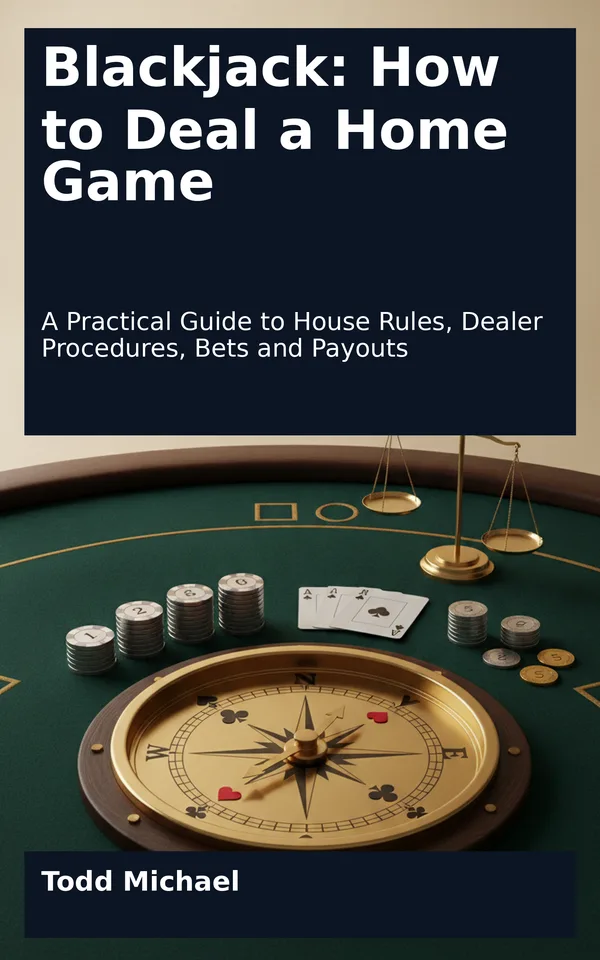
Cover of Blackjack

Poker & Game Strategy

Blackjack: How to Deal a Home Game

A Practical Guide to House Rules, Dealer Procedures, Bets and Payouts

by Todd Michael

Available now

Want to run a blackjack night without stopping every round to debate the rules? This practical guide takes you from opening a deck to settling the final bet, with clear procedures you can practice before your guests arrive.

If your search for “blackjack how to deal” has left you with scattered answers, start here. You’ll learn how to set up the table, explain the house rules, deal the opening cards, handle hits and stands, resolve splits and doubles, and pay winning hands accurately. Worked examples and troubleshooting scenarios help you deal confidently when real questions come up.

Choose a money-free game with chips or points, or keep any permitted stakes modest. You’ll also find a pregame checklist, practice routines, and a quick-reference procedure for keeping play fair, friendly, and moving. No casino experience required—just a deck, a table, and a willingness to practice.

Contents
  1. 1. Your Job as the Home Dealer
  2. The Aim of Blackjack
  3. The Dealer’s Role
  4. A Few Words You Will Use Often
  5. Before the First Bet
  6. The Shape of a Round
  7. A Sample Round
  8. What Makes the Sample Work
  9. Fairness Is a Procedure
  10. Ready to Set the Table
  11. 2. Set Up the Table
  12. 3. Agree on the House Rules
  13. 4. Cards, Totals, and Winning Hands
  14. 5. Bets, Chips, and the Bank
  15. 6. Deal the Opening Round
  16. 7. Guide Each Player’s Turn
  17. 8. Handle Doubles and Splits
  18. 9. Insurance, Naturals, and Dealer Checks
  19. 10. Play the Dealer’s Hand
  20. 11. Resolve Hands and Pay Winnings
  21. 12. Correct Mistakes and Settle Disputes
  22. 13. Practice Before Game Night
  23. 14. Run a Friendly Game from Start to Finish
  24. Other Books by Todd Michael

Read a sample: The Aim of Blackjack

In blackjack, each player competes against the dealer, not against the other players. The object is to finish with a hand worth more than the dealer’s without going over 21. A hand that exceeds 21 busts and loses. A player can also win when the dealer busts, provided that player has not already busted.

Number cards count at their face values. A jack, queen, or king counts as 10. An ace counts as either 1 or 11, whichever produces the more useful total without exceeding 21. For example, an ace and a 6 can count as 7 or 17; an ace, a 6, and a 10 count as 17, because counting the ace as 11 would make 27.

A two-card hand consisting of an ace and any 10-value card is a blackjack, also called a natural. It is special: under the baseline rules used in this book, a winning natural pays more than an ordinary winning hand. A total of 21 made with three or more cards is a strong hand, but it is not a natural.

An ordinary tie between a player and the dealer is called a push. Neither side wins that wager; the player keeps the original bet. The treatment of naturals, including a natural against another natural, will be spelled out with the house rules.

The important distinction is that a player’s decision happens before the dealer completes the dealer’s hand. If a player takes a card and busts, that player loses even if the dealer later busts too. The dealer does not rescue an already-busted hand by going over 21.

More Poker & Game Strategy

Cover of The GTO PlaybookThe GTO PlaybookAvailable nowThe Safe KingComing soonCover of Texas Holdem PokerTexas Holdem PokerAvailable nowCover of Poker Tournament Play Without the GuessworkPoker Tournament Play Without the GuessworkAvailable nowCover of Poker Strategy GuidesPoker Strategy GuidesAvailable nowCover of Tournament PokerTournament PokerAvailable now

About Todd Michael

Todd Michael is an American author and the founder of ToddMichael.tv. He writes practical, plain-English books on money, health, preparedness, technology, games, humor and more.

About the author Todd Michael · Todd Michael’s author site

Part of the ToddMichael.tv network.