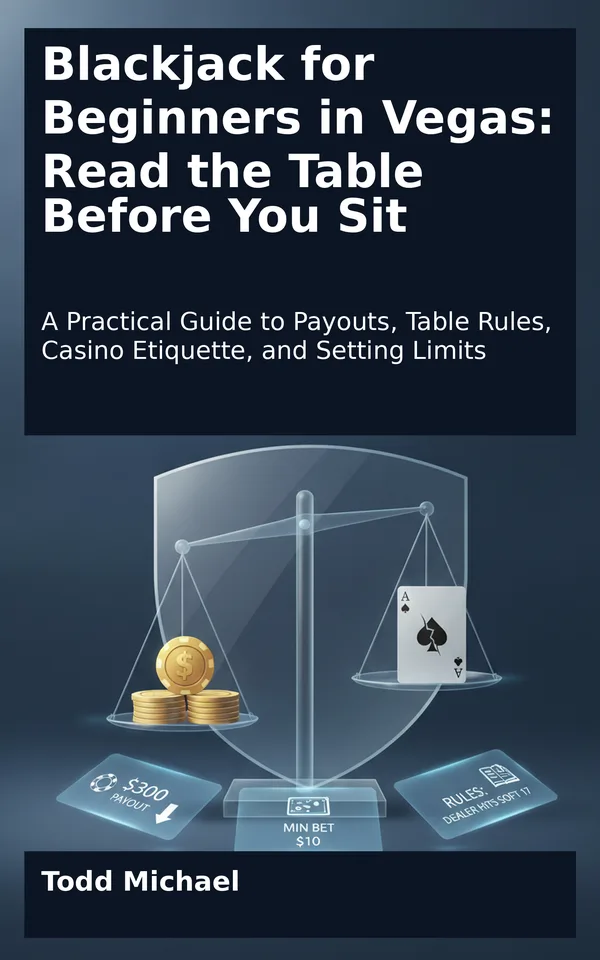
Read a sample: 1. Before You Enter the Casino
You have arrived in Las Vegas, and blackjack is on your list. Maybe you have watched a game in a movie, played a few hands online, or stood behind a table wondering how anyone knows when to touch the chips. The room looks exciting, but it can also feel as if everyone else received instructions you missed.
They did not. Every player at the table had a first visit, and you do not need to understand every variation of blackjack before you walk through the casino doors. You do, however, benefit from making a few decisions before you reach the table.
Blackjack is a gambling game, not a dependable way to pay for dinner, recover travel expenses, or build a vacation fund. You may win during a session, and you may lose the money you bring to play. The outcome of any short visit is uncertain, even when you choose a favorable table and make thoughtful decisions.
That uncertainty is part of the activity you are considering. The goal of this book is not to remove it or dress it up as a secret advantage. The goal is to help you understand what you are buying: a chance to play a particular game under particular rules, at a price you choose to accept.
The important phrase is you choose. Before the lights, noise, and open seats start making decisions feel urgent, give yourself a plan.
It is easy to assume that a successful casino visit means leaving with more money than you brought. Winning is enjoyable, but using profit as the only measure of success gives chance control over your entire experience.
A more useful question is: What would make this a worthwhile leisure activity even if I lost the amount I planned to spend?
You might want to learn how a live blackjack table works. You might want to play alongside a friend, enjoy the atmosphere for a little while, or practice recognizing a good payout. Perhaps you are curious but would rather watch than play until you feel comfortable. All of those are reasonable aims.
Your answer affects the table you should seek. A player who wants a relaxed introduction may value a manageable minimum, a dealer who can answer a brief question, and a setting where the pace feels comfortable. Someone playing with friends may care whether there are enough seats together. A visitor who has studied the rules may be willing to walk farther to find a better combination of payout and table conditions.
Notice what is not on that list: a table that guarantees a win. There is no such choice. A better table can improve the terms on which you play, but it cannot tell you what the next card will be.
It also helps to decide what you are not looking for. You do not have to play at the first table you see, match another player’s bet, or stay because you finally found a seat. You do not have to prove that you belong. If the game is confusing, the minimum is uncomfortable, or the atmosphere is not enjoyable, walking away is a complete and acceptable decision.
A casino floor may contain several blackjack games that look much alike from a distance. The cards, chips, and green felt can give the impression that one table is interchangeable with another. Look closer and you may find different minimum bets, payouts, and playing rules.
Casinos set the conditions they offer, and those conditions can differ by property, table, game format, and time. A minimum that fits your plan on one visit may be higher on another. A nearby table may offer a different payout for a natural blackjack or follow a different dealer rule. Some differences are displayed clearly; others require a question.
There is no need to memorize every rule on your first walk through the room. For now, understand three broad categories.
The minimum bet is the smallest main wager the table normally accepts for a hand. If the minimum is $15, you generally cannot sit down and place a $5 main bet at that table. The minimum matters because your planned session budget must support the size of the bets you intend to make—and because some playing decisions may call for an additional wager.
The blackjack payout tells you what a qualifying natural blackjack pays. A natural is typically an ace and a ten-value card as your first two cards. Common posted payouts include 3:2 and 6:5. On a $10 wager, a 3:2 blackjack payout is $15 in winnings, while a 6:5 payout is $12 in winnings. In each case, the original winning wager is also returned. These payouts concern qualifying blackjacks, not every ordinary winning hand.
That $3 difference on a $10 bet is worth noticing. A natural blackjack does not appear on every hand, and a better payout does not ensure that you will win a particular session. Even so, being paid less for the same qualifying result makes the game less favorable to the player over time. Chapter 4 will walk through the comparison in more detail.
The playing rules determine what the dealer must do and what choices are available to you. For example, tables can differ in how the dealer plays a soft 17, a total involving an ace counted as eleven. Rules can also restrict when you may double down, split a pair, or surrender.…