Cooking
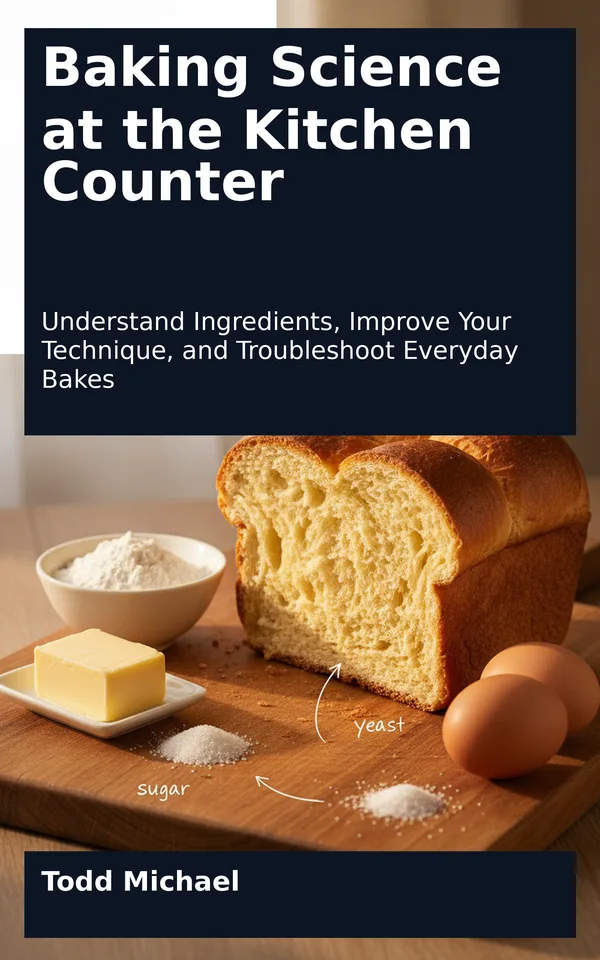
Baking Science at the Kitchen Counter
Understand Ingredients, Improve Your Technique, and Troubleshoot Everyday Bakes
by Todd Michael
Available nowWhy did your cookies spread, your muffins turn tough, or your cake sink in the middle? Baking Science at the Kitchen Counter makes the answers useful without making them complicated.
Explore how flour, fat, sugar, eggs, and leaveners work in everyday recipes, then see what happens when ingredients or mixing methods change. From tender biscuits and golden muffins to chewy cookies, soft cakes, and crusty breads, each chapter connects a familiar bake to the choices that shape its texture, rise, and color.
Inside you'll find approachable recipes, practical comparisons, and troubleshooting notes that help you recognize problems and adjust your next batch. Learn when to cream, fold, knead, or stop mixing—and why those decisions matter.
Whether you're new to baking or ready to understand recipes more deeply, this guide brings baking science out of the textbook and onto your kitchen counter.
Contents
- 1. A Baker's Working Kitchen
- 2. Flour, Water, and Structure
- Everyday Drop Biscuits
- A Simple Everyday Loaf
- Two doughs, two decisions
- 3. Fat and the Tender Crumb
- Cold-Butter Vanilla Scones
- Oil and a Soft Quick-Bread Crumb
- Cinnamon Yogurt Quick Bread
- Butter Cookies and the Question of Spread
- Everyday Vanilla Butter Cookies
- Choosing and Substituting Fats
- 4. Sugar Beyond Sweetness
- Granulated Sugar Butter Cookies
- Brown Sugar Butter Cookies
- Vanilla Brown Sugar Snack Cake
- Reducing sugar thoughtfully
- 5. Eggs at Work
- Lemon Custard Cake
- A Two-Custard Egg Comparison
- Using Egg Knowledge in Everyday Baking
- 6. Leaveners and Lift
- 7. Mixing for Muffins and Quick Breads
- 8. Creaming, Foaming, and Folding Cakes
- Creamed Vanilla Butter Cake
- Whisked-Egg Vanilla Cake
- Comparing the Cakes
- Cake Troubleshooting
- 9. Cookies: Spread, Chew, and Crispness
- Chewy Brown Sugar Drop Cookies
- Crisp Vanilla Cookies
- Read the Dough, Then Read the Cookie
- Troubleshooting Spread and Texture
- A Small Experiment: Warm Dough and Chilled Dough
- 10. Biscuits, Scones, and Flaky Layers
- 11. Yeast Doughs and Gluten Development
- Everyday Sandwich Loaf
- Soft Pull-Apart Rolls
- Reading the Finished Bread
- A Small Comparison: Time and Touch
Read a sample: 1. A Baker's Working Kitchen
A good bake begins before the oven is hot. It begins when you know how much flour went into the bowl, which pan you used, and what the batter looked like before you slid it onto the rack. None of this requires a professional kitchen. It requires a few dependable tools, a little attention, and a willingness to notice what happens.
That last skill is especially useful when a recipe disappoints you. A dry muffin is not proof that you lack a baker’s touch. It is a clue. Perhaps it baked a few minutes too long, or perhaps extra flour found its way into the measuring cup. By keeping the conditions reasonably consistent, you can make a thoughtful adjustment instead of guessing at five things at once.
This chapter sets up the habits we will use throughout the book. You will organize a practical workspace, learn two ways to measure ingredients, check how your oven behaves, and bake a simple vanilla muffin. The muffin is intentionally straightforward: its mild flavor makes the texture easy to notice, and its method gives you a first look at how mixing affects a tender crumb.
Before you start, read the recipe all the way through. Notice which ingredients need to be melted or brought to room temperature, when the oven should be turned on, and whether the batter needs to go into the pan promptly. Set out the pan and tools as well as the ingredients. A minute spent finding the baking powder is easier than a frantic search while a bowl of mixed batter waits on the counter.
Clear enough space for a large mixing bowl, a smaller bowl, and the prepared pan. Keep a towel nearby for spills and a separate dry towel or oven mitts for handling hot pans. If your counter is small, group ingredients on a tray and return packages to the cupboard as soon as you have measured them.
As you work, distinguish between the ingredient as listed and the ingredient as prepared. “Butter, melted and cooled” means to melt the butter and let it lose its heat before adding it. “One egg, at room temperature” calls for an egg that is no longer refrigerator-cold. These details are not decorative: temperature can affect how readily ingredients combine and how a batter behaves.
You do not need to arrange every ingredient in a separate little bowl. Measuring directly into the mixing bowl is often quicker, especially with a scale. For a new recipe, however, having everything ready before mixing makes it easier to follow the steps without interruption.
A digital scale is one of the most useful tools in a baking kitchen. It lets you measure ingredients by weight, avoids the variations that come with packing a cup, and makes it easy to repeat a batch. Choose one that displays grams and has a tare function, which resets the display to zero when a bowl is on it.
Beyond a scale, a modest kit will take you a long way:
- Mixing bowls: One large and one medium bowl are enough for many batters and doughs.
- Dry measuring cups and spoons: Useful when a recipe gives volume measurements, especially for small quantities.
- A liquid measuring jug: A clear jug with markings makes liquids easier to measure at eye level.
- A whisk and flexible spatula: The whisk distributes dry ingredients and combines liquids; the spatula reaches the bottom and sides of the bowl.
- A standard muffin pan and a light-colored baking sheet: Sturdy pans that sit flat help you judge results from batch to batch.
- An oven thermometer: A separate thermometer gives you another point of reference for the temperature inside your oven.
- A cooling rack: Air can circulate around baked goods, helping prevent trapped steam from softening their undersides.
A hand mixer, rolling pin, loaf pan, and cake pans will be useful as you explore more recipes, but you can build your collection gradually. When choosing a pan, make a note of its size and material. A dark pan may encourage faster browning than a light-colored one, and a different pan size changes the depth of the batter. Those differences matter more than owning the most expensive equipment.
Weight is the most consistent starting point for the recipes in this book. Flour in particular can settle or compact, so two cups that look equally full may contain different amounts. More flour can make a batter thicker and a finished bake drier or denser.
To weigh an ingredient, place the bowl on the scale and press tare. Add the ingredient until the display reaches the amount called for. If you are adding several ingredients to the same bowl, press tare again between additions. Add slowly as you approach the target; removing an excess of baking powder from a bowl of flour is much harder than adding the last small pinch.
Small quantities are often more convenient to measure with spoons. Use the spoon size specified, fill it without packing unless directed otherwise, and level it with a straight edge. Check that you have picked up the teaspoon rather than the tablespoon before adding a leavener or salt.
If you do not have a scale, use a consistent method for dry ingredients:
1. Stir the flour in its container to loosen it. 2. Spoon it lightly into a dry measuring cup until the cup is…




