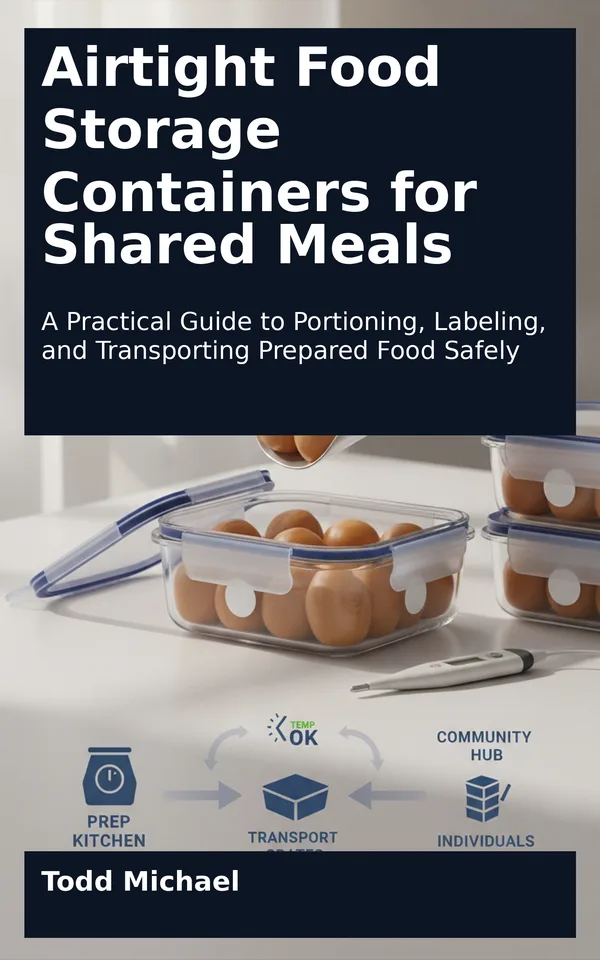
Read a sample: 1. A Safe Path from Kitchen to Community
A shared meal can travel a surprisingly complicated path. It may begin in a large pot, move through a busy packing line, spend time in an insulated carrier, and pass from a driver to a volunteer at a community center before anyone sits down to eat. Each step is manageable, but each also creates an opportunity for something to go wrong.
A lid might not fit properly. A serving spoon may touch an unclean surface. A carrier can be left waiting while a driver searches for an address. A recipient may expect meals at one entrance while the delivery arrives at another. None of these problems requires a complicated solution, but they do require a team to notice and respond.
This book is about creating a dependable path for prepared food, especially when several people share the work. Airtight, lidded containers are useful tools on that path. They help protect food from spills and exposure, make portions easier to handle, and carry labels from kitchen to recipient. They do not, by themselves, make food safe or keep it at a suitable temperature.
The goal is not to make volunteers anxious about every meal. It is to replace guesswork with a shared plan: who does what, what gets checked, where information travels, and how the team responds when the plan changes.
Before choosing containers or setting out serving utensils, picture the meal from the moment preparation begins until someone takes responsibility for it at the destination. Include the pauses between tasks. A meal is not protected simply because the kitchen has finished cooking or the driver has reached the building.
A useful journey map has these stages:
1. Plan and prepare. Confirm the menu, intended recipients, preparation site, delivery arrangements, and applicable food-safety requirements.
2. Cook and hold. Prepare the food using the team’s approved practices and maintain it under the required conditions while packing is organized.
3. Portion and close. Transfer food into suitable containers with clean utensils, check the rims, and secure compatible lids.
4. Identify and stage. Label packages, keep them under the conditions required by the holding plan, and prepare carriers without leaving food unattended in an unsuitable area.
5. Transport. Load containers securely, monitor conditions as the plan requires, and follow a route that the receiving team expects.
6. Hand off. Confirm that an appropriate person has received the food, communicate its handling needs, and record the transfer as required by the team’s procedure.
7. Resolve and learn. Address any missing information, damaged packages, delays, or other concerns, and use what the team learns to improve the next meal.
These stages may overlap. One volunteer may label containers while another portions food, and a driver may help load a carrier. The map is not intended to create unnecessary paperwork or rigid job boundaries. It exists to make sure that an important step does not disappear between two people who each thought the other was handling it.
Consider where food is most likely to wait. A packing table, a vehicle, and a reception desk can all become holding areas, even if no one intended them to serve that purpose. Ask what will happen if the next person is not ready. A plan that works only when every step runs on time is not yet complete.
Community meal programs differ. One team may cook and package meals for a nearby gathering. Another may portion food prepared by a partner organization and deliver it across town. A third may provide containers and transport while a separate kitchen controls cooking and holding.
Write down where your team’s responsibility begins and ends. Identify who prepares the food, who has authority over the kitchen, who packs it, who transports it, and who receives it. If another organization handles a stage, agree on what information must pass between you. For example, the packing team needs to know how the food has been held and what conditions must be maintained after packing. The recipient needs instructions that match the meal and the agreed delivery arrangement.
Do not assume that an informal arrangement removes food-safety obligations. Requirements can differ by location, type of operation, food, and intended recipients. Before the first meal, the coordinator should consult the relevant local health authority or other appropriate official source and confirm which requirements apply. Use those requirements alongside current public-health guidance and the food program’s established procedures when building the workflow. If a partner operates under an approved food-safety plan, coordinate with that partner rather than creating conflicting instructions.
The team’s scope should also reflect its capacity. A kitchen may be able to prepare a meal but lack the equipment, volunteers, or route coverage to deliver it under the required conditions. A recipient may be able to accept shelf-stable supplies but have no suitable space for holding prepared meals. Discovering such limits during planning is useful; it gives everyone a chance to adjust the menu, arrange support, or choose a different delivery approach.
Volunteers work best when they can see both their own task and the person to ask when something does not fit the plan. A team lead does not need to perform every check, but someone must have clear authority to make or escalate food-safety decisions.
For a small meal, one person may coordinate several responsibilities. For a larger effort, the work may be divided among a kitchen lead, packing lead, driver, and receiving contact. Whatever…