Money, Investing & Precious Metals
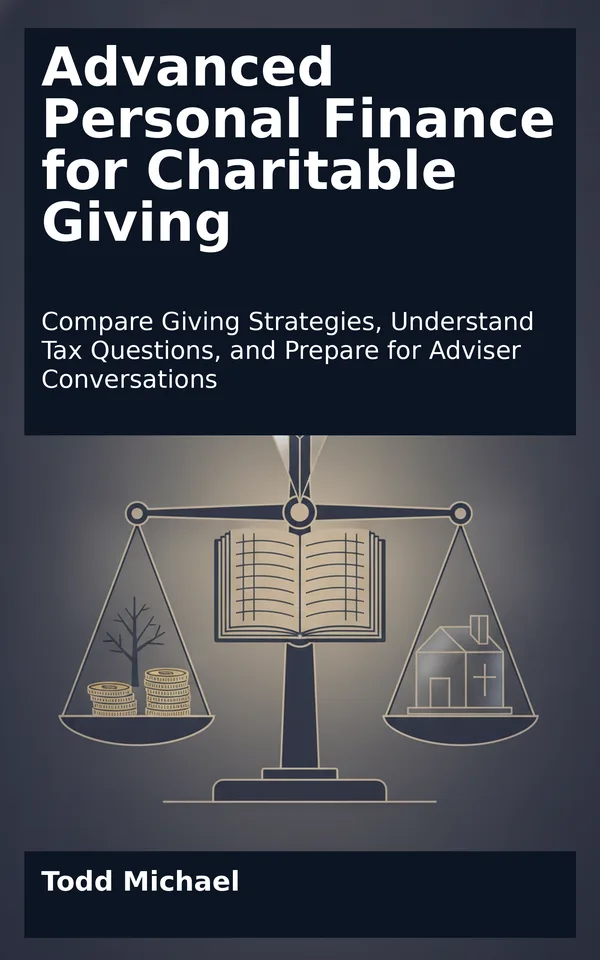
Advanced Personal Finance for Charitable Giving
Compare Giving Strategies, Understand Tax Questions, and Prepare for Adviser Conversations
by Todd Michael
Available nowIf you are searching for personal finance advanced guidance that connects your generosity with your broader financial life, this book offers a practical place to start. Rather than promising a perfect tax strategy, it helps you compare the choices behind a charitable gift.
Explore when cash may be straightforward, why appreciated investments deserve a closer look, and how donor-advised funds separate the timing of a contribution from later grant recommendations. Learn the eligibility questions surrounding qualified charitable distributions, the records different gifts may require, and the trade-offs that can affect both your finances and your charitable goals.
Illustrative scenarios, comparison worksheets, and adviser-ready questions help you organize the facts before acting. You will also learn how to check recipient eligibility, plan around deadlines, and review your giving over time.
Written for U.S. donors, this guide is educational and is not a substitute for individualized tax, legal, or financial advice.
Contents
- 1. Build a Giving Framework
- Begin with the purpose, not the vehicle
- Separate your giving budget from your giving ambition
- Match the gift’s timing to the need
- Identify the people involved
- Build a household giving profile
- A hypothetical household puts the framework to work
- Use consistent criteria to compare methods
- From framework to action
- 2. Understand the Tax Questions
- 3. Make a Cash Gift
- 4. Give Appreciated Investments
- 5. Assess Other Noncash Assets
- 6. Evaluate Donor-Advised Funds
- 7. Understand Qualified Charitable Distributions
- 8. Compare the Giving Paths
- 9. Check the Recipient and Its Fit
- 10. Plan Gift Timing
- 11. Keep Records That Support the Gift
- 12. Coordinate with Your Advisers
- 13. Work Through Complex Scenarios
- 14. Create and Review Your Giving Plan
- Other Books by Todd Michael
Read a sample: Begin with the purpose, not the vehicle
A giving vehicle is a way to make or organize a gift. Cash, publicly traded securities, a donor-advised fund, and a qualified charitable distribution are among the possibilities considered in this book. They differ in timing, administration, potential tax treatment, and the degree of involvement you retain. None establishes what you care about.
Start instead with the change you hope to support. You might want to strengthen services in your community, advance research, preserve an institution that has mattered to your family, or respond to needs that emerge unexpectedly. You may also have preferences about how organizations work: perhaps you value local knowledge, direct services, advocacy, long-term research, or the ability to respond quickly.
These preferences need not form a grand mission statement. A useful description can be simple:
> We want our giving to support organizations addressing food insecurity in our region, while preserving some flexibility for urgent needs and causes important to our family.
That statement is hypothetical, but its structure is useful. It identifies a primary focus, a geographic preference, and room for exceptions. It does not assume that every worthy request deserves a gift or that one organization must receive all available funds.
Consider writing down your answers to four questions:
- What concerns do we most want to address? Name causes or communities, not just organizations you already know.
- What kind of contribution feels meaningful? You may prefer steady operating support, a specific project, or an unrestricted gift that allows an organization to decide where funds are needed.
- When do we want the recipient to benefit? Some priorities call for support now; others may involve a commitment over several years.
- What do we want to learn? You might care about an organization’s approach, its financial information, or how it reports on its work.
A cause can be important even when it is difficult to measure results. A simple metric may miss meaningful work, and an impressive report does not by itself establish effectiveness. Your framework should make room for judgment rather than reduce every gift to a single score.