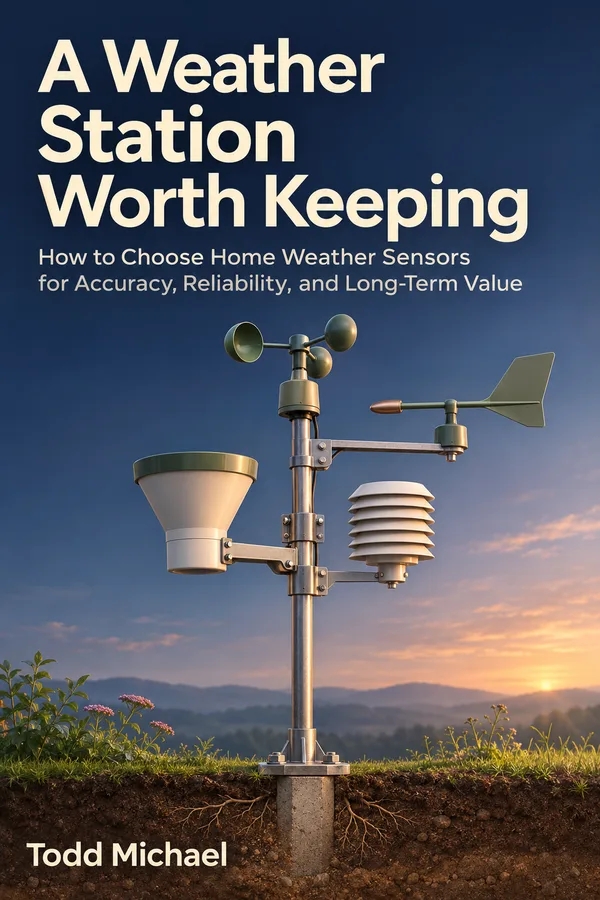
A Weather Station Worth Keeping
How to Choose Home Weather Sensors for Accuracy, Reliability, and Long-Term Value
by Todd Michael
Available nowSearching for the best home weather station to buy can lead to a maze of sensor bundles, impressive-sounding accuracy claims, and reviews that may be outdated by the time you read them. This guide helps you make a choice that fits your own observing goals—and still makes sense years from now.
Learn which measurements matter for gardening, everyday curiosity, or a long-term weather record. Understand how placement affects readings, what specifications can and cannot promise, and why batteries, connectivity, maintenance, and replacement parts deserve a place in your budget. A step-by-step, text-based decision process walks you from a wish list to a defensible shortlist, with worked examples for different homes and budgets.
There are no fleeting product rankings to chase. Instead, you'll gain the confidence to compare current options, ask better questions before buying, and choose a station worth keeping.
Contents
- 1. Begin With the Weather You Want to Know
- Start With a Question, Not a Shopping List
- Decide What Must Be Measured
- Match the Observation to the Place
- Decide What You Need to Do With the Numbers
- The Observation-Goals Worksheet
- Separate Useful Features From Appealing Extras
- Think Beyond the Day You Open the Box
- A Short Example: From Curiosity to Requirements
- 2. What a Home Station Actually Measures
- 3. Choose Sensors That Fit the Job
- 4. Read Accuracy Claims With Confidence
- 5. Find a Place Your Sensors Can Work
- 6. Plan for Power and Connection
- 7. Decide Where Your Data Should Live
- 8. Buy for Maintenance, Not Just Installation
- 9. Investigate Parts, Support, and Repair
- 10. Calculate the Cost of Keeping a Station
- 11. Compare Trade-Offs Without a Ranking
- 12. Work Through Four Buyer Scenarios
- The Gardener: Useful Conditions at Plant Level
- The Balcony Observer: A Smaller Question, Better Answered
- The Family: A Station People Will Actually Use
- The Long-Term Record Keeper: Continuity Over Features
- Reading Across the Four Choices
- 13. Verify Before You Buy
- Start With the Questions That Could Change Your Choice
- Confirm the Exact Product and Bundle
- Read the Specifications Against Your Site
- Check Power, Connection, and Data Access
- Investigate Parts as a Current Purchase Question
- Read the Return and Warranty Terms Separately
- Ask Questions That Invite Usable Answers
- Make the Final Purchase Check
- 14. Set Up for a Record Worth Keeping
- Other Books by Todd Michael