Read a sample: 1. A Job Beneath the Clouds
By the time Mara Vale found the orchard, she had stopped looking for the sign and begun looking for somewhere to sit down.
The lane had climbed steadily since the village, winding between hedges thick with blackberries and the last pale flowers of summer. Her case had one good handle and one handle that had come away outside the baker’s shop. She had carried it against her hip for the better part of an hour, growing increasingly sympathetic toward the handle.
At the top of the hill stood a gate, a low stone wall, and a wooden board on which someone had painted an apple beneath a cloud. The cloud looked rather more like a sheep, but Mara had spent eleven years working with clouds and knew how often the distinction depended on the weather.
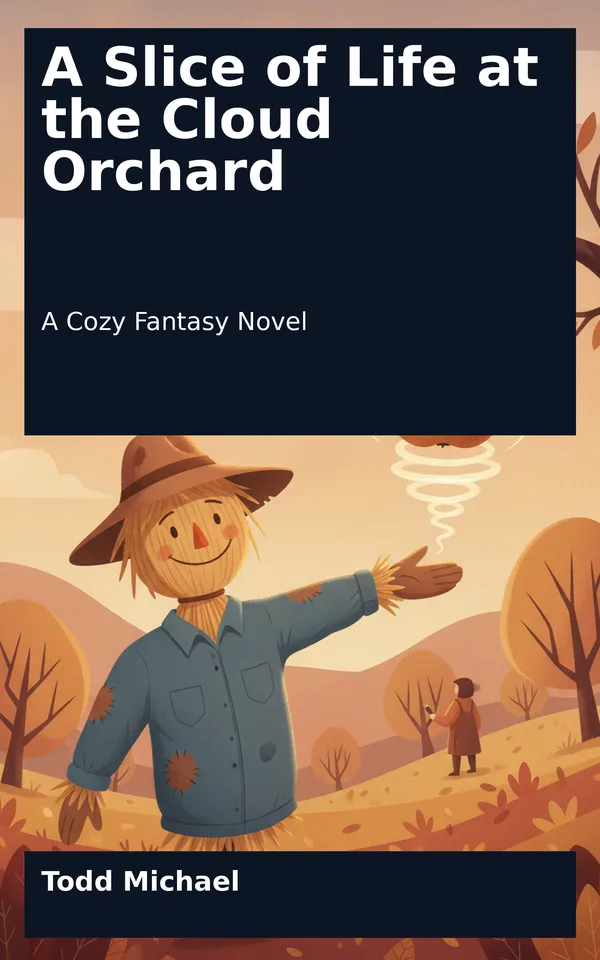
Beyond the gate, trees stepped down the hillside in crooked rows. Their leaves were beginning to yellow at the edges, though the grass beneath them was still lush. A cottage sat among them with smoke rising from its chimney and a blue apron hanging from an upstairs window. Farther down stood a barn, several stacks of empty baskets, and a scarecrow whose hat had slipped over one eye.
Mara set down her case.
A cloud drifted over the hill, low and woolly, its underside the color of unbleached linen. Without thinking, she lifted two fingers and gave a soft, descending whistle.
The cloud continued on its way.
“Fair enough,” she said.
She had not brought her herding crook. It was hanging on a peg in a cottage three valleys away, beside a kettle she hoped her former landlady would remember to give to someone who needed it. For a week after leaving, Mara had reached for the crook whenever a shadow crossed the road. Apparently her hands had not yet accepted the news.
She opened the gate, which complained but allowed her through, and followed the path toward the cottage.
Halfway there, she noticed that the nearest trees bore apples.
It was difficult not to notice them. They hung in pairs and clusters, round and full-sized, their skins as green as a spring pond. A few showed a blush of gold, but most looked as though they had no intention of changing.
Mara touched one lightly. It was cool and hard beneath her fingers.
“Not yet,” she told it.
“Not that one, certainly.”
Mara turned so quickly that the apple bobbed on its stem.
A woman stood in the cottage doorway, holding a wooden spoon in one hand and a folded cloth in the other. She was broad-shouldered, with gray hair pinned up in a way that suggested it had been done efficiently rather than decoratively. Flour marked one sleeve of her dark dress.
“Sorry,” Mara said. “I didn’t mean to handle your fruit.”
“You didn’t pick it. That’s the important distinction.” The woman looked at Mara’s case, then at her boots, which were dusted white from the lane. “Can I help you?”
“I hope so. I’m looking for the owner of Cloud Orchard.”
“You’ve found her. Ada Bell.” She tucked the spoon into the fold of her apron. “And you are?”
“Mara Vale. I heard at the village shop that you might be looking for help with the harvest.”
Ada considered her for a moment. “Might be. Come and have some tea before you fall over.”
“I’m not about to fall over.”
“Good. You can carry your case, then.”
Mara picked it up and followed her inside.
The cottage smelled of baked apples, woodsmoke, and something savory simmering on the stove. The kitchen table was scattered with string, a basket of onions, and a sheet of paper covered in neat columns. Ada moved the onions to a chair and gestured for Mara to sit.
Mara lowered herself onto the bench with more gratitude than she cared to show. Through the window she could see the orchard slope away toward a patchwork of fields. A line of hills lay beyond them, their tops softened by a veil of mist.
Ada poured tea into two mismatched cups. One had a painted bluebird on it; the other had lost its handle and been fitted with a loop of twine.
“Sugar?” she asked.
“Please.”
Ada set down the bowl. “There’s bread, too, if you’re hungry.”
Mara hesitated just long enough to make the answer obvious.
Ada sliced a thick piece from a loaf and put it on a plate with butter. “Now. What sort of work have you done?”
“Mostly cloud herding.”
Ada sat opposite her. “Mostly?”
“I helped my aunt in her garden when I was young. And I worked in a laundry for a winter.”
“Did you enjoy the laundry?”
“The warmth was pleasant. The sheets were enormous.”
“That sounds about right.” Ada wrapped both hands around her cup. “What brings a cloud herder to an orchard?”
Mara spread butter carefully to the edge of her bread. She had answered versions of this question at the inn, at the village shop, and once from a man who had only wanted to know whether she could make it rain on his cabbages. Each time she had tried to make the answer tidy. Each time it had come out feeling like a coat fastened one button wrong.
“I wanted different work,” she said.
Ada waited.
Mara took a bite, chewed, and added, “I liked herding. For a long…