Everyday Guidebooks
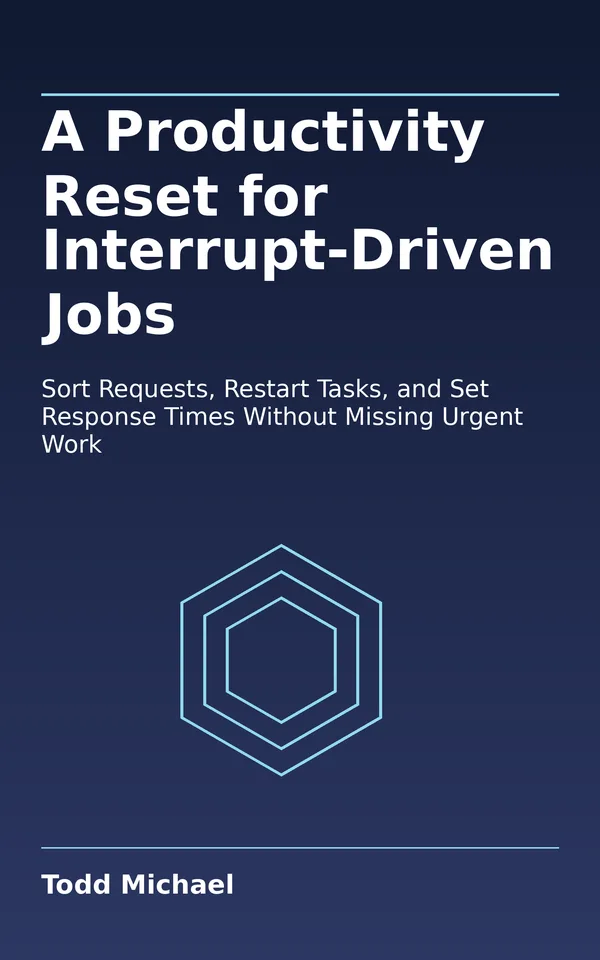
Cover of A Productivity Reset for Interrupt-Driven Jobs

Business, AI & Entrepreneurship

A Productivity Reset for Interrupt-Driven Jobs

Sort Requests, Restart Tasks, and Set Response Times Without Missing Urgent Work

by Todd Michael

Available now

Your workday starts with a plan. Then the phone rings, a visitor arrives, and three people need an answer.

If responding to others is part of your job, advice to silence every notification may not help. This guide offers productivity tips for beginners who need to stay available while still finishing essential work.

Learn a simple way to sort incoming requests, recognize urgent issues, and decide what can wait. Create a quick restart note before switching tasks, use clear language to negotiate response times, and recover your place when the next interruption arrives.

Through relatable examples featuring receptionists, coordinators, and support staff, you’ll practice handling busy shifts without pretending you control every demand. Templates, short exercises, and a practical reset plan help you adapt the approach to your workplace—and make progress even when the day refuses to go according to plan.

Contents
  1. 1. Productivity When Availability Is the Job
  2. Availability Is Work
  3. The Competing Demands of a Shift
  4. Busy Is Not the Same as Clear
  5. Map a Typical Shift
  6. Look for Work That Disappears From the List
  7. Decide What the Map Tells You
  8. A More Useful Standard for the Day
  9. 2. Find Your Interruption Patterns
  10. Observe the Work You Actually Do
  11. Choose a Small Observation Window
  12. Keep the Log Brief and Private
  13. Count Switches Without Counting Everything
  14. A Receptionist’s Sample Shift
  15. Look for Friction, Not Fault
  16. Separate the Interruption From the Recovery
  17. Turn One Pattern Into a Small Experiment
  18. 3. Sort What Comes In
  19. 4. Recognize Urgency Without Guessing
  20. 5. Make a Quick Restart Note
  21. 6. Return to Work Without Starting Over
  22. Treat the Note as a Starting Point
  23. Find the Last Reliable Point
  24. Check What Could Have Changed
  25. Turn the Note Into a Concrete Action
  26. When the Note Is Stale
  27. Choose Among Several Open Tasks
  28. Resume After a Handoff
  29. Keep the Details Where They Belong
  30. When You Return Without a Note
  31. Make the Return Part of the Work
  32. 7. Negotiate a Useful Response Time
  33. 8. Protect Essential Tasks During a Busy Shift
  34. 9. Keep a Queue You Can Trust
  35. 10. Handle Several Requests at Once
  36. 11. Agree on Expectations With Your Team
  37. 12. Recover From a Shift That Went Sideways
  38. Start With What Is Still at Risk
  39. Gather a Minimum Picture of Open Work
  40. A Support Coordinator’s Difficult Shift

Read a sample: 1. Productivity When Availability Is the Job

You begin the shift with a reasonable plan. A report needs to be finished, two appointments need confirmation, and a colleague is waiting for an updated schedule. Then the phone rings. A visitor arrives while you are on the call. A message appears from someone who needs help before a meeting, and another colleague stops by with a question that seems simple until you look into it.

By the time you return to the report, you have forgotten which figures you checked. You start again, only to be interrupted before you reach the place where you left off.

It is easy to look at a day like this and decide that you were not productive. The report is still unfinished, after all, and your original list has hardly changed. But that conclusion leaves out much of what happened. You helped a caller, received a visitor, answered questions, and kept information moving. Those activities were not obstacles to your job. In an interrupt-driven role, they were part of it.

That does not mean unfinished work should be ignored or that every interruption deserves the same response. It means your productivity system has to account for the whole job: being available, making progress on ongoing work, and recognizing the situations that cannot wait. A system built only around uninterrupted concentration will make an ordinary busy shift look like a failure.

The aim of this book is not to turn an unpredictable job into a perfectly predictable one. It is to help you make sound decisions within the work you actually have: sort what comes in, keep track of what you leave, communicate realistic response times, and return to essential tasks without repeatedly starting over.

More Business, AI & Entrepreneurship

Cover of AIAIAvailable nowCover of The New Gold RushThe New Gold RushAvailable nowCover of Leadership Intelligence for Succession PlanningLeadership Intelligence for Succession PlanningAvailable nowCover of Remote Jobs and the Scam TestRemote Jobs and the Scam TestAvailable nowCover of The Entrepreneur Mindset for Patient DecisionsThe Entrepreneur Mindset for Patient DecisionsAvailable nowCover of Price Without ApologyPrice Without ApologyAvailable now

About Todd Michael

Todd Michael is an American author and the founder of ToddMichael.tv. He writes practical, plain-English books on money, health, preparedness, technology, games, humor and more.

About the author Todd Michael · Todd Michael’s author site

Part of the ToddMichael.tv network.




